Adjacency Matrices (Leaving Cert Applied Maths): Revision Notes
📚Revision Notes
Adjacency Matrices
What is a matrix?
A matrix is a rectangular arrangement of numbers organised in rows and columns. Think of it like a table of data that mathematicians use to solve problems. These numerical arrays are particularly useful in computer science for storing and processing information.
Note
Matrices are fundamental structures in mathematics and computer science, providing a systematic way to organise and manipulate data in rows and columns.
The dimensions of a matrix are described as , where:
- = number of rows (horizontal lines)
- = number of columns (vertical lines)
For example, a matrix with 2 rows and 3 columns would be called a matrix.
What is an adjacency matrix?
An adjacency matrix is a special type of square matrix that represents the connections in a graph or network. It shows how many direct connections (edges) exist between different points (vertices or nodes) in the network.
In an adjacency matrix:
- Each row and column represents a vertex in the graph
- The numbers in the matrix show whether vertices are connected
- For simple graphs: 1 means connected, 0 means not connected
- For graphs with multiple edges: the number shows how many connections exist
Important
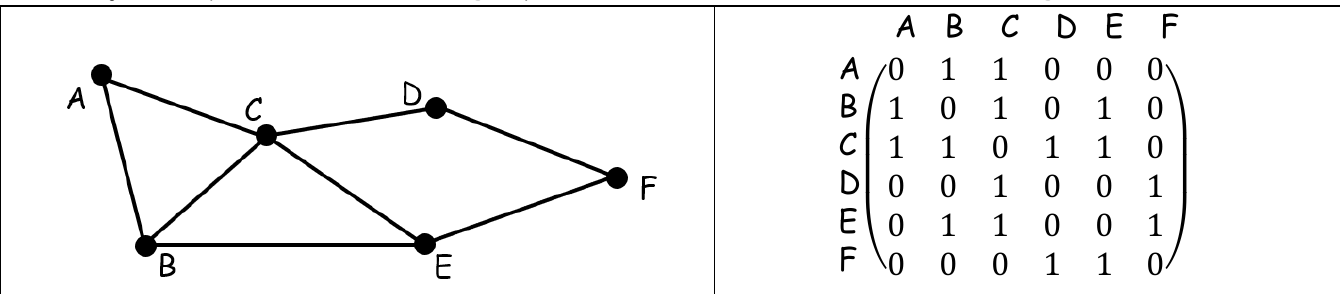
The adjacency matrix shown above demonstrates how a graph with 6 vertices (A through F) can be represented mathematically. Notice that this is a square matrix because there are 6 vertices in the graph.
Reading adjacency matrices
When reading matrices, we follow the "Lawn Tennis" rule - we read from left to top. This means:
- Each row shows the connections FROM that vertex
- Each column shows the connections TO that vertex
- The entry in row , column tells us about connections between vertex and vertex
Important
Key properties of adjacency matrices:
- They are always square matrices (same number of rows and columns)
- For undirected graphs, they are symmetrical about the main diagonal
- The main diagonal typically contains zeros (no self-loops) unless specified otherwise
Powers of adjacency matrices
One of the most powerful features of adjacency matrices is that their powers reveal important information about paths in the graph.
Important
Key concept: If is an adjacency matrix, then gives the number of walks of length between vertices.
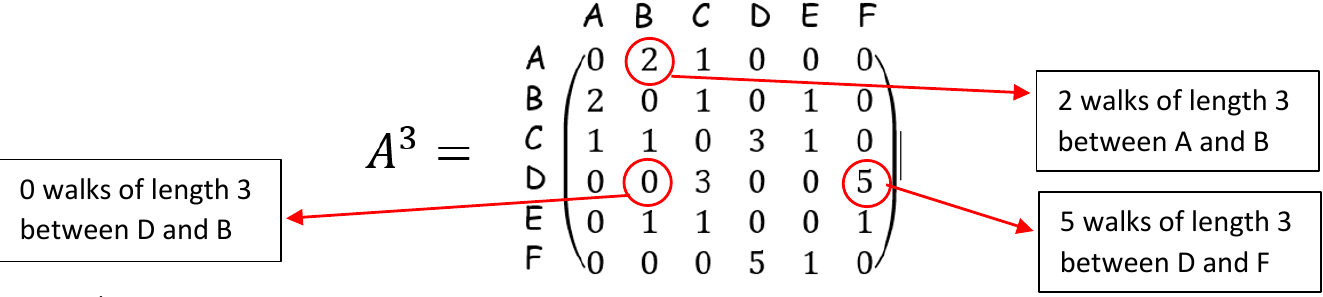
This diagram shows (A cubed), which counts all possible walks of exactly 3 steps between vertices.
Example
Understanding Results:
- There are 2 walks of length 3 between nodes A and B
- There are 0 walks of length 3 between nodes D and B
- There are 5 walks of length 3 between nodes D and F
Working with matrix powers
Let's look at a practical example using a simple network:
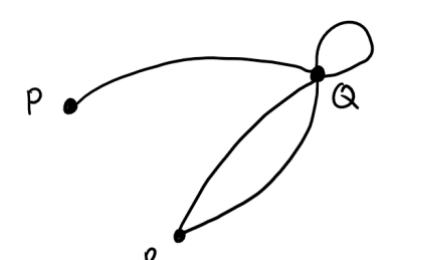
For this network with vertices P, Q, and R, we can:
- Create the adjacency matrix
- Calculate to find walks of length 2
- Calculate to find walks of length 3
Example
Practical Matrix Power Applications:
- shows indirect connections (2-step paths)
- shows 3-step paths
- Higher powers reveal longer routes through the network
Matrix operations basics
When working with adjacency matrices, you need to understand basic matrix operations:
Note
Matrix Operations:
- Adding matrices: Add corresponding entries together
- Multiplying matrices: Use the row-by-column method (more complex process)
Important
Matrix multiplication is not commutative, meaning in general.
Practical applications
Adjacency matrices are used in:
- Computer networks: Mapping connections between devices
- Social networks: Showing relationships between people
- Transportation: Planning routes and finding shortest paths
- Internet routing: Determining how data packets travel
Exam tips
Summary
Essential Exam Strategies:
- Always check your matrix dimensions match the number of vertices
- Remember that adjacency matrices for undirected graphs are symmetrical
- Use the power property () to count walks of specific lengths
- Practice reading matrices using the "left to top" rule
- When multiplying matrices, work systematically row by row
Remember!
Summary
Key Points to Remember:
- A matrix is a rectangular array of numbers used to organise data systematically
- Adjacency matrices represent graph connections using 1s and 0s (or actual connection counts)
- Read matrices "left to top" - each row shows connections from that vertex
- counts walks of length between vertices in the graph
- Adjacency matrices are always square and symmetrical for undirected graphs