Real-World Applications (Leaving Cert Applied Maths): Revision Notes
📚Revision Notes
Real-World Applications
Networks and graphs are powerful mathematical tools that help us understand and solve problems in many areas of modern life. Understanding how these concepts work in practice shows why they are so important in applied mathematics and everyday decision-making.
What are networks and graphs in real life?
A network is a system of interconnected points (called vertices or nodes) connected by links (called edges or connections). In real-world situations, networks help us model complex systems and find efficient solutions to practical problems.
Note
Understanding Network Components:
- Vertices (or nodes): The individual points in a network (e.g., train stations, websites, people)
- Edges (or connections): The links that connect vertices (e.g., railway lines, hyperlinks, relationships)
- Network: The complete system formed by all vertices and their connecting edges

This visualisation shows how complex networks can become, with thousands of interconnected pathways flowing between different connection points, much like the systems we use every day.
Internet and web networks
The Internet represents one of the largest and most complex networks ever created by humans. In this digital network:
- Vertices are individual website pages
- Edges are the hyperlinks that connect pages together
- The entire World Wide Web forms an interconnected graph where users can navigate from any page to millions of others through these connections
This network structure allows search engines and web browsers to find optimal paths between different pieces of information, making the Internet as efficient and accessible as it is today.
Example
Worked Example: Web Navigation
When you click on a Wikipedia link:
- Starting vertex: Current Wikipedia page
- Edge: The hyperlink you click
- Destination vertex: New Wikipedia page
- Network path: The sequence of links that brought you from your original search to your current page
This demonstrates how the web forms a massive interconnected graph structure.
Transportation systems
All forms of public transport create graph structures that can be analysed mathematically:
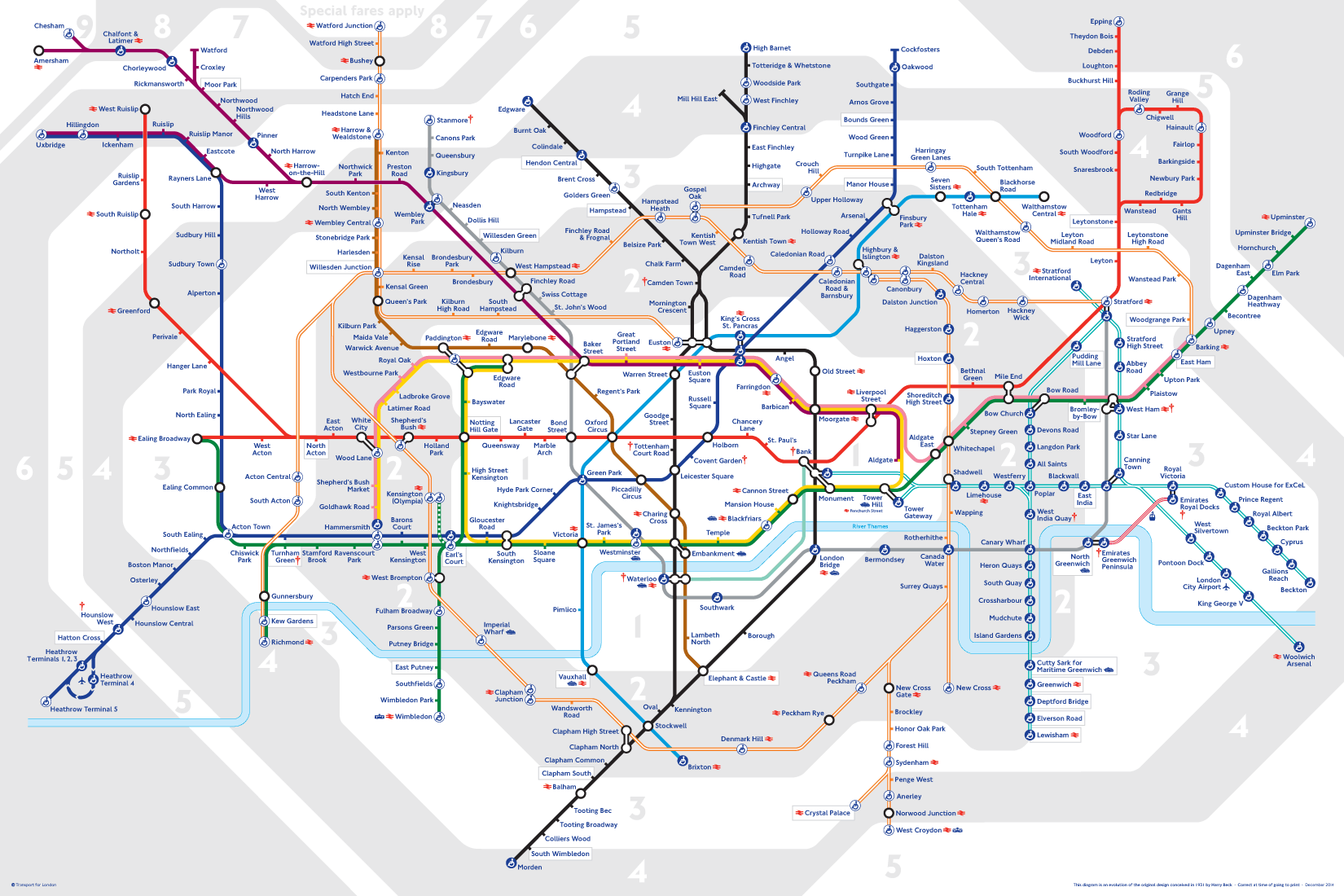
- Railway networks: stations are vertices, and railway lines are edges connecting them
- Subway systems: like the London Underground map shown, each stop is a vertex connected by coloured lines representing different routes
- Bus networks: stops are vertices, and bus routes are the edges
- Flight paths: airports are vertices, and flight routes are edges
Important
Transport planners use graph theory to create efficient timetables, reduce journey times, and ensure good coverage of urban areas. The mathematical analysis helps determine the best locations for new stations and the most effective routing of services.
Disease and epidemic modelling
Medical researchers use network models to understand how diseases spread through populations:
- Vertices can represent individual people, communities, or geographical locations
- Edges represent potential transmission paths between people or places
- The strength of connections can indicate how likely transmission is between different points
Note
This type of modelling became particularly important during recent global health challenges, helping governments and health services understand transmission patterns and plan intervention strategies. The mathematical analysis can predict which areas might be most affected and where resources should be focused.
Language processing and translation
Modern translation services, like Google Translate, use graph theory to understand grammatical structures:
- Vertices represent words, phrases, or grammatical components
- Edges show how these elements connect within sentence structures
- Different languages have different graph patterns, and understanding these allows algorithms to translate between them
By modelling language as a network, computer systems can identify equivalent structures in different languages and produce more accurate translations. This application shows how mathematical concepts enable the technology we use daily for communication across language barriers.
Optimal path applications
Finding the most efficient routes through networks is crucial in many professional fields. An optimal path is the best route through a system based on specific criteria such as shortest distance, least time, lowest cost, or greatest safety.
Transportation and navigation
Navigation systems like GPS use optimal path algorithms constantly:
- Google Maps and SatNav systems calculate fastest routes considering current traffic conditions, road closures, and toll charges
- Delivery companies plan daily routes for drivers to minimise fuel costs and delivery times
- Logistics firms coordinate multiple vehicles to serve customers efficiently
Airlines and shipping routes
Aviation and maritime industries rely heavily on optimal path planning:
- Airlines reduce fuel costs by considering weather patterns, wind conditions, and air traffic when planning flight paths
- Shipping companies avoid dangerous areas like storms or piracy zones while finding the shortest practical routes
- Transatlantic flights often follow great circle routes, which are mathematically the shortest paths on the Earth's curved surface

Note
Great circle routes represent the shortest distance between two points on a sphere, which is why flight paths often appear curved when viewed on flat maps but are actually the most efficient routes on Earth's curved surface.
Telecommunications and internet networks
Digital communications use optimal routing to ensure fast, reliable data transmission:
- Internet data travels along paths with the least network congestion to ensure quick delivery
- Streaming services route video data through the most efficient pathways to prevent buffering and delays
- Routing protocols automatically adjust to network conditions, finding alternative paths when connections fail

Urban planning and public transport
City planners use optimal path analysis to design efficient public transport systems:
- Road networks are designed to minimise travel times between important destinations
- Public transport routes are planned to maximise population coverage while minimising journey times
- Dublin's Luas tram system was designed using these principles to provide optimal coverage of the city
Emergency services
Emergency response teams depend on optimal routing for life-saving work:
- Ambulances use real-time traffic data to reach patients via the fastest possible routes
- Fire brigades plan station locations to ensure optimal response times across their coverage areas
- Police services use control room systems that guide vehicles through traffic efficiently during emergency calls
Important
Critical for Public Safety: Optimal path algorithms in emergency services can mean the difference between life and death. Every second saved through efficient routing increases the chances of successful emergency interventions.
Robotics and artificial intelligence
Automated systems use optimal path algorithms for safe, efficient operation:
- Warehouse robots calculate safe routes to collect and deliver packages without collisions
- Hospital robots plan paths through busy corridors to deliver supplies and medications
- Manufacturing robots coordinate movements to avoid interference with other automated systems
Supply chains and logistics
Businesses use optimal path analysis to reduce costs and improve service:
- Supermarket chains plan delivery routes to ensure fresh products reach stores efficiently
- Online retailers optimise distribution networks to minimise delivery times and costs
- Manufacturing companies coordinate complex supply chains involving multiple suppliers and production facilities
This type of analysis often involves solving variations of the Travelling Salesman Problem, where the goal is to visit multiple locations via the shortest possible route.
Example
Worked Example: Delivery Route Optimization
A delivery company has 5 stops to make:
- Problem: Find the shortest route visiting all stops exactly once and returning to the depot
- Vertices: Depot + 5 delivery locations (6 total)
- Edges: Roads between all locations with known distances
- Solution: Use algorithms to test different route combinations and select the one with minimum total distance
- Result: Reduced fuel costs, faster deliveries, and improved customer satisfaction
Summary
Key Points to Remember:
- Networks model real systems: From the Internet to transport systems, networks help us understand complex interconnected systems in the world around us
- Vertices and edges represent real things: Website pages and hyperlinks, train stations and railway lines, people and transmission paths - the mathematical concepts have direct real-world equivalents
- Optimal paths save resources: Finding efficient routes reduces costs, saves time, improves safety, and helps emergency services save lives
- Graph theory enables modern technology: From GPS navigation to Google Translate, many technologies we use daily depend on network analysis and optimal path algorithms
- Applications span all industries: Transportation, healthcare, technology, logistics, urban planning, and emergency services all benefit from network and graph theory applications