Overview (Leaving Cert Applied Maths): Revision Notes
📚Revision Notes
Overview
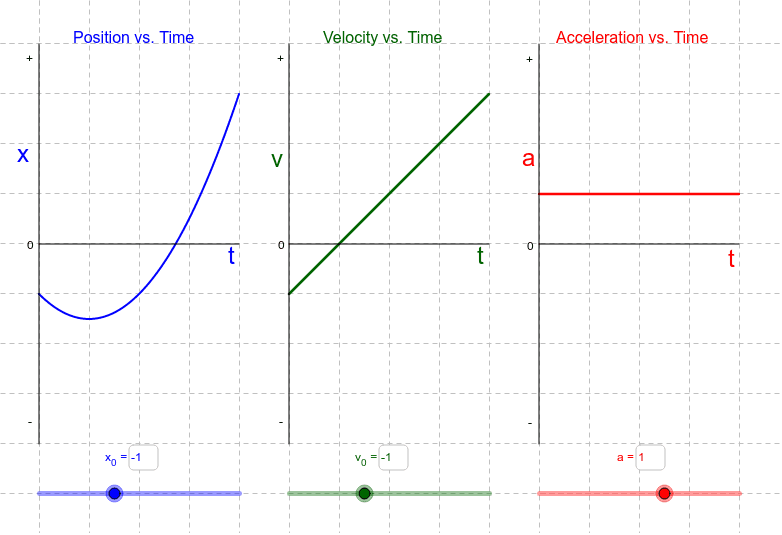
Uniform acceleration is one of the most important topics in kinematics, forming the foundation for understanding how objects move when they experience constant acceleration. This topic provides you with powerful mathematical tools to solve a wide variety of motion problems.
Note
Understanding uniform acceleration is crucial because it serves as the foundation for more complex motion analysis. Many real-world situations can be modelled using these principles, from cars accelerating on a highway to objects falling under gravity.
The fundamental equations of motion
When dealing with uniform acceleration, you have four essential equations at your disposal. These equations connect five key variables: initial velocity (u), final velocity (v), acceleration (a), time (t), and displacement (s).
The four kinematic equations are:
- - This shows how velocity changes with time
- - This calculates displacement using average velocity
- - This finds displacement directly from initial conditions
- - This relates velocity to displacement without time
Important
Each equation is missing one of the five variables, which makes them incredibly useful for different types of problems. Choose the equation that contains the variables you know and the one you want to find.
Understanding different types of problems
Velocity-time graphs
Velocity-time graphs are powerful visual tools for understanding motion. The most important concept to remember is that the area under a velocity-time graph equals the total distance travelled.
For triangular areas (representing constant acceleration), you can calculate the area using the standard triangle formula. This geometric approach often provides an alternative method to using the kinematic equations directly.
Note
When working with velocity-time graphs, remember that the shape of the graph tells you about the type of motion: straight lines indicate constant acceleration, while curved lines suggest changing acceleration.
Two bodies in motion and overtaking
When analysing problems involving two moving objects, such as overtaking scenarios, follow this systematic approach:
First, clearly identify what you know about each object's motion. Then, establish a time relationship - for example, if one body starts moving 2 seconds after another, account for this time difference in your equations.
The key insight is that at the moment of greatest separation, both objects have the same velocity. For overtaking problems, remember that the distance travelled by both objects from a fixed reference point will be equal at the moment one overtakes the other.
Gravity and vertical motion
Vertical motion problems require careful attention to the direction of acceleration. The acceleration due to gravity always acts downwards, but how you define your coordinate system affects the sign:
- For falling objects: acceleration = (if taking downward as positive)
- For objects thrown upwards: acceleration = (if taking upward as positive)
Important
Be particularly careful with displacement when objects are thrown from heights above the ground. Always define your reference point clearly at the start of your solution. Many students lose marks by being inconsistent with their coordinate system throughout a problem.
Passing through successive points
These problems involve an object moving past multiple reference points along its path. The strategy is methodical:
Start from the same initial point and use the same initial velocity for all calculations. If you need to find motion from point A to B, then to C, and finally to D, work through each stage systematically. Form equations for each stage and solve them step by step, using the results from earlier stages to inform later calculations.
Note
Systematic Approach for Multi-Point Problems:
- Always start from the same reference point
- Use consistent initial conditions for all stages
- Work through each segment methodically
- Use results from earlier stages to solve later ones
Essential exam strategies
Success in uniform acceleration problems comes from following a systematic approach:
Before you start calculating, always draw a clear velocity-time graph if possible. This visual representation helps you understand what's happening physically and can reveal alternative solution methods.
Define your terms clearly at the beginning of each solution. State what you're taking as positive direction, identify your reference points, and list your known values.
Important
Critical Rule: Only use the kinematic equations when acceleration is constant. If acceleration varies, these equations don't apply.
Don't assume anything that isn't explicitly stated in the question. For example, don't assume an object starts from rest unless the question clearly states this.
Take time to think before jumping into calculations. Understanding what the question is really asking will save you time and prevent errors.
Check your answer by seeing if it makes physical sense. Does the magnitude seem reasonable? Is the direction correct?
Summary
Key Points to Remember:
- The four kinematic equations are your main tools - choose the one that contains the variables you know and the one you want to find
- Area under a velocity-time graph always equals total distance travelled
- For two-body problems, identify when objects have equal velocities or equal displacements
- Gravity problems require careful attention to coordinate systems and signs
- Always define your terms clearly and draw diagrams where helpful
- These equations only work for constant acceleration - check this condition first