Mary Swanzy (Leaving Cert Art): Revision Notes
📚Revision Notes
Mary Swanzy
Introduction
Mary Swanzy (1882-1978) was a groundbreaking Irish painter who played a crucial role in bringing European modernist art movements to Ireland. Born in Dublin and later based in London, she was among the first Irish artists to fully embrace and understand modernist techniques, particularly cubism and post-impressionism.
Note
Swanzy's significance extends beyond her artistic achievements - she was a cultural bridge between the European avant-garde and Irish art, helping to modernise Irish artistic traditions during a period of significant cultural and political change.
Early life and education
Mary Swanzy came from a middle-class Dublin family - her father was a surgeon. Her artistic journey began at the Dublin Metropolitan School of Art, where she studied under Mary Manning. This early mentor recognised Swanzy's potential and encouraged her to continue her artistic education in Paris, the centre of the avant-garde art world.
In 1906, the young artist moved to Paris to further develop her skills. There, she studied with several important figures:
- Antonio de La Gandara - a fashionable society painter who taught her technical skills
- She also attended classes at the Académie de la Grande Chaumière and Académie Colarossi
Note
Paris in 1906 was at the epicentre of revolutionary artistic developments. Swanzy's decision to study there placed her at the heart of modernist innovation, exposing her to cutting-edge techniques and theories that were reshaping European art.
Artistic influences and development
Key influences
Swanzy's artistic development was shaped by several major modernist artists:
- Paul Cézanne - Perhaps the most significant influence on her work. She was likely the first Irish artist to truly understand Cézanne's revolutionary approach to form and colour
- André Lhote and Albert Gleizes - Important cubist artists who influenced her early modernist work
- Robert Delaunay - His orphism (a movement focused on pure colour and light) also impacted her style
Early artistic recognition
Swanzy's work began gaining recognition in 1914 when she first submitted paintings to the prestigious Salon des Indépendants in Paris. This was a significant achievement for any artist, particularly an Irish woman working in the male-dominated art world of early 20th century Paris.
Artistic periods and style evolution
Early modernist period (1910s-1920s)
During this period, Swanzy's work showed strong influences from cubism. She developed a distinctive approach that combined:
- Geometric fragmentation of forms
- Bold use of colour
- Complex layering of translucent planes
- Integration of organic and geometric elements
Example
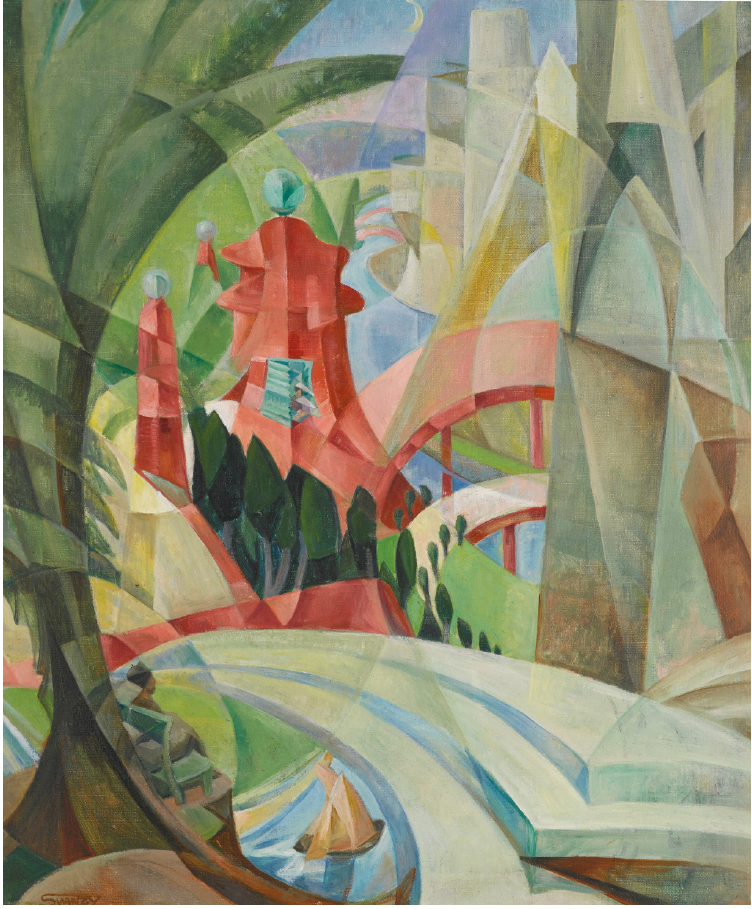
Artwork Analysis: "Cubist Landscape with red pagoda and bridge" (1925-1930)
This painting exemplifies Swanzy's mastery of cubist techniques through:
- Fragmented forms that break down the landscape into geometric planes
- Overlapping translucent colours creating depth and movement
- Curved and angular shapes working together harmoniously
- A small sailboat providing a focal point within the complex composition
This work demonstrates how Swanzy successfully adapted European cubist principles to create her own distinctive visual language.
Landscape painting development
Swanzy became particularly known for her innovative approach to landscape painting. Rather than simply depicting scenery, she transformed natural forms through modernist techniques.
Example
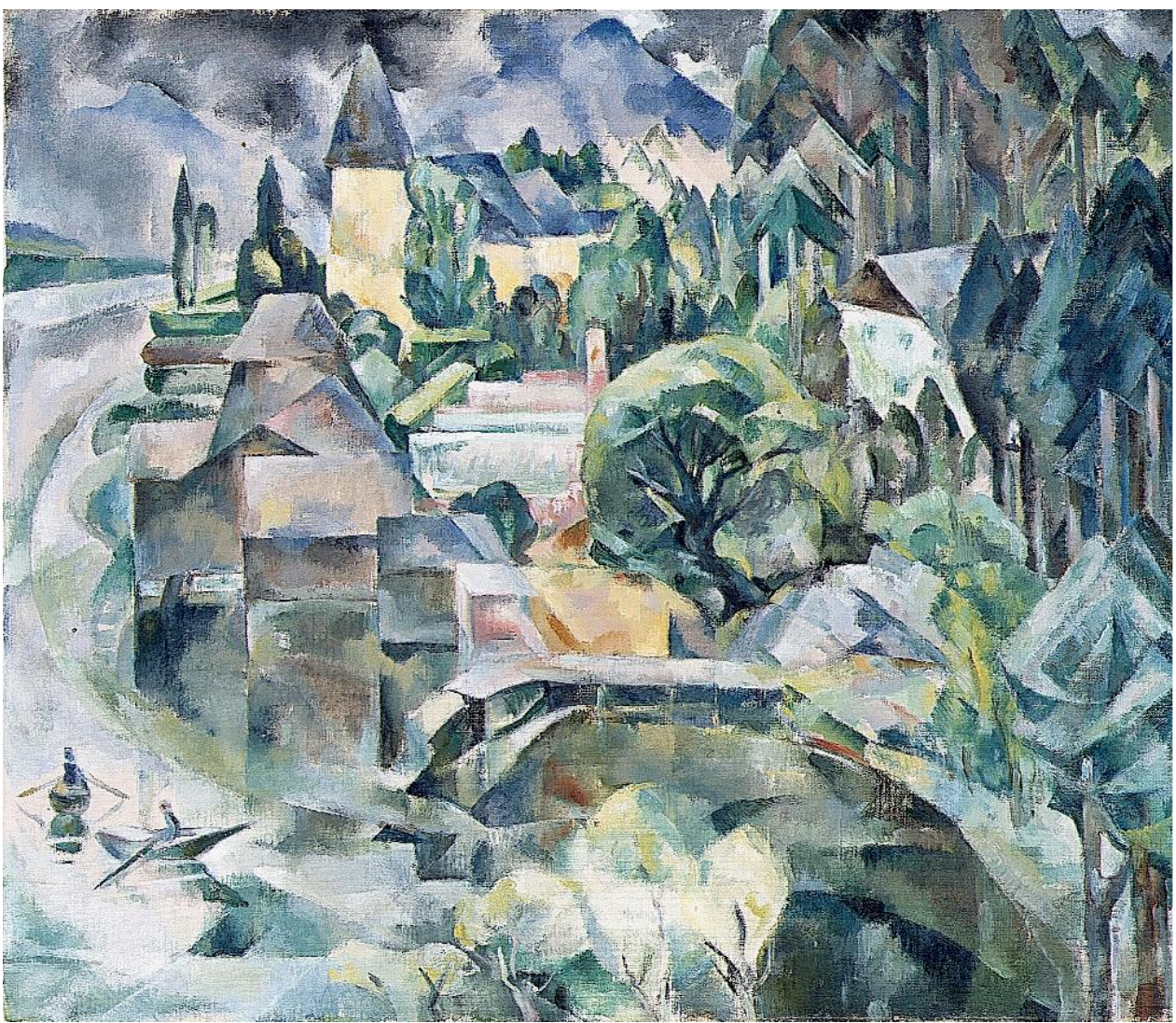
Artwork Analysis: "French River Landscape" (ca. 1920)
This work shows her post-impressionist approach:
- Geometric simplification of architectural and natural forms
- Structured brushstrokes that build form through colour
- Cool palette dominated by blues and greens with warm earth tones
- Elevated viewpoint looking down into a valley settlement
The painting demonstrates how Swanzy combined observational accuracy with modernist formal innovations.
Abstract period
As her career progressed, Swanzy moved towards more abstract compositions while maintaining connections to natural forms.
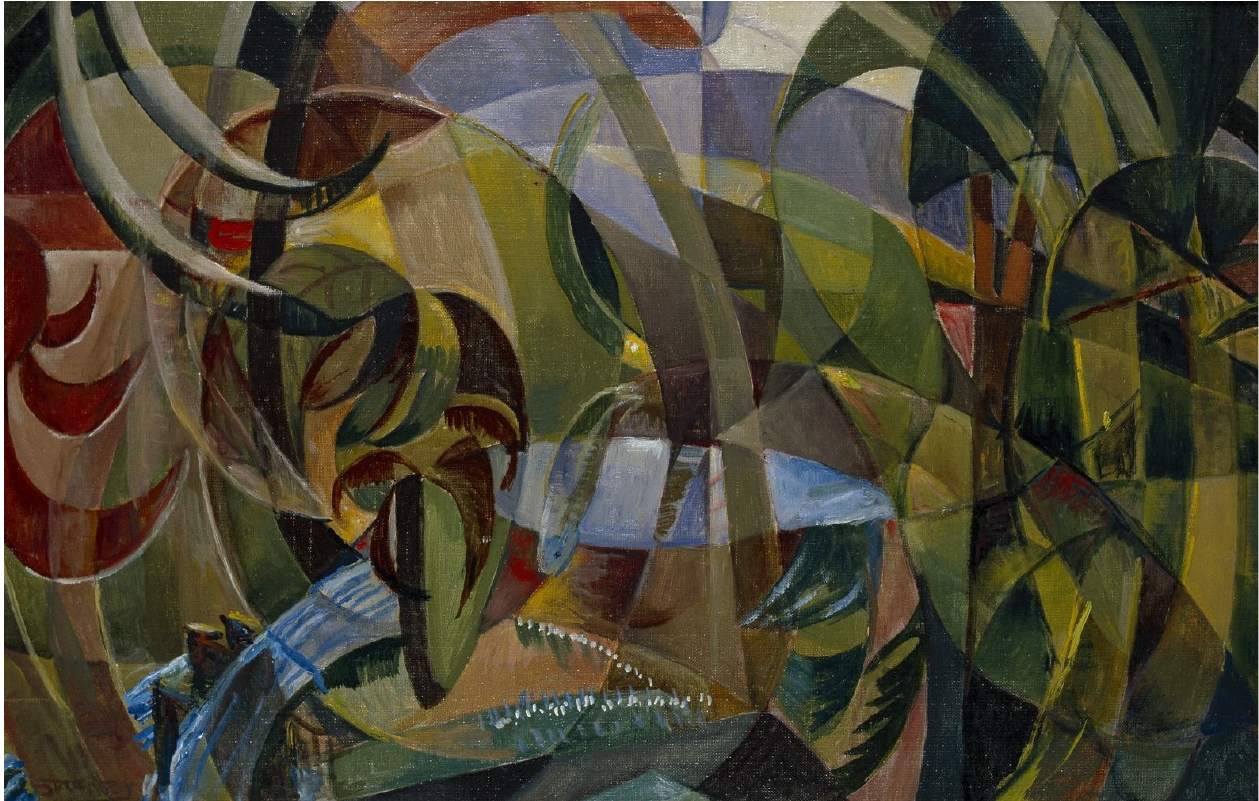
Her abstract works demonstrate:
- Complex layering of organic and geometric shapes
- Rich, earthy colour palettes with vibrant accents
- Dynamic, flowing compositions that suggest natural growth
- Integration of representational hints within abstract frameworks
Artistic techniques and characteristics
Note
Understanding Swanzy's Visual Language
Swanzy developed a sophisticated visual vocabulary that combined multiple modernist influences:
Visual elements:
- Fragmentation: Breaking down forms into geometric planes and facets
- Translucent layering: Overlapping colours to create depth and luminosity
- Colour relationships: Using colour contrasts and harmonies structurally
- Multiple perspectives: Showing subjects from various viewpoints simultaneously
Subject matter:
- Landscapes: Both urban and natural scenes transformed through modernist vision
- Abstract compositions: Pure relationships of form and colour
- Coastal and tropical themes: Reflecting her travels and international exposure
Later career and legacy
Continued evolution
Throughout the 1930s and during World War II, Swanzy's work became more symbolic and sometimes darker in palette, reflecting the changing times. However, she remained committed to modernist principles throughout her career.
Recognition and exhibitions
- Her major retrospective exhibition in Dublin in 1968 brought long-overdue recognition
- She maintained connections with both Irish and international art communities
- Her work influenced younger generations of Irish artists
Important
Despite her significant contributions to modern art, Swanzy's work was largely overlooked during her lifetime. The 1968 retrospective was crucial in establishing her rightful place in art history, highlighting how female artists often faced delayed recognition for their achievements.
Significance in Irish art history
Summary
Mary Swanzy's Historical Importance:
- Pioneer of modernism: She was among the first Irish artists to fully embrace European avant-garde movements
- International perspective: Her training in Paris and exposure to major modernist artists gave her work a sophisticated, international quality
- Technical innovation: She successfully adapted cubist and post-impressionist techniques to her own artistic vision
- Gender barrier breaking: As a woman artist working internationally in the early 20th century, she overcame significant social and professional obstacles
Mary Swanzy holds a unique position in Irish art history as a cultural bridge between European modernism and Irish artistic tradition. Her work represents a sophisticated understanding of international art movements while maintaining a distinctive personal vision.
Exam tips
Important
When analysing Swanzy's work:
- Look for geometric fragmentation and how she breaks down natural forms
- Note her use of translucent colour layers to create depth
- Consider how she balances abstract and representational elements
- Discuss her role in bringing European modernism to Ireland
- Compare her approach to landscape with traditional Irish landscape painting
Common mistake to avoid: Don't simply describe what you see - always connect her techniques to the broader modernist movement and explain how she adapted these influences to create her own artistic language.
Remember!
Summary
Key Points to Remember:
- Mary Swanzy (1882-1978) was a pioneering Irish modernist painter who studied in Paris
- She was likely the first Irish artist to fully understand and apply Cézanne's innovations
- Her work successfully combined cubist fragmentation with vibrant colour relationships
- She played a crucial role in introducing European avant-garde techniques to Irish art
- Her paintings demonstrate sophisticated understanding of modernist principles while maintaining individual artistic vision