Gas Exchange in the Alveoli (Leaving Cert Biology): Revision Notes
📚Revision Notes
Gas Exchange in the Alveoli
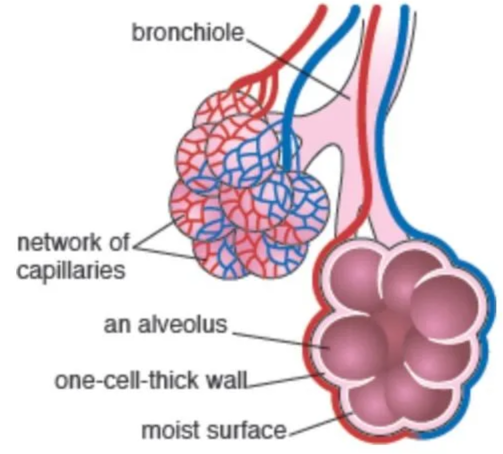
Each bronchus leads into a lung and branches into about 1 million smaller bronchioles. Each bronchiole ends in a sac called an alveolus (plural: alveoli).
Alveoli are Adapted for Gas Exchange
- Numerous: There are many of them.
- They have a large surface area for efficient gas exchange.
- They have a rich blood supply to carry gases away from the lungs.
- They have elastic walls for efficient inhalation and exhalation.
- They have moist surfaces which allow gases to diffuse more quickly into the blood.
The Process of Gas Exchange
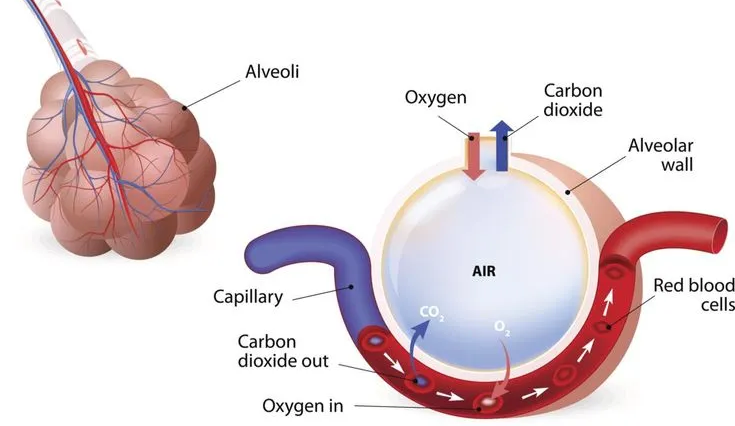
- Capillaries cover 90% of the surface of each alveolus, allowing efficient gas exchange.
- The capillaries are narrower than red blood cells, causing the cells to press against the capillary walls. This close contact makes it easier for oxygen and carbon dioxide to diffuse through the capillary walls.
- As red blood cells squeeze through these narrow capillaries, they slow down, giving more time for oxygen to diffuse into them.
- The alveolus is surrounded by a film of moisture. Oxygen diffuses into the moisture, across the thin walls of the alveolus and capillary.
- It enters the red blood cells, where it binds to haemoglobin for transport.
- At the same time, carbon dioxide from the blood diffuses out into the alveolus to be exhaled.
Note
Definition Review: Diffusion: the movement of substances from an area of high concentration to an area of low concentration.
Note
Exam Question - 2007 HL Q13 (a)
(i) Name the blood vessel that returns blood to the heart from the lungs.
(ii) Name the main gas transported in the blood vessel that you have named in (i). How is this gas transported?
Answer
(i) Pulmonary vein
(ii) Oxygen
Transported by (oxy)haemoglobin in red blood cells or bound to iron.