Ancient Funeral Practices (Leaving Cert Classical Studies): Revision Notes
📚Revision Notes
Funerary Practices
Death rituals in the ancient world were far more than simple burials - they were elaborate ceremonies that reflected religious beliefs, social structures, and cultural values. Both Greek and Roman societies developed complex funerary traditions that served to honour the deceased, comfort the living, and maintain connections between the worlds of the living and the dead.
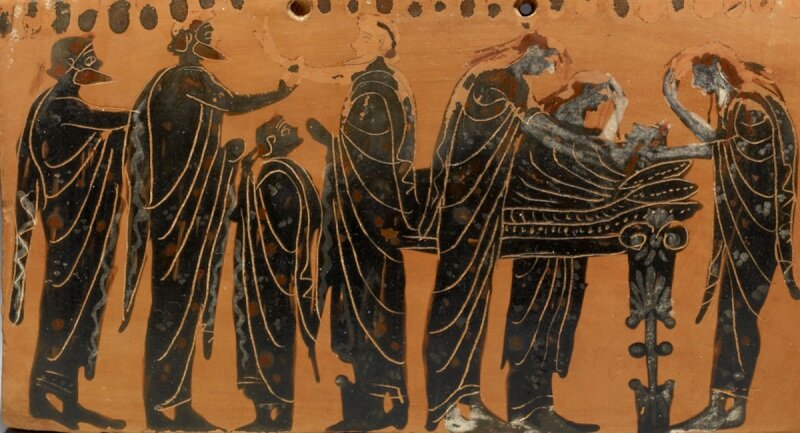
Evidence for ancient funeral practices
Understanding ancient funerary customs comes from examining both physical remains and literary descriptions that have survived from antiquity.
Note
The combination of archaeological and literary evidence provides a comprehensive picture of ancient funeral practices. Material remains show us what actually happened, while written sources explain the meaning and significance behind these rituals.
Greek sources
Archaeological evidence provides us with tangible proof of Greek burial customs. Grave stelae - marble monuments carved with relief sculptures - show us family scenes and farewell moments, such as the famous Hegeso Stele from around 410 BC. Lekythoi were special white-ground pottery vessels used specifically for funeral offerings, often decorated with touching scenes of departure or images of Charon ferrying souls across the river to the underworld. Archaeological sites like the Kerameikos cemetery in Athens reveal the layout and organisation of ancient burial grounds.
Literary sources give us detailed accounts of funeral rituals and their meaning. Homer's epic poems (the Iliad and Odyssey) describe elaborate funeral ceremonies for heroes like Patroclus and Hector, including the burning of funeral pyres and competitive games held to honour the dead. Plato's Laws discusses the need for moderation in funeral rituals, warning against excessive displays that might bankrupt families or create social tensions.
Roman sources
Material evidence from Roman sites shows the evolution of their burial practices. Sarcophagi - ornate stone coffins - were often richly carved with mythological scenes or personal imagery that reflected the deceased's life and beliefs. Columbaria were communal burial chambers designed to hold the cremated remains of freed slaves and lower-class citizens, showing how funeral practices varied by social status. Grand monuments like the Mausoleum of Augustus and the Tomb of the Scipios demonstrate how elite families used funerary architecture to display their power and prestige.
Written accounts provide detailed descriptions of Roman customs. Cicero's On the Laws outlines specific regulations governing funeral procedures, showing how the state sought to control these important rituals. Virgil's Aeneid contains vivid descriptions of funeral rites and journeys to the underworld. Ovid's Fasti references festivals like the Parentalia, which honoured deceased family members.
Greek funeral traditions
Greek funerary practices followed a structured sequence that ensured proper treatment of the dead and provided comfort for grieving families.
Prothesis - preparing the body
The prothesis involved the careful preparation and display of the deceased at home. Family members would wash, anoint, and dress the body before laying it out for viewing. This intimate ritual allowed relatives to say their final goodbyes in a familiar setting. Mourning women, particularly female family members, played a crucial role during this stage, lamenting loudly and singing traditional dirges that expressed grief and celebrated the deceased's life.
Ekphora - the funeral procession
The ekphora was the public journey from home to the burial site. At dawn, the body would be carried to the cemetery on a bier or transported in a cart. This procession was a community event - family members, friends, and neighbours would follow behind, demonstrating their respect for the deceased and support for the bereaved family. The timing at dawn held symbolic significance, representing the transition from life to death.
Important
The timing of Greek funeral processions at dawn was not arbitrary - it represented the symbolic transition from life to death, with the dawn marking the deceased's journey from the world of the living to the realm of the dead.
Burial or cremation
Greeks practised both burial and cremation, with preferences changing over time. In the Homeric period described in epic poetry, cremation was more common, but later periods saw burial become the dominant practice. Regardless of the method chosen, grave offerings were essential - pottery vessels, weapons, jewellery, and food were placed with the deceased to provide for their needs in the afterlife.
Memorial markers
Grave markers such as stelae or tumuli (burial mounds) served as permanent memorials to the deceased. The inscriptions on these monuments typically emphasised family relationships, civic roles, or personal virtues, helping to preserve the memory of the dead within the community.
Example
Worked Example: The Hegeso Stele
The famous Hegeso Stele (c. 410 BC) demonstrates typical Greek memorial practices:
- Material: White marble with relief sculpture
- Scene: Shows Hegeso selecting jewellery from a box held by her servant
- Inscription: Simply states "Hegeso, daughter of Proxenos"
- Function: Emphasises her role as a wife and her family's wealth and status
Significance: Greek funeral rituals served multiple important functions. They ensured the proper passage of the soul to Hades, following religious requirements for the deceased to reach the underworld safely. The ceremonies reinforced family bonds and social status, as elaborate funerals demonstrated a family's wealth and devotion. The prominent role of women in lamentation gave females a key position in religious and ritual life, even in male-dominated society.
As Homer wrote in the Iliad (23.243): "So they raised a great and high pyre for Patroclus."
Roman funeral traditions
Roman funerary practices evolved significantly over time, becoming increasingly elaborate displays of family prestige and political power.
Lying in state
The Roman custom of lying in state involved displaying the deceased at home, often with wax masks (imagines) of ancestors brought out for the occasion. These ancestral masks connected the recently deceased to their family lineage, emphasising the continuity of the family line and the accumulated honour of generations.
Funeral processions
Roman funeral processions were spectacular public events that varied dramatically based on social class. Wealthy families could afford musicians, professional mourners, and even actors wearing the masks of ancestors who would perform as if the dead were attending their descendant's funeral. In contrast, slaves and freedmen typically received much simpler ceremonies, often involving only immediate family members.
Note
The contrast between elite and common funeral processions in Rome was stark. While wealthy families could stage elaborate theatrical performances with dozens of participants, the poor might have only a simple procession of family members carrying the body to burial.
Disposal of remains
Romans practised both cremation and burial, with historical preferences shifting over time. During the Republic, cremation was more common, but by the later Empire, burial became the preferred method. Cremated remains were typically placed in urns and stored in family tombs, columbaria, or elaborate mausoleums, depending on the family's wealth and status.
Eulogies and public ceremonies
Elite funerals often featured eulogies delivered in the Forum, the heart of Roman public life. These speeches celebrated the deceased's achievements and reinforced their family's standing in society. Sacrifices and offerings at the tomb maintained ongoing relationships between the living and dead.
Festivals honouring the dead
Romans observed regular festivals to maintain connections with deceased family members. Parentalia in February was when families would visit tombs and offer food and wine to their ancestors. Lemuria in May involved rituals designed to appease restless spirits and ensure they did not disturb the living.
Example
Worked Example: Roman Ancestral Masks
The imagines (ancestral masks) system worked as follows:
- Creation: Wax impressions taken from deceased family members' faces
- Storage: Kept in wooden cupboards in the home's atrium
- Display: Brought out during family funerals and special occasions
- Performance: Actors wore the masks and "performed" as ancestors during processions
- Effect: Created the impression that entire family lineages attended funerals together
Significance: Roman funeral customs served to reinforce family lineage and ancestral memory, connecting each generation to their prestigious forebears. Public funerals displayed social status and political power, as elaborate ceremonies demonstrated a family's importance in society. Regular festivals ensured continuing bonds between the living and dead, maintaining family unity across generations.
As Cicero wrote in On the Laws (2.22): "Honours should be paid to the dead, but within measure."
Comparing Greek and Roman approaches
While both cultures honoured their dead with elaborate rituals, their emphasis differed significantly. Greek practices focused primarily on honouring the individual and supporting the immediate family through their grief. The intimate prothesis at home and community involvement in the ekphora created a supportive environment for mourning.
Roman customs placed greater emphasis on ancestry and civic identity, using funerals as opportunities to display family heritage and political connections. The use of ancestral masks and public eulogies in the Forum transformed private grief into public spectacle that reinforced social hierarchies.
Important
The key difference between Greek and Roman funeral practices lay in their focus: Greeks emphasised individual honour and family support during grief, while Romans used funerals as political and social displays of ancestral prestige and civic importance.
Summary
Key Points to Remember:
-
Greek funerals emphasised individual honour and family support through structured rituals (prothesis, ekphora, burial/cremation, and memorial markers)
-
Roman funerals focused on ancestral heritage and political status, featuring elaborate processions with ancestral masks and public eulogies
-
Material evidence (stelae, lekythoi, sarcophagi, columbaria) provides crucial archaeological proof to support literary accounts
-
Both cultures viewed proper funeral rites as essential for the deceased's successful transition to the afterlife and for maintaining family bonds
-
Funerary practices served civic, religious, and political functions, not just private grief - they reinforced social structures and cultural values in both societies