Structural Integrity (Leaving Cert Construction Studies): Revision Notes
📚Revision Notes
Structural forms - Structural integrity
Buildings need to stay upright and stable, which requires understanding the natural laws that govern how structures work. Think of a building's structure like a human skeleton - it holds all the weaker parts together and gives them stability.
When designing buildings, there are four key aspects to consider:
Note
Four Key Aspects of Structural Design:
- Types of loading a building experiences
- Types of forces that impact on buildings
- How components react when subjected to forces
- Properties of materials
Understanding how different parts of a building behave under various loads helps designers counteract the effects of these forces.
What is structural integrity?
Structural integrity means that buildings must be designed to be rigid and stable. To achieve this, all forces (or loadings) that act on buildings must be carefully considered.
Important
Load Transfer Process
Structural loads travel through the building's structural system - including walls, beams and columns - down to the foundations and into the ground. This process transfers all the forces safely away from the building structure itself.
Buildings face two main categories of loads:
- Static loads - forces that remain constant
- Dynamic loads - forces that change over time
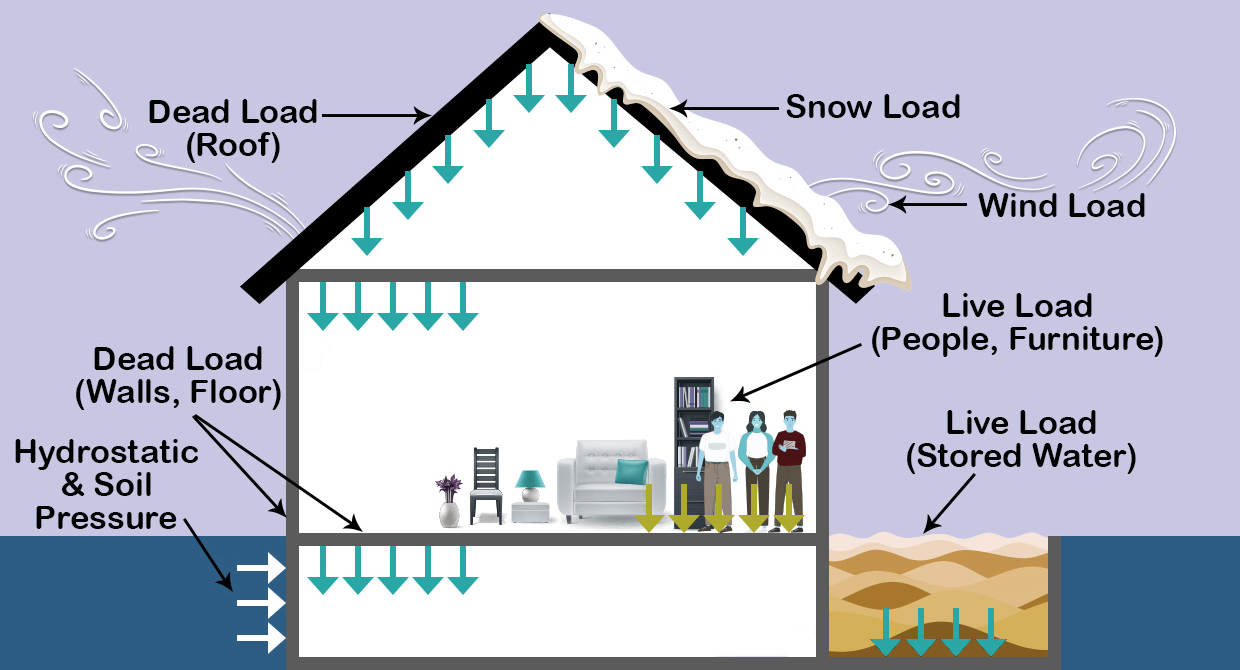
Static loads
Static loads are forces that apply slowly and remain relatively constant over time. These are also called vertical loads or gravity loads because they typically act downwards. Static loads represent the everyday forces that buildings must constantly support.
Dead loads
Dead loads come from the weight of the building structure itself. This includes all permanent parts of the building that never move or change, such as:
- Walls and structural framework
- Roof materials and ceiling panels
- Floor joists and permanent fixtures
- Any other permanently installed components
Example
Worked Example: Dead Load Calculation
For a simple residential building:
- Concrete floor slab: 150 kg/m²
- Timber frame walls: 50 kg/m²
- Clay tile roof: 45 kg/m²
- Ceiling and services: 25 kg/m²
Total dead load = 270 kg/m² acting vertically downward
Dead loads always act vertically downwards due to gravity. The building must be strong enough to support its own weight at all times.
Live loads
Live loads result from how people use the building and from weather conditions. Unlike dead loads, these can vary significantly over time. Live loads include:
- People inside the building
- Furniture and moveable equipment
- Water and snow collected on roofs
- Any temporary loads from building occupancy
Note
Live loads can change depending on how busy the building is or what weather conditions occur. Building codes specify minimum live load requirements for different types of occupancy to ensure safety.
Environmental loads
Environmental loads are static forces that constantly act on buildings from their surroundings. The most common environmental loads are:
- Pressure from soil pushing against foundation walls
- Forces from groundwater or soil movement
- Constant pressure from earth against basement walls
These loads remain fairly constant but must be accounted for in the structural design, especially for foundations and below-ground elements.
Dynamic loads
Dynamic loads change the amount of force they apply to buildings, sometimes quite suddenly. These loads vary in both intensity and where they apply force. Dynamic loads typically work laterally (sideways) or horizontally on structures rather than vertically downwards.
Wind loads
Wind creates forces when moving air hits building surfaces. Wind loads can be complex because they create both:
- Positive forces - pushing against surfaces facing the wind
- Negative forces - pulling on surfaces as wind flows around the building
Example
Worked Example: Wind Load Effects
On a 20-story building during high winds:
- Windward side experiences positive pressure (+800 Pa)
- Leeward side experiences negative pressure (-400 Pa)
- Total lateral force across the building creates significant overturning moment
The building must resist both the direct wind pressure and the suction effects.
Wind loads vary constantly based on:
- Wind speed and direction
- Building height and shape
- Local terrain and surrounding buildings
These forces can cause buildings to sway or create pressure differences that affect structural stability.

Earthquake loads
Earthquake loads occur when ground movement creates horizontal forces at a building's base. During earthquakes:
- The ground moves suddenly in different directions
- Buildings tend to resist this movement, creating internal forces
- In extreme cases, earthquake loads can cause structural failure or collapse
Important
Seismic Design Philosophy
In earthquake-prone areas, builders use special construction methods and materials that allow buildings to move safely with ground motion rather than resist it rigidly. This approach, called "ductile design," prevents catastrophic brittle failure.
Results of loads on structures
All loads create stresses, deformations and displacements within building structures. When loads become excessive (overloading), they can cause structural failure. This is why buildings must be designed to safely handle all expected loads under normal conditions.
Important
Preventing Structural Failure
To understand how buildings respond to loads, engineers must examine:
- The stresses placed on individual structural elements
- The internal structure and properties of the materials used
- How different materials behave when subjected to various forces
Proper structural design ensures that buildings can cope with the full range of static and dynamic loads they will experience throughout their lifetime.
Summary
Key Points to Remember:
- Structural integrity requires buildings to be rigid and stable by properly managing all applied forces
- Static loads (dead, live, environmental) are constant forces that buildings must always support
- Dynamic loads (wind, earthquake) are variable forces that change in intensity and direction
- Dead loads come from the building's own weight and permanent fixtures
- All loads must be transferred safely through the structure to the foundations and ground to prevent failure