Water Sources and Treatment (Leaving Cert Construction Studies): Revision Notes
📚Revision Notes
Water sources and treatment
Introduction to water supply
Clean drinking water is vital for human survival. Historically, settlements developed near freshwater sources like rivers and lakes to ensure access to clean water.
Note
Uisce Éireann (formerly Irish Water) is the national body in charge of public water and wastewater services in Ireland. It looks after the water supply, treatment, and pipes that bring clean water to homes and take wastewater away. Most people in Ireland get their water through Uisce Éireann, but in some rural areas, local group schemes or private wells are still used. Two other organisations help make sure water is safe and fairly managed — the EPA (Environmental Protection Agency) checks water quality and the CRU (Commission for Regulation of Utilities) helps make sure the service is fair and affordable.
Water sources
The water cycle foundation
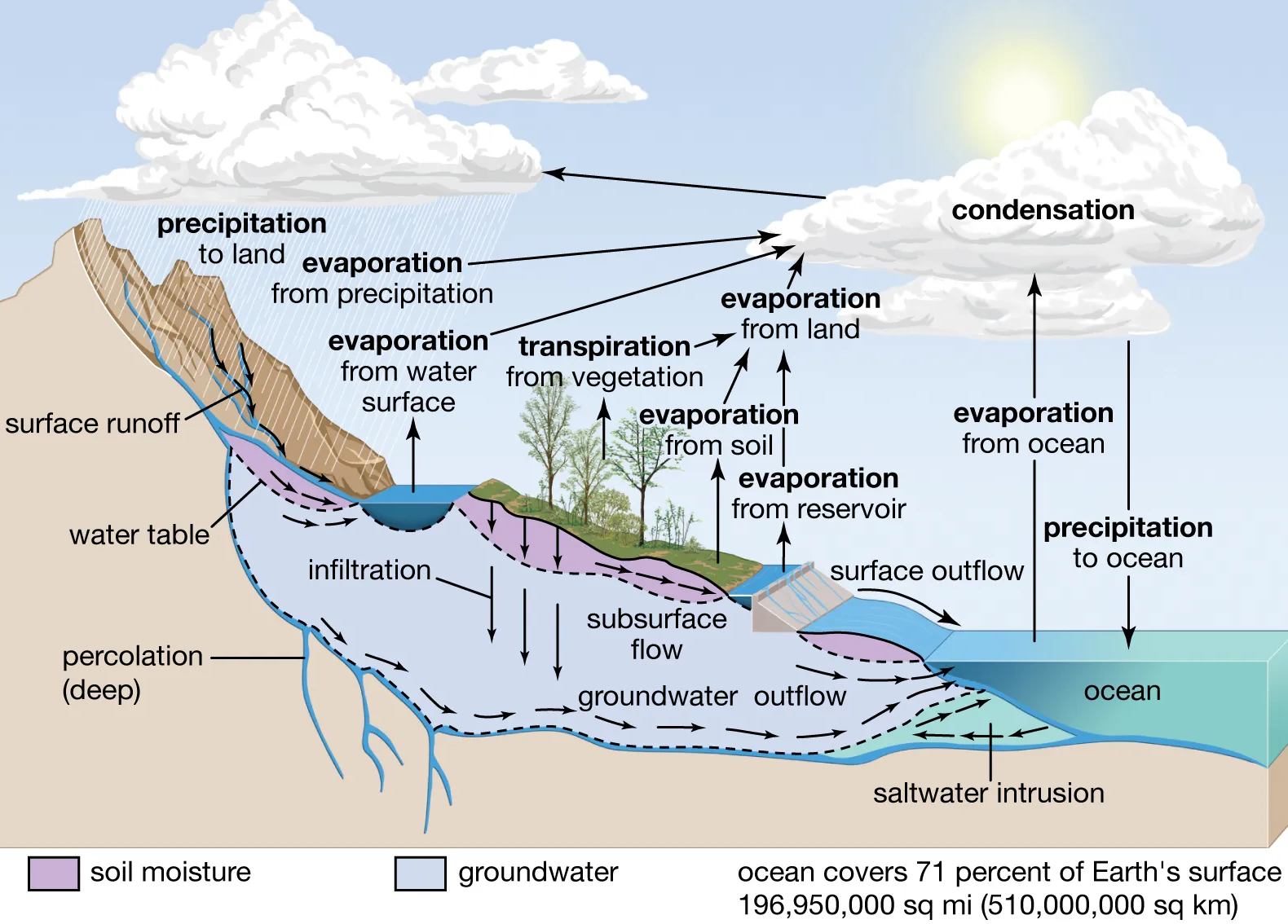
All water supplies originate from rainfall. The water cycle shows how water moves continuously through the environment via evaporation, condensation, precipitation and collection processes.
Surface water sources
Surface water includes water that does not soak into the ground after rainfall. These sources comprise:
- Lakes and rivers
- Streams and reservoirs
- Runoff from roofs and paved surfaces
Important
Surface water faces significant contamination risks from agricultural and industrial waste. This pollution makes treatment essential before household use.
Water from shallow, fast-flowing rivers tends to be cleaner than stagnant sources, but still requires treatment for safe consumption.
Groundwater sources
When rainfall soaks into soil, it philtres downwards until reaching an impermeable layer of rock or clay. At this barrier, water either:
- Collects to form underground reservoirs (aquifers)
- Flows along the surface of the impermeable material to create underground streams
Wells are constructed to access these underground water supplies. The water table represents the upper level of saturated ground where wells can successfully extract water. Proper well protection prevents contamination from surface water infiltrating the upper sections.
Example
Natural Filtration Process:
As groundwater flows through multiple layers:
- Water passes through soil particles
- Rock layers act as natural philtres
- Harmful particles and bacteria are trapped
- Clean water emerges at springs and wells
This natural filtration makes spring water generally purer than surface sources.
Local water supply systems
Local authorities manage water collection from multiple sources. They store, treat and distribute water through pipe networks to households. Each authority ensures every dwelling receives access to clean water for domestic needs.
Properties not connected to mains supply use local group water schemes. These systems serve multiple households and typically source water from wells.
Water treatment process
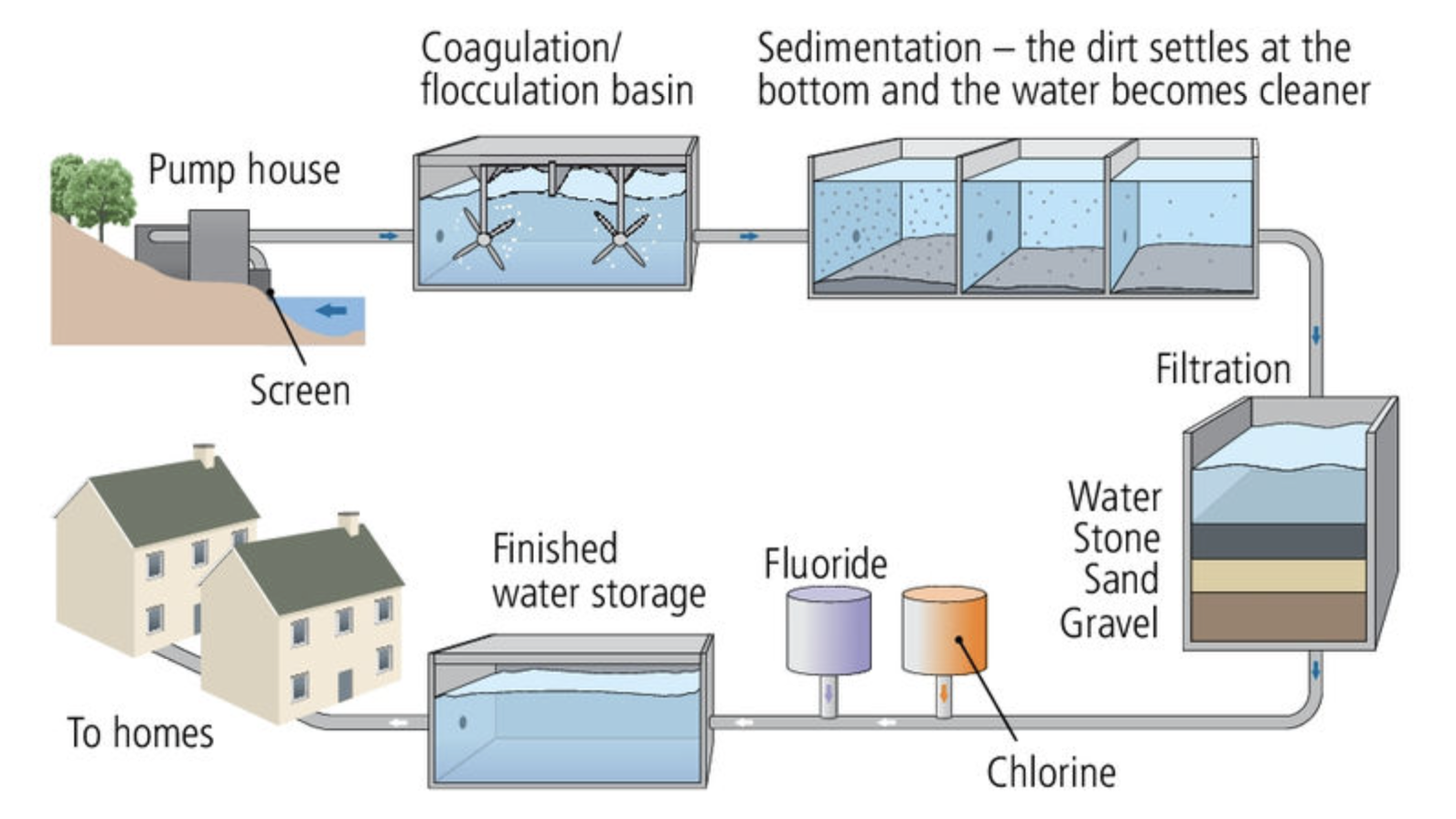
Water supplied to households must meet strict safety standards. Treatment removes particles and bacteria whilst adding beneficial minerals like chlorine and fluoride. The treatment process involves seven sequential steps:
- Collection and pumping
- Screening
- Flocculation
- Sedimentation
- Filtration
- Disinfection
- Fluoridation
Step 1: Collection and pumping
Water is extracted from surface and underground sources and pumped into treatment facilities.
Step 2: Screening
Raw water passes through stainless steel mesh screens that remove large debris including twigs, leaves and other particles.
Note
Groundwater often bypasses this stage because soil acts as a natural philtre.
Step 3: Flocculation
Aluminium potassium sulphate (alum) is added to the water. This chemical attracts small particles, causing them to clump together and become heavy enough to sink to the bottom of treatment tanks.
Step 4: Sedimentation
Water flows into sedimentation tanks positioned close to flocculation tanks to minimise disturbance. Particles settle at the bottom, forming sludge layers that are subsequently removed.
Step 5: Filtration
Remaining suspended particles are eliminated through filtration systems. Philtres consist of layered stone, gravel and sand with gradually decreasing spaces between materials. Water flows through these layers, leaving particles trapped whilst clean water continues downward.
Example
Filtration Layer Structure:
From top to bottom:
- Coarse stone - traps largest particles
- Medium gravel - catches smaller debris
- Fine sand - philtres out tiny particles
- Clean water collection - at the bottom layer
Step 6: Disinfection
Chlorine is added to eliminate any surviving bacteria or microbes. The chlorine concentration is carefully controlled - sufficient to prevent contamination between the treatment facility and household taps, but not enough to create noticeable taste or odour.
Step 7: Fluoridation
Unlike most European countries, Ireland adds controlled amounts of fluoride to reduce tooth decay in the population.
Important
Following these seven steps, the water is safe for human consumption and ready for distribution to homes.
Summary
Key Points to Remember:
- Water sources include surface water (rivers, lakes) and groundwater (aquifers, wells)
- Surface water requires more treatment due to higher contamination risk
- The seven-step treatment process ensures water safety: screening, flocculation, sedimentation, filtration, disinfection, and fluoridation
- Key treatment chemicals include alum (for flocculation), chlorine (for disinfection), and fluoride (for dental health)
- Irish Water manages national water supply infrastructure with metered billing systems