Building Materials (Leaving Cert Construction Studies): Revision Notes
📚Revision Notes
Timber
Timber is a popular natural renewable material that plays a crucial role in the construction industry. Both native and imported timber are widely used in building projects across Ireland and beyond.
Native species found in Irish forests include pine, willow, birch and oak. However, the construction industry also relies heavily on exotic imported timbers such as ebony, rosewood and teak. Timber offers excellent versatility as a building material because it can be easily processed and provides relatively high load-bearing capacity, making it suitable for many structural applications.
Note
Timber's popularity in construction stems from its unique combination of being environmentally sustainable, structurally capable, and easily workable - making it an ideal choice for both traditional and modern building techniques.
Classification of wood
Timber is divided into two main categories: softwood and hardwood. It's important to understand that these terms don't refer to the actual hardness of the wood, but rather to the type of tree it comes from.
Softwoods come from coniferous, cone-bearing trees such as spruce, cedar and fir. These trees typically have needle-like leaves and remain green throughout the year.
Hardwoods come from deciduous, fruit-bearing trees like oak, mahogany and teak. These trees shed their leaves annually and produce fruits or nuts.
Important
The key difference between softwoods and hardwoods lies in their cellular structure rather than their physical hardness. This cellular structure affects how the timber behaves and performs in different applications. Don't assume that all hardwoods are harder than softwoods - some softwoods can actually be harder than certain hardwoods!
Structure and growth
Wood is composed of fibres or cells arranged in an irregular honeycomb pattern. This tight structure gives wood its rigidity and strength. The tube-like structures within wood carry nutrients and water through the fibres, which is why timber is described as hydroscopic - meaning it naturally absorbs moisture from its surroundings.
Important
This hydroscopic property means that timber will not remain structurally sound when exposed to wet conditions over extended periods. Understanding this characteristic is crucial for proper timber use and maintenance in construction applications.
Parts of a tree
Each part of a tree serves a specific function, and understanding these parts helps explain timber's properties:
Bark forms the rough exterior layer that protects the tree against insect attack and helps retain moisture within the trunk.
Bast is a thin layer just beneath the bark containing phloem cells, which transport nutrients to all parts of the tree.
Cambium layer produces new cells, enabling the tree to grow in diameter each year.
Medullary rays radiate outward from the centre, allowing sap to travel through the trunk horizontally.
Growth rings consist of alternating light and dark bands formed by the cambium layer's activity. Counting these rings provides a reliable method for determining a tree's age.
Sapwood carries nutrients from the roots up through the trunk to the leaves. This active transport system keeps the tree alive and healthy.
Heartwood consists of inactive cells that provide structural support. This section contains minimal moisture and offers the best quality timber for construction purposes.
Pith represents the centre of the log where the tree began life as a sapling.
Note
Understanding tree anatomy helps explain why heartwood is preferred for construction - it's the most stable part of the tree with the lowest moisture content and strongest structural properties.
Log selection and timber conversion
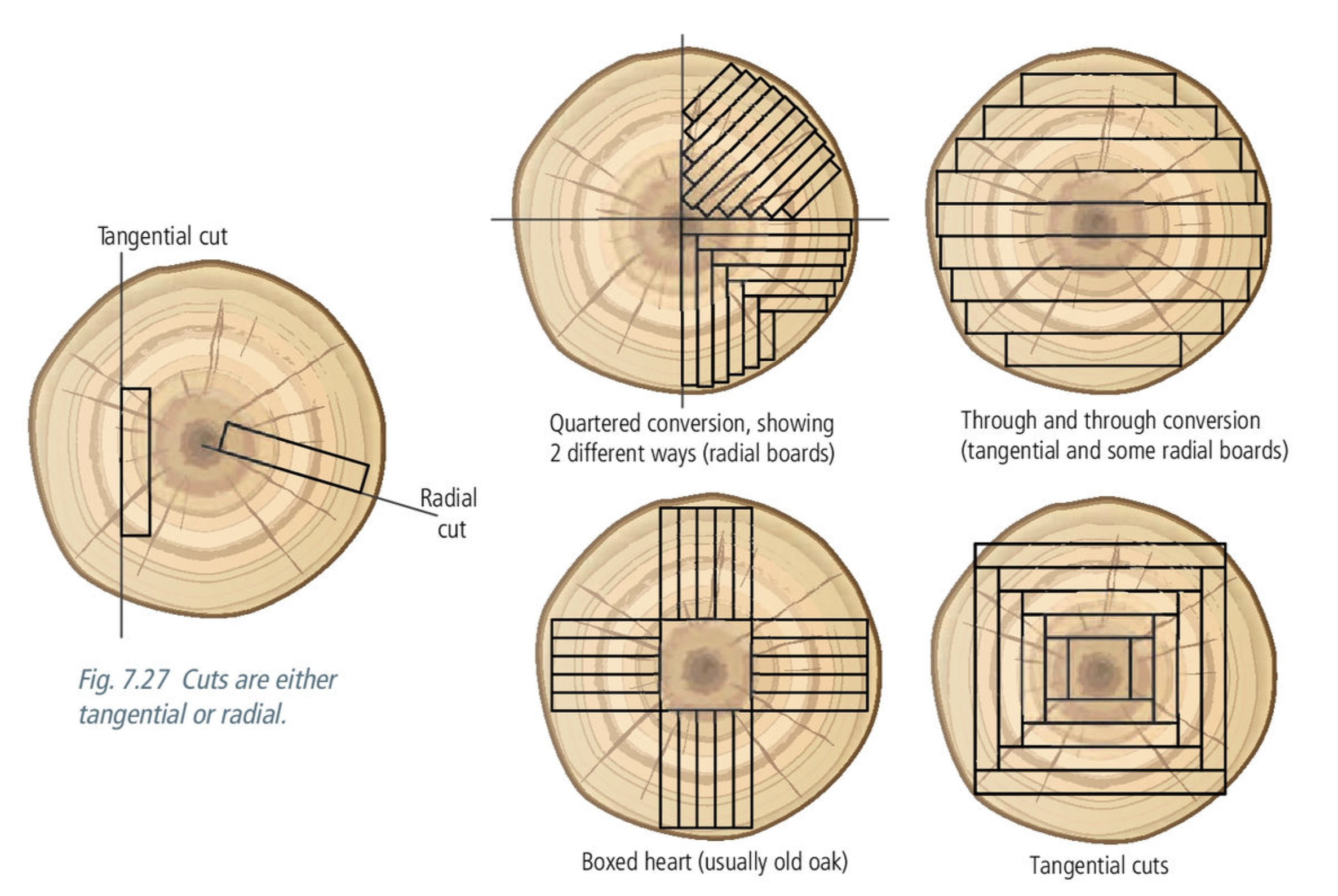
When logs arrive at sawmills, they undergo a grading process where machines sort them by thickness and length. Similar-sized logs are grouped together for efficient processing. All timber must be cut to standard dimensions and regular shapes for construction use.
There are three main methods for converting logs into timber, each producing different grain patterns and structural properties:
Tangential cutting follows the growth rings, producing boards with distinctive curved grain patterns.
Radial cutting cuts perpendicular to the growth rings, creating boards with straight, parallel grain lines.
Quartered conversion combines both methods to maximise timber yield while maintaining good structural properties.
Note
The cutting method chosen affects the final timber's strength, appearance and suitability for different applications. Incorrect cutting can lead to defects in the finished product, making proper conversion techniques essential for quality timber production.
Defects in timber
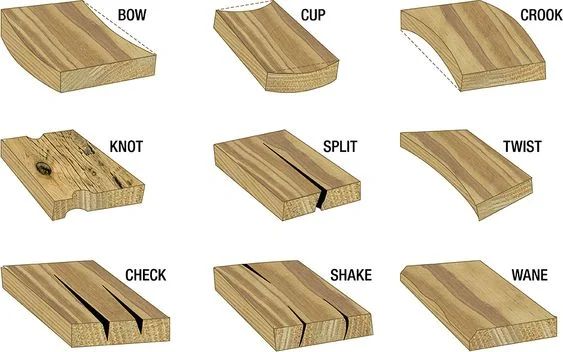
Timber defects can occur naturally or result from the conversion process. Understanding these defects helps in selecting appropriate timber for specific applications.
Natural defects include:
- Checks: small splits that develop as timber dries
- Shakes: separations along the grain lines
- Knots: sections where branches grew from the trunk
Conversion defects result from processing and include:
- Twisting: warping that causes timber to spiral
- Bowing: lengthwise curvature
- Splitting: cracks that develop during or after cutting
Important
These defects can affect timber's structural integrity and suitability for different construction applications. Always inspect timber carefully and select grades appropriate for the intended structural load requirements.
Structural classification of timber
In Ireland, structural timber must comply with European Union standards, specifically IS EN 1995. All timber receives official stamps showing its classification, which includes information about the species, structural strength, relevant standards, and the National Standards Authority of Ireland (NSAI) logo.
The classification system uses specific codes such as:
- WE/SG1: Western Europe, Species group 1 (including pine, douglas fir, sitka and Norway spruce sourced in Ireland)
- WE/SG2: Western Europe, Species group 2 (including larch and Scots pine sourced in Ireland)
Structural strength is indicated by a 'C' followed by a number - the higher the number, the greater the strength e.g. C18, C27. The timber's grade is determined by species and visual inspection, with grades including GS (General structural grade) and SS (Special structural grade).
Important
Compliance with IS EN 1995 standards is mandatory for all structural timber used in construction. Always verify that timber carries the proper NSAI certification stamps before use in load-bearing applications.
Moisture content
Timber's hydroscopic nature means it constantly absorbs and releases moisture depending on environmental conditions. After kiln drying, timber's moisture content typically drops to between and , but this increases if the timber isn't stored properly.
Moisture fluctuations cause timber to expand and contract, which can create structural problems. For structural applications, timber's moisture content at construction time must not exceed , though ideally it should be no higher than . After construction, structural timber must maintain moisture levels below .
Different applications require different moisture content levels:
- External joinery, windows, and structural timber:
- Internal joinery and furniture:
- Internal joinery in continuously heated rooms:
Important
Proper moisture content control is critical for preventing structural problems. Timber with excessive moisture content can lead to warping, splitting, and reduced load-bearing capacity. Always check moisture levels before installation.

Rot in timber
Timber, being a natural material, will decay over time, particularly when exposed to damp conditions. Rot occurs when mould grows and spreads across timber surfaces, potentially leading to complete structural failure if left untreated.
Wet rot
Wet rot attacks timber with a constant moisture content of or higher. This fungal infection begins when spores land on wet timber and germinate. The fungi feed on the timber, gradually eroding and destroying the wood structure.
Wet rot can be identified by several characteristics:
- A distinctive musty smell
- Split grain with visible white fungal strands
- Spongy, wet wood texture
- General weakening of the timber structure
Example
Treatment Process for Wet Rot:
Step 1: Eliminate the moisture source (fix leaks, improve ventilation) Step 2: Remove all affected timber completely Step 3: Treat remaining healthy timber with preservatives Step 4: Apply water-repellent finishes to prevent future moisture ingress

Dry rot
Despite its name, dry rot actually requires timber with moisture content above . However, it's far more severe and damaging than wet rot. The fungus spreads through spores that germinate on timber, sending out thin roots that bore into the wood seeking nutrients.
In warm, humid conditions, the fungus develops fruiting bodies similar to mushrooms. When fully mature, these structures release more spores, rapidly infecting surrounding timber areas.
Important
Dry rot spreads extremely quickly to healthy timber and is much more dangerous than wet rot. It requires immediate and aggressive treatment to prevent extensive structural damage.
Dry rot shows these characteristics:
- Visible fruiting bodies
- Dry, crumbly wood texture
- Presence of red dust
- Deep, cube-like cracks in the timber
- Strong musty odour
Example
Treatment Process for Dry Rot:
Step 1: Remove the moisture source completely Step 2: Cut away all infected timber plus a minimum of 600mm of healthy timber around the infection Step 3: Burn all infected material (never reuse) Step 4: Treat nearby masonry with fire to kill any remaining spores Step 5: Apply three coats of preservative to all replacement timber
Preserving timber
Outdoor timber faces extreme temperature variations and physical conditions, requiring pre-treatment to protect against weather, insects, and fungal attack. Preservation typically involves applying oils or protective coatings to seal the material.
Note
Preservation is essential for outdoor timber applications. Without proper treatment, even the highest quality timber will deteriorate rapidly when exposed to the elements.
The standard preservation process follows these steps:
- Sand and clean all surfaces, treating knots with knotting varnish
- Apply primer to all surfaces and allow complete drying
- Fill holes, cracks and dents, allow setting, then sand smooth
- Clean surfaces again before applying undercoat
- Apply two undercoat layers, allowing proper drying between applications
- Lightly sand before applying the final coat using quality brushes, working in the direction of the grain
Alternative preservation methods include pressure treatment, where timber is placed in a vacuum chamber and preservative is pulled deep into the wood fibres under pressure.
Internal timber may receive different treatments depending on its function, commonly including wax, varnish, or polish applications.
Manufactured boards
When natural timber products don't meet specific building requirements or cost considerations, manufactured boards provide excellent alternatives. These products are created by glueing strips and pieces of wood together, offering properties suited to different construction needs.
Plywood consists of thin layers, each positioned at 90-degree angles to adjacent layers. This cross-grain construction ensures even shrinkage and provides consistent strength in all directions. Plywood always contains an odd number of layers so both outer surfaces show the same grain direction. Common applications include floors, walls, roofs, and concrete formwork. Marine plywood offers waterproof properties ideal for bathroom installations.
Oriented Strand Board (OSB) uses wood chips arranged in layers and bonded with resin and wax. Its distinctive surface pattern makes it easily recognisable. OSB commonly serves as upper floor sheeting before carpet installation and finds use in wall, flooring, and roofing applications.
Chipboard is manufactured from small timber particles and represents the weakest option among manufactured boards. It's typically covered with decorative veneer and frequently used in kitchen cabinet construction, fire doors, worktops, and flat-pack furniture.
Medium-density fibreboard (MDF) is produced from sawdust particles using glue, heat, and pressure. Available in various densities including hardboard and particleboard variants, MDF serves decorative purposes and cabinet making. Like chipboard, it can be veneered to resemble natural hardwoods.
Note
Each manufactured board type offers specific advantages: plywood for structural strength, OSB for cost-effective sheathing, chipboard for furniture applications, and MDF for smooth decorative finishes. Choose the appropriate type based on your specific requirements.
Summary
Key Points to Remember:
- Timber classification depends on tree type: softwoods come from cone-bearing trees, hardwoods from fruit-bearing trees
- Timber is hydroscopic and absorbs moisture, requiring careful moisture content management for structural applications
- Wet rot needs + moisture while dry rot (more dangerous) needs only + moisture content
- Proper preservation is essential for outdoor timber to protect against weather, insects, and fungal attack
- Manufactured boards like plywood, OSB, chipboard, and MDF offer alternatives when solid timber doesn't meet specific requirements
- Always ensure structural timber complies with IS EN 1995 standards and carries proper NSAI certification