Structural System Forces (Leaving Cert Construction Studies): Revision Notes
📚Revision Notes
Structural system forces
Understanding force equilibrium
For any structure to remain standing and stable, all forces acting upon it must be in perfect balance - this is called force equilibrium. Think of a person leaning against a wall - they apply a force to the wall, but they don't fall over because the wall provides an equal force back. This demonstrates Newton's fundamental law of motion: "For every action there is an equal and opposite reaction."
Important
This principle is crucial in construction because it ensures that buildings don't collapse under the various loads they experience, from the weight of the structure itself to environmental forces like wind and the loads from people using the building.
Structural logic and classification
Structural logic refers to how the elements of a structure are organised and arranged. This includes everything from how cavity walls support the roof's weight to how foundations distribute loads evenly through the ground. The structural system combines all load-bearing elements in a building.
Structures can be classified in three main ways based on how forces travel through them:
- Solid structures - forces pass through solid mass
- Skeletal structures - forces travel through a framework
- Surface structures - forces move along the surface of the structure
Note
Many buildings use combinations of these systems to resist complex forces effectively. Understanding how each system works allows engineers to choose the most appropriate structural approach for different building requirements.
Types of structural system forces
Buildings are designed around three primary structural force systems:
- Compressive structures
- Tensile structures
- Truss structures
Compressive structures
Compressive structures work by pushing building elements together. The compression forces keep elements stable by pushing their ends towards each other. These forces can work both horizontally and vertically.
In compressive structures, the main forces acting on elements are compressive, though tensile forces may also be present. There are several types of compressive structures:
Two-dimensional repetitive shapes:
- Post and beam - the simplest form with two upright pillars supporting a horizontal beam
- A-frame - uses triangular shapes for stability
- Arch structures - can be curved (Romanesque style) or pointed (Gothic style)
Example
Historical Example: Ancient Irish Architecture
The post and beam system can be traced back thousands of years to Ireland's earliest built structures, like the Poulnabrone Dolmen in County Clare. This ancient monument demonstrates how simple compressive forces between vertical posts and horizontal beams can create lasting structures that have survived for millennia.
Note
Triangles are inherently stable, and when repeated in construction, they add significant strength. This is why A-frame structures are particularly effective in areas with heavy snow loads or strong winds.
Three-dimensional surfaces: These include vaults and domes, which are essentially meeting points of multiple arched chambers.
Important
Curved arches distribute compressive forces continuously through their shape, but their weakest points are at the base where loading intensifies and may require extra support like flying buttresses.
Tensile structures
Tensile structures work primarily with forces of tension, where the majority of structural elements are stretched rather than compressed. A common example is fabric structures where supporting posts stretch the fabric to form a rigid roof system.
These structures are particularly useful for creating large, open spans without intermediate supports, making them popular for sports facilities and temporary structures.
Truss structures
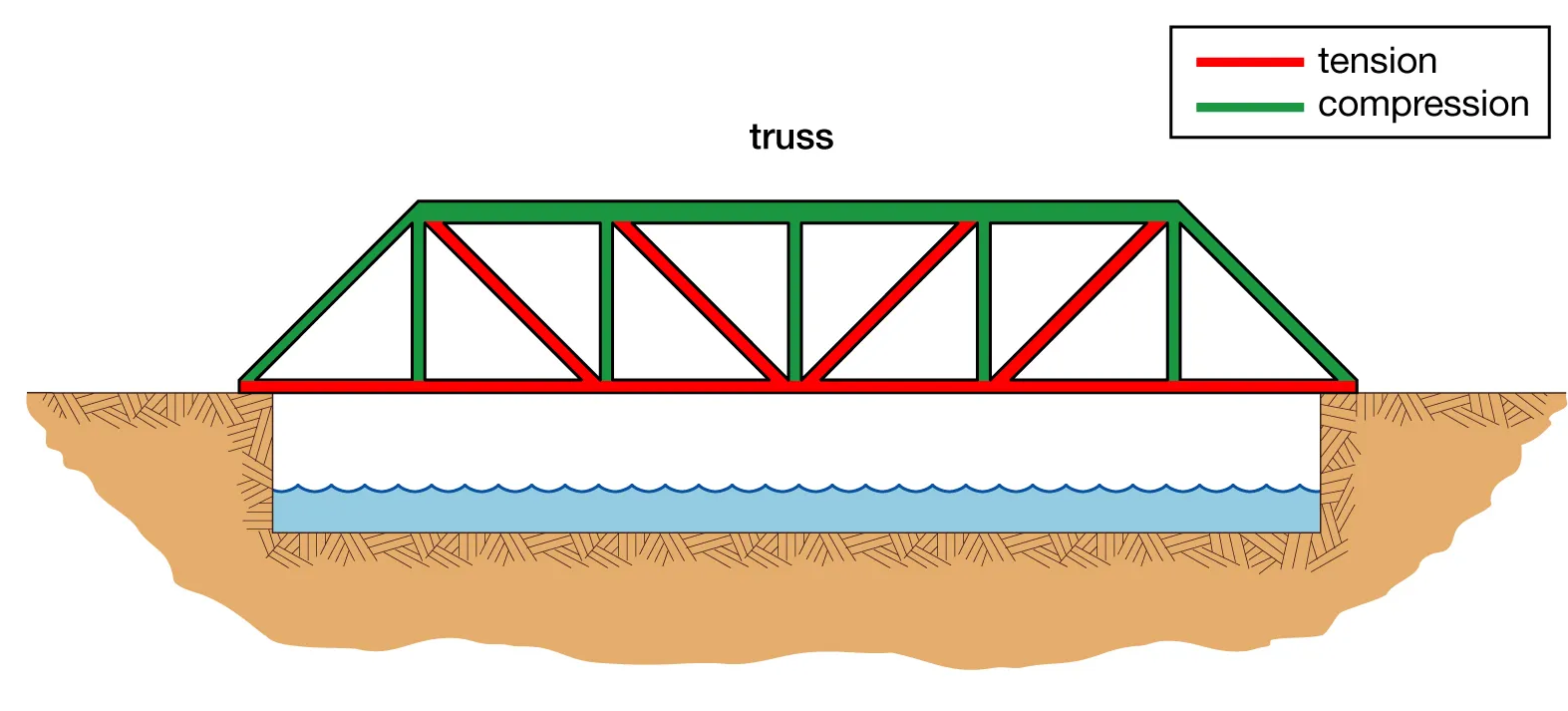
A truss consists of straight elements arranged in triangular patterns. Trusses are highly effective because they respond well to dynamic loads - each element can experience compression, tension, or both depending on the loading conditions.
Truss structures are economical to construct because they use materials very efficiently. The triangular arrangement distributes forces effectively throughout the structure.
Example
Famous Example: The Eiffel Tower
The Eiffel Tower in Paris is perhaps the world's most famous example of truss construction. Its intricate lattice of iron trusses demonstrates how triangular arrangements can create both structural strength and architectural beauty, supporting the tower's height of 330 metres while using materials efficiently.
Active structural systems
Beyond the basic force systems, structures can also be classified as active systems that redistribute and redirect forces:
Form active systems
These are non-rigid, flexible systems whose form creates structural stability when secured at the ends. Examples include:
- Cable structures
- Tent structures
- Pneumatic structures
- Some arch structures
Vector active systems
Vector active systems use short, straight, solid elements that redistribute forces effectively. They utilise the strength of triangular arrangements to divide forces into tensile and compressive components. This means individual elements may experience either tension or compression.
These systems include:
- Flat trusses
- Curved trusses
- Space trusses
Note
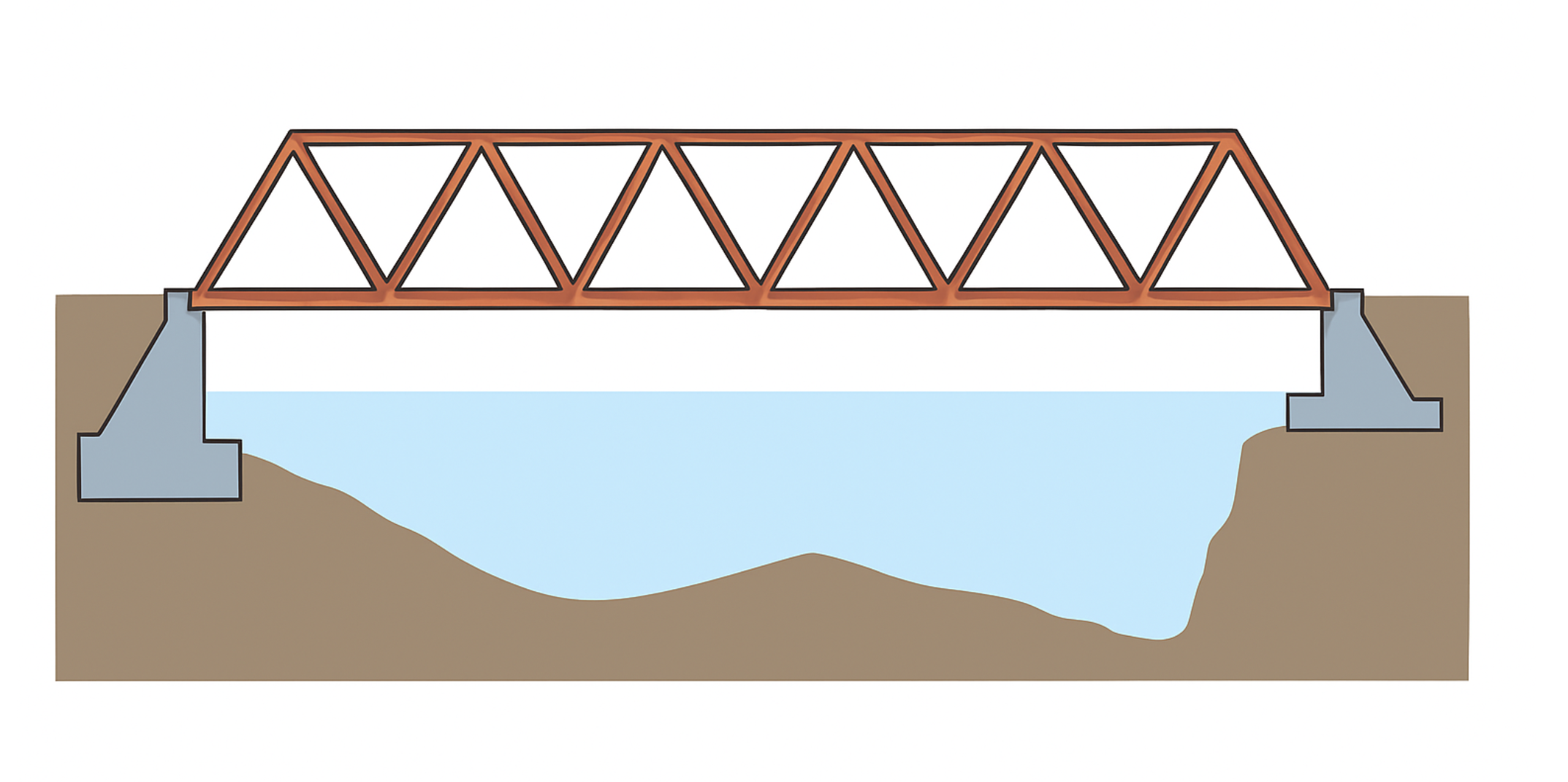
Vector active structures form the basis for many structural designs, including bridges, where simple triangular trusses support the bridge deck below. This demonstrates the versatility and effectiveness of triangular force distribution.
Section active systems
These systems contain many groups of elements (rigid, solid and linear) where parts of the structure can move and redirect forces acting upon them. Examples include:
- Beam structures
- Frame structures
- Slab structures
Surface active systems
Surface active systems consist of flexible or rigid planes that can resist tension, compression and shear forces. These structural elements can move and redirect forces effectively. Examples include:
- Plate structures
- Folded structures
- Shell structures
Struts and Ties
- A strut is a structural element that resists compression (pushing forces). It helps to hold things up by being squeezed.
- A tie is a structural element that resists tension (pulling forces). It holds things together by being stretched.
In a typical roof truss:
- The horizontal member is often a tie because it is in tension.
- The sloped members are usually struts because they are in compression.
Struts and ties work together to keep the structure stable and balanced.
Summary
Key Points to Remember:
- All forces in a structure must be in equilibrium for it to remain stable - following Newton's law that every action has an equal and opposite reaction
- The three main structural force systems are compressive (pushing together), tensile (pulling apart), and truss (triangular arrangements)
- Compressive structures include post and beam, A-frame, and arch systems
- Truss structures are economical and efficient, using triangular patterns to distribute forces
- Active systems (form, vector, section, and surface) provide flexible ways to redistribute and redirect structural forces