Walls and Plastering (Leaving Cert Construction Studies): Revision Notes
📚Revision Notes
Plastering and rendering
Understanding plastering vs rendering
Plastering and rendering are both finishing techniques that serve different purposes in construction. Rendering refers to the external finish applied to outdoor walls, whilst plastering describes the internal finish used on indoor walls.
The key difference lies in their composition and function. External renders contain more cement content to provide weather resistance, whilst internal plasters focus on creating smooth, decorative surfaces. Importantly, external renders can be used indoors, but internal plasters cannot be used outdoors due to their lack of weather protection.
Note
Understanding the fundamental difference between rendering and plastering is essential for selecting the correct technique for your project. The choice depends on whether you're working on internal or external surfaces, and the level of weather protection required.
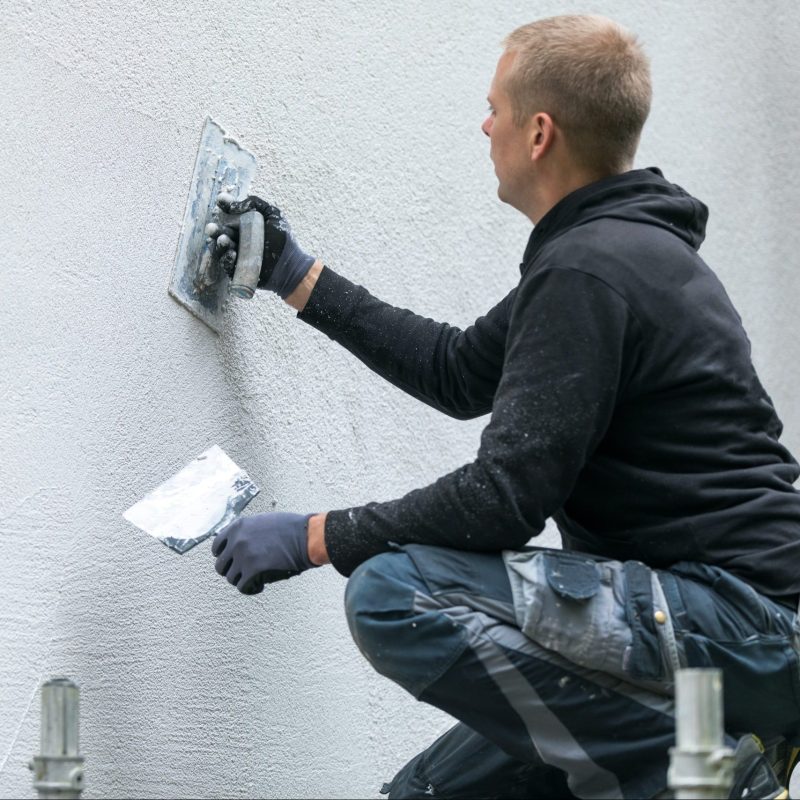
Both techniques offer several benefits beyond appearance:
- Improved thermal insulation
- Enhanced acoustic insulation
- Increased wall durability
- Weather protection (rendering only)
External wall rendering
External walls require a robust three-coat rendering system to protect against weather damage whilst improving the building's appearance. This system acts like a protective skin that resists rain and weather damage.
The three-coat system
External rendering follows a systematic approach using three distinct layers, each with specific properties and functions.
Scud coat (base layer)
The scud coat creates the crucial link between the wall surface and subsequent render layers. This coat uses a mix ratio of cement to sharp sand, with enough water to achieve a thick slurry consistency. The mixture is thrown at the wall using a hand scoop rather than applied smoothly.
Before application, the wall surface must be dampened periodically to ensure proper adhesion. The scud coat reaches a thickness of -mm and provides the essential 'key' that holds the entire render system in place.
Scratch coat (middle layer)
Once the scud coat has cured, the scratch coat is applied using a trowel. This layer uses a mix ratio of cement, lime and sand. When lime isn't available, a plasticiser can be substituted to improve workability.
The scratch coat is applied to a thickness of -mm and left to become firm but not fully hardened. Before it sets completely, the surface is scratched with a tool to create grooves. These grooves provide the texture needed for the final coat to grip effectively.
Finish coat (top layer)
The finish coat provides the final appearance and weather protection. It uses the same mix as the scratch coat, or can be made slightly weaker - never stronger.
Important
If the finish coat is stronger than the layer beneath, it can cause defects like cracking and crazing due to shrinkage. Always ensure the finish coat is the same strength or weaker than the scratch coat.
The scratch coat must cure fully and be moistened before applying the finish coat. This prevents excessive suction that would compromise the bond. The final layer reaches approximately mm thickness and is applied using a plasterer's float to create a smooth surface. For textured finishes, a plasterer's sponge creates irregular patterns.
Important
Critical Thickness Requirement
The total thickness of all three coats combined must not exceed mm to prevent structural issues.
Finish textures
Wet-dash (roughcast)
Wet-dash finish is achieved by throwing the final render coat at the wall whilst wet and leaving it untrowelled. The coarse aggregate in the mix determines the final texture appearance. This finish offers superior weather resistance and durability, making it ideal for coastal regions with extreme weather conditions.
Dry-dash
Dry-dash involves throwing loose stone chippings onto fresh render whilst the finish coat remains soft. The work must be completed in one continuous session to ensure uniform appearance. This technique creates an attractive textured surface with excellent weather resistance.
Internal wall plastering
Internal wall finishes depend on the wall construction type. Block walls typically receive wet plaster finishes, whilst stud partitions use dry-lined plasterboard systems.
Block wall plastering methods
Three-stage method
Example
Worked Example: Three-Stage Plastering Method
The three-stage approach follows the same principle as external rendering but uses different materials suited for interior use:
Step 1 - Scud coat: Applied to bare blockwork using sand to cement mix, providing the base adhesion layer
Step 2 - Scratch coat: Applied with trowel using cement, lime and sand mix to create the base for final finishing
Step 3 - Finish coat: Final layer using gypsum plaster that will accept paint or decorative finishes
Two-stage method
Example
Worked Example: Two-Stage Gypsum Method
This simplified approach uses gypsum-based materials throughout:
Step 1 - Undercoat: mm thick gypsum undercoat applied to the wall and scratched deeply to provide keying for the finish layer
Step 2 - Finish coat: -mm thick gypsum finish coat applied and smoothed to create the final surface ready for decoration
Dry lining systems
Dry lining was originally developed to prevent moisture penetration through thick walls affecting internal finishes. Whilst cavity wall construction has reduced this issue, dry lining remains popular because it eliminates the need to chase electrical and plumbing services into walls.
Note
Materials and Installation Process
Plasterboard forms the most common dry lining material. These are rigid m × m sheets with gypsum cores lined with durable paper on both sides. Foil-backed variants prevent moisture ingress. Standard thicknesses include mm and mm.
Installation involves fixing timber battens to the wall with insulation placed between them. The battens must be spaced to accommodate standard plasterboard dimensions. Plasterboard is then nailed or screwed to the battens and finished with up to mm thick gypsum plaster.
Ceiling applications
Ceilings use similar plasterboard and wet plaster combinations. Foil-backed plasterboard combats condensation effectively. Boards are screwed to ceiling joists, with canvas fibre 'scrim' tape reinforcing joints where ceiling meets walls to prevent cracking. The ceiling finish matches wall treatment with mm gypsum plaster.
Painting
Painting provides the decorative finish for plastered surfaces. Proper preparation is crucial for achieving professional results and preventing future problems.
Important
Critical Preparation Requirements
Plaster must be completely dry before painting begins. External render may require up to six weeks drying time. Painting wet plaster traps moisture inside, leading to mould growth and finish failure.
Once dry, surfaces are brushed clean to remove dust and sealed using a mixture of one part water to four parts paint. This seal prevents the porous plaster from absorbing moisture from the paint, which would cause the finish to dry out and flake.
Application process
After sealing, walls are primed and finished using sprays, rollers or brushes. Paint must be applied evenly across the entire surface to create uniform appearance and coverage. Multiple thin coats typically produce better results than single thick applications.
Summary
Key Points to Remember:
- Rendering protects external walls from weather damage, whilst plastering provides smooth internal finishes
- External rendering uses a three-coat system: scud coat (-mm), scratch coat (-mm), and finish coat (mm)
- Internal walls can use either three-stage wet plaster methods or two-stage gypsum systems depending on requirements
- Dry lining with plasterboard offers advantages for service installation and moisture control
- Proper drying time before painting is essential - up to six weeks for external render - to prevent mould and finish failure