Party, Boundary and Retaining Walls (Leaving Cert Construction Studies): Revision Notes
📚Revision Notes
Party, boundary and retaining walls
Party walls
A party wall serves as a shared barrier that divides one building from its neighbouring property. When two residential buildings share this type of wall, each property owns exactly half of the wall structure.
Note
The concept of shared ownership means both property owners have equal rights and responsibilities for maintaining the party wall structure.
Main functions of party walls
Party walls serve two critical purposes in building design:
Fire prevention: The wall acts as a fire barrier to stop flames spreading between adjacent buildings. This protects both properties and their occupants from fire damage.
Sound control: The wall reduces noise transmission between neighbouring buildings, providing acoustic privacy for residents on both sides.
Construction methods for party walls
Party walls can be built using either concrete or timber construction techniques. Each method has specific advantages and construction requirements.
Concrete party walls offer simpler construction and allow masonry chimneys to be attached directly to the wall structure. This makes them particularly suitable for traditional building designs.
Timber party walls require additional fire protection measures but can be more cost-effective in timber frame developments. Wire-reinforced mineral wool must be packed into the wall cavity at floor level to enhance fire resistance.
Fire protection systems
Important
Party walls incorporate several critical fire protection features that must be properly installed to prevent flame and smoke spread between properties.
Party walls incorporate several fire protection features to prevent flame and smoke spread:
Cavity barriers are installed within the wall structure to compartmentalise spaces and slow fire progression.
Firestops seal gaps at the top of the wall where non-combustible insulation is packed in. The wall is then capped with mortar to create a complete seal from foundation to roof level.
Non-combustible building boards and spandrel panels provide additional fire resistance within the wall construction.
Floor joist connections
Special care must be taken when connecting floor joists to party walls to maintain structural integrity and fire protection:
Important
Critical Rule: Floor joists must NEVER be built directly into party wall structures as this compromises the fire barrier properties and can cause structural issues.
Perpendicular joists: When floor joists meet the party wall at right angles, they must not be built directly into the wall structure. Instead, joist hangers provide support while maintaining the wall's fire barrier properties.
Parallel joists: When joists run alongside the party wall, small timber packers are installed between the joists and wall to prevent direct contact. This prevents joist movement that could cause springy floors.
Boundary walls
Boundary walls establish property limits and provide privacy for building occupants. These walls should complement the main building's appearance by using materials that link visually with the dwelling.
Note
Choosing materials that harmonise with the main building creates visual continuity and enhances the overall property appearance.
Common materials and design
Boundary walls commonly use brick, stone, steel, and timber in their construction. Materials are often combined effectively, such as brick pillars supporting timber fencing sections.
Structural considerations
Foundation requirements: All boundary walls need proper foundation systems. The foundation type depends on local soil conditions and must provide adequate support for the wall height and loading.
Important
Height limitations: Tall boundary walls spanning long distances can buckle under wind loads and their own weight. This is a critical structural consideration that must be addressed in design.
Height limitations: Tall boundary walls spanning long distances can buckle under wind loads and their own weight. Several methods address this structural challenge:
- Increasing wall thickness
- Reducing overall height
- Installing piers at regular intervals along the wall length
Piers provide the most practical solution, allowing thin, high walls to be constructed safely by providing intermediate structural support.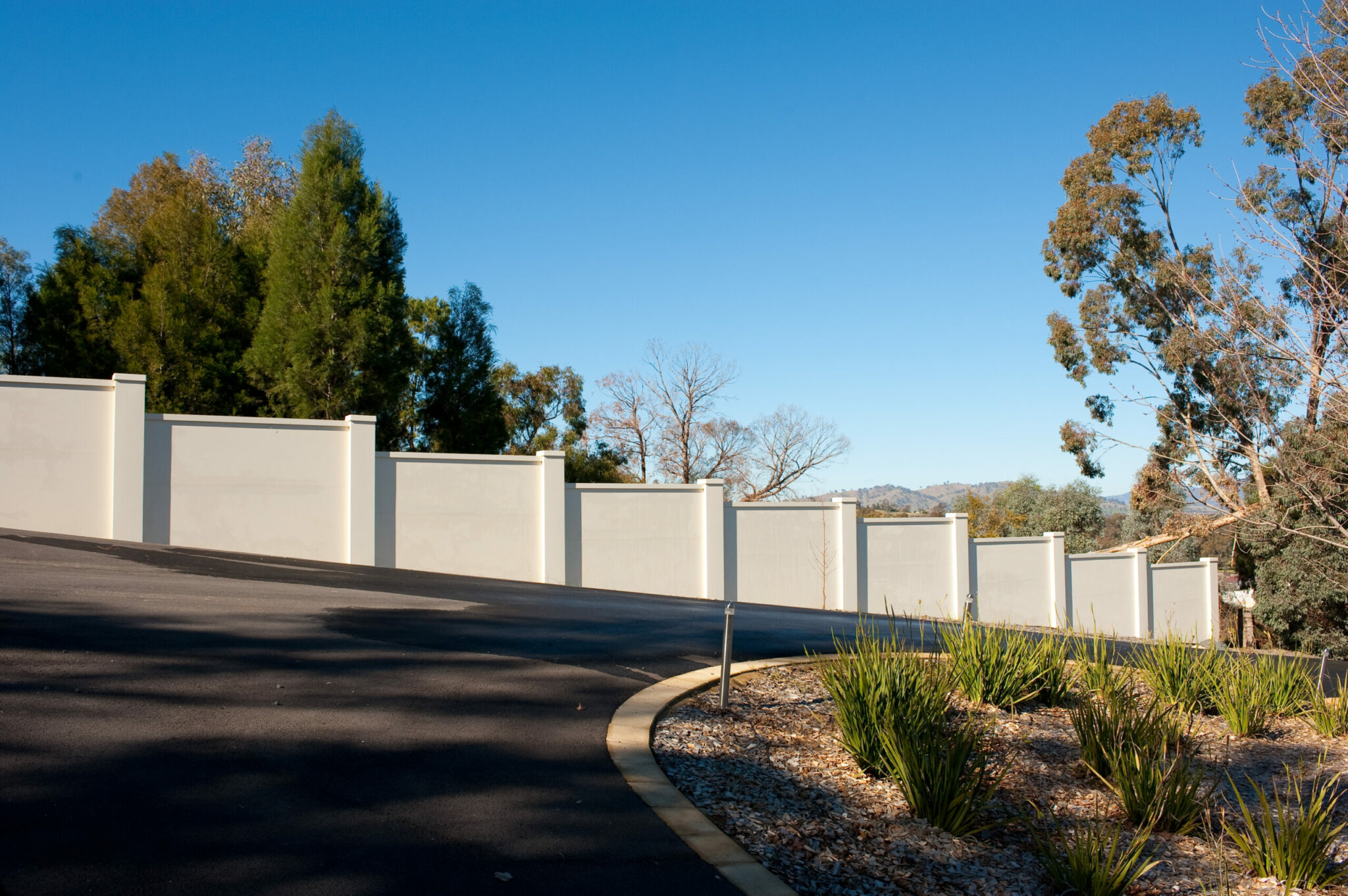
Retaining walls
Retaining walls control soil movement and create different ground levels on building sites. They are commonly found in gardens with steep slopes and alongside roadways where level changes are necessary.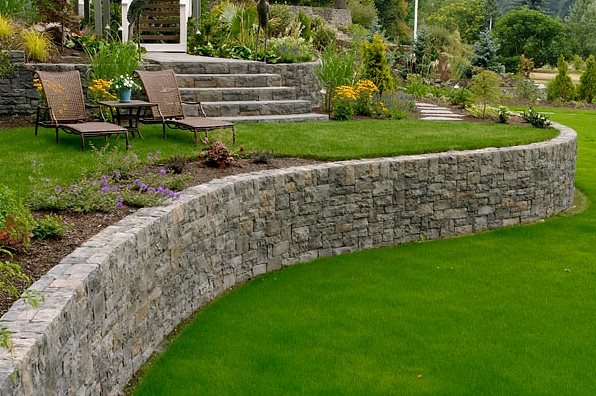
Types of retaining walls
Gravity walls rely on their own weight to resist soil pressure. They work best for moderate height differences and stable soil conditions.
Piling walls use deep foundations driven into the ground to resist horizontal soil forces. This method suits areas with poor surface soil conditions.
Cantilever walls use an L-shaped concrete structure where the horizontal base section is loaded with soil weight to provide stability against overturning.
Anchored walls incorporate tie-back systems that extend into the retained soil mass, providing additional resistance to soil pressure forces.
Example
Worked Example: Choosing a Retaining Wall Type
Scenario: A 2-meter high retaining wall is needed for a garden terrace on clay soil.
Step 1: Assess soil conditions - clay provides good bearing capacity
Step 2: Consider wall height - moderate height (2m)
Step 3: Select appropriate type - Gravity wall is suitable for stable clay soil and moderate height
Step 4: Design foundation - adequate width needed to distribute load across clay base
Result: Gravity wall selected for cost-effectiveness and suitability to site conditions.
Soil pressure considerations
All retaining walls must resist earth pressure forces that push horizontally against the wall structure. The wall's own gravity provides a downward force that helps resist overturning. Reactive forces from the foundation and anchoring systems provide additional stability.
Summary
Key Points to Remember:
- Party walls have two main functions: preventing fire spread and reducing sound transmission between neighbouring buildings
- Floor joists must never be built directly into party walls - use hangers for perpendicular joists and packers for parallel ones
- Boundary walls need proper foundations and may require piers for structural stability over long spans
- Four main types of retaining walls exist: gravity, piling, cantilever, and anchored, each suited to different soil conditions
- Rendering is for external walls (weather-resistant), while plastering is for internal walls (smooth finish only)