External Doors (Leaving Cert Construction Studies): Revision Notes
📚Revision Notes
External doors
Introduction and functions
External doors provide the primary access point into a building while serving multiple critical functions. These doors must balance practical requirements with aesthetic considerations, as they significantly impact both the building's appearance and performance.
Note
The design of external doors requires careful consideration of both functional performance and visual appeal, as they serve as the building's primary interface between interior and exterior environments.
The primary functions of external doors include:
- Preventing weather infiltration
- Maintaining thermal efficiency
- Providing security
- Ensuring comfortable access for users
- When closed, doors act as barriers against wind and rain while preventing heat loss.
- When open, they allow natural ventilation and light to enter the building.
Additionally, external doors serve as noise barriers and can help slow fire spread within a structure.
External doors must meet several performance criteria to function effectively. They need to be stable and durable to withstand regular use and weather exposure. Security features are essential to prevent unauthorised access. Thermal efficiency helps maintain comfortable indoor temperatures while reducing energy costs.
Materials for external doors
External doors are manufactured using two main materials, each with distinct characteristics and maintenance requirements.
Timber external doors
Timber doors typically use hardwood due to its superior durability and weather resistance. Hardwood species provide the strength needed to withstand external conditions while maintaining structural integrity over time. However, timber doors require regular maintenance including painting, staining, or sealing to protect against moisture damage and weathering.
Important
Timber doors demand consistent maintenance schedules to prevent moisture damage, rot, and weathering that can compromise both appearance and structural integrity.
uPVC external doors
uPVC (unplasticised polyvinyl chloride) doors offer a low-maintenance alternative to timber. These doors feature hollow frames with aluminium reinforcement in the core for structural strength. The panels are insulated to minimise heat loss, contributing to the building's thermal efficiency. While traditionally white, uPVC doors are now available in various colours, including timber grain effects to mimic natural wood appearance.
Types of external doors
Panelled doors
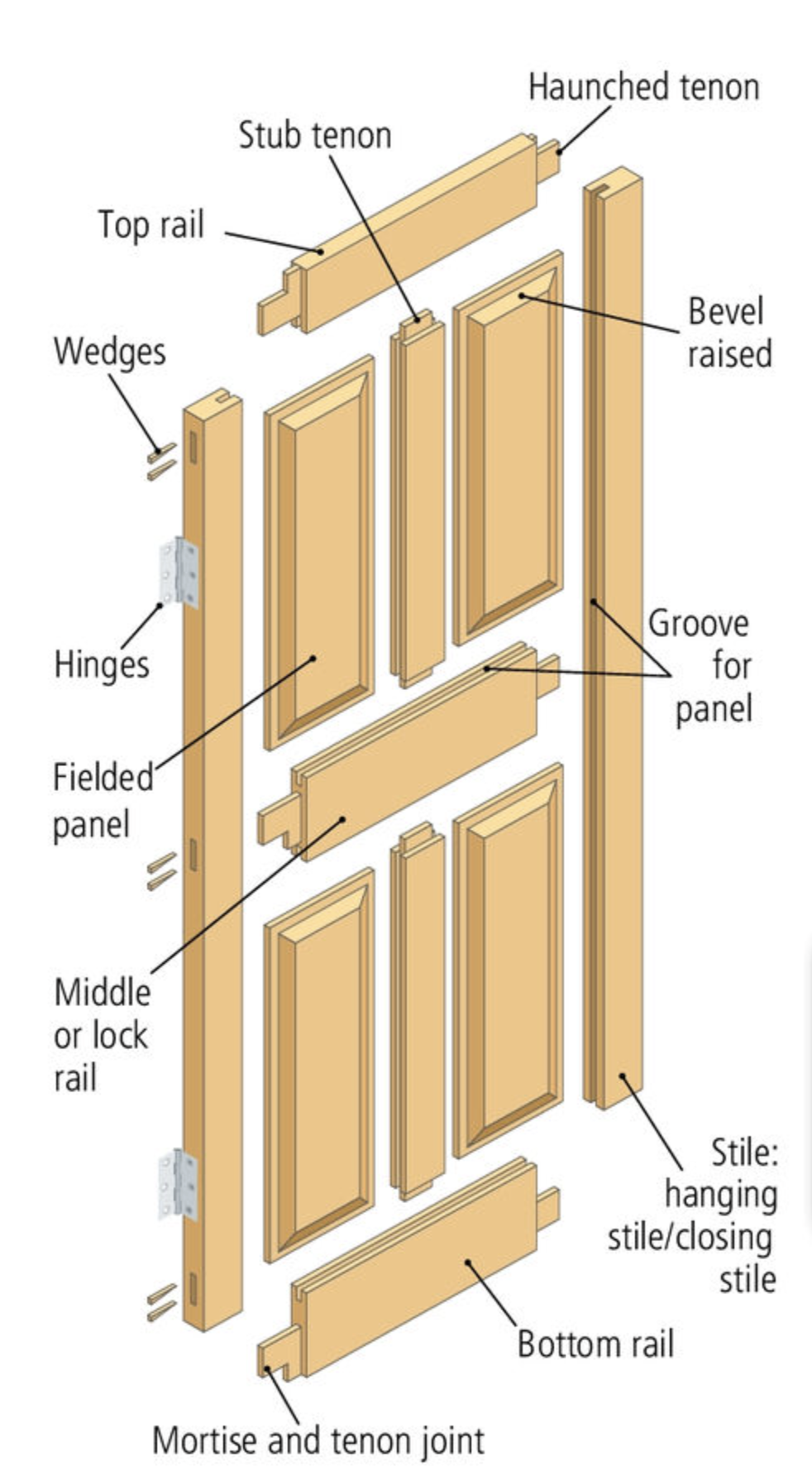
Panelled doors represent a traditional construction method using hardwood components joined with mortise and tenon joints. The door frame consists of vertical stiles and horizontal rails that create a rigid framework. Panels sit within grooves cut into this frame, allowing for natural timber movement while maintaining structural integrity.
Note
The mortise and tenon joinery system has been used for centuries because it creates incredibly strong, long-lasting connections that can withstand the stresses of daily use and weather exposure.
The construction includes several key components:
- Stiles: Vertical frame members on the sides
- Rails: Horizontal frame members (top, middle, bottom)
- Panels: Flat or fielded sections that fit within the frame
- Wedges and tenons: Traditional joinery securing the frame
This construction method provides excellent durability and allows for decorative panel arrangements that enhance the door's aesthetic appeal.
Matchboard doors
Matchboard doors use tongue-and-groove boards that interlock along their edges, creating a solid door surface. These doors are commonly used for sheds, side gates, and utility areas where a more rustic appearance is acceptable.
The construction varies in complexity:
- Ledged and battened doors use horizontal ledges (95 x 22mm timber) spanning the door width to hold the matchboards together. This simple construction is suitable for basic applications.
- Ledged and braced doors add diagonal braces (95 x 22mm timber) between the ledges. The braces provide additional support and prevent the door from sagging over time.
- Framed, ledged and braced doors incorporate a complete frame (95 x 45mm framing) around the door perimeter, with ledges (146 x 27mm) and braces for maximum stability. This construction includes a hanging stile for proper hinge attachment.
Note
The progression from ledged and battened to framed, ledged and braced construction represents increasing levels of structural support and longevity, with each method suitable for different applications and budgets.
All matchboard doors use 16mm thick matchboarding for the door surface, providing adequate weather resistance while remaining cost-effective.
Weatherproofing and threshold details
Effective weatherproofing is crucial for external door performance. Water must not penetrate the building either through pooling at the door base or wind-driven rain.
Important
Poor weatherproofing at external doors is one of the most common causes of moisture problems in buildings, leading to structural damage, mould growth, and reduced thermal efficiency.
Threshold construction
The threshold detail creates a weatherproof transition between exterior and interior spaces. Key elements include:
- A level transition for comfortable access, particularly important for accessibility
- A drainage channel in front of the doorway to collect and redirect rainwater away from the building
- A grating over the drainage channel that won't trap items like prams or heels
- Proper integration with the building's foundation and floor structure
Weather sealing systems
Various sealing systems prevent wind-driven rain from entering at the door base:
- Flexible strips: Simple seals that compress against the door
- Brush seals: Use bristles to create a barrier while allowing door movement
- Flexible arch seals: Curved seals that accommodate door swing
- Complete kit systems: Comprehensive sealing solutions combining multiple elements
These systems must be durable enough to withstand repeated door operation while maintaining effective weather protection.
Accessibility requirements
External doors must accommodate users with varying physical abilities. Specific dimensional requirements ensure comfortable access for all users.
Important
Building regulations mandate specific accessibility requirements for external doors to ensure buildings are usable by people with disabilities and mobility impairments.
Letter box positioning
Building regulations specify precise positioning for letter boxes to ensure accessibility:
- Maximum height: 1450mm from external ground level for standing access
- Ideal height: 1070mm to the centre of the aperture
- Minimum height: 760mm from external ground level
These measurements ensure the letter box is accessible to users of different heights while remaining practical for postal delivery.
Door opening and approach
The door opening must provide sufficient space for wheelchair access and allow comfortable approach angles. The threshold should be as level as possible to prevent tripping hazards and accommodate mobility aids.
Summary
Key Points to Remember:
- External doors serve multiple functions: weather protection, security, thermal efficiency, and access control
- Timber doors (hardwood) offer traditional aesthetics but require regular maintenance, while uPVC doors provide low maintenance with good thermal performance
- Panelled doors use mortise and tenon joinery for strength, while matchboard doors use tongue-and-groove boards with varying support systems
- Proper weatherproofing requires careful threshold design with drainage channels and effective sealing systems
- Accessibility requirements specify precise letter box positioning (760-1450mm height range) and level thresholds for comfortable access