Internal Doors (Leaving Cert Construction Studies): Revision Notes
📚Revision Notes
Internal doors
Internal doors serve as passageways between rooms within buildings. Unlike external doors, they don't require weather protection, allowing them to be manufactured from softwood materials. This makes them generally lighter and more cost-effective than their external counterparts.
Note
The key advantage of internal doors is that they don't face the same environmental challenges as external doors, which allows for more economical construction methods and material choices.
The construction of internal doors focuses on providing adequate strength for daily use whilst maintaining affordability and ease of installation. Most internal doors are designed to standard sizes and can be modified on-site if needed.
Main types of internal doors
Internal doors fall into two primary categories:
- Flush doors and
- Panelled doors.
Each type offers different aesthetic and practical benefits.
Flush doors
Flush doors feature smooth, flat surfaces on both sides, creating a clean, modern appearance. Despite their similar external appearance, they can be constructed using several different methods.
Solid core flush doors
These represent the strongest option among flush door types. The core consists of small timber pieces or particle board strips joined together to create a completely solid interior. This construction method provides excellent durability and resistance to damage.
The solid core extends throughout the entire door area, making these doors heavier than alternatives but significantly more robust. A plywood facing is applied to both sides to create the smooth finish. The door frame consists of horizontal rails and vertical stiles that form the structural framework.
Hollow core flush doors
This construction method balances strength with weight reduction. The door features a solid wooden frame around the perimeter, with cardboard webbing filling the interior space. This webbing creates a honeycomb-like structure that provides structural rigidity whilst keeping the door relatively lightweight.
Note
The cardboard core functions similarly to the structure found in beehives, creating strength through its geometric pattern. This biomimetic design principle demonstrates how nature-inspired engineering can be applied to construction materials.
However, these doors are more susceptible to dents and punctures compared to solid core alternatives. A lock block is incorporated into the design to provide a solid fixing point for door hardware.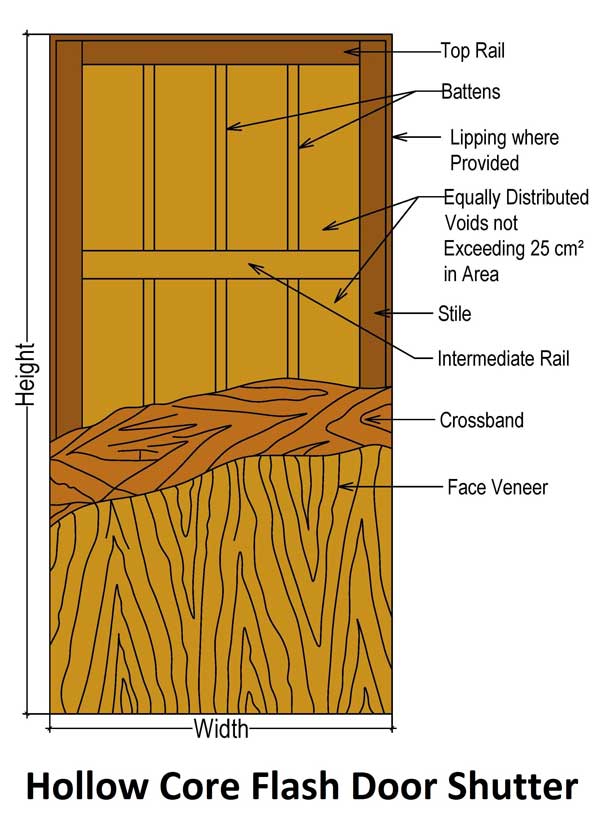
Stamped hardboard flush doors
These offer the most economical option for flush door construction. The manufacturing process involves creating a hardwood veneer surface that mimics natural wood grain patterns through stamping techniques.
The core can be either hollow (filled with particle board or foam) or constructed using similar methods to other flush doors. However, like hollow core doors, they are prone to damage from impacts and require careful handling during installation and use.
Panelled doors
Panelled internal doors share many construction principles with external panelled doors but can utilise softwood materials rather than hardwoods. This makes them more affordable whilst maintaining the traditional aesthetic appeal.
The construction involves horizontal rails and vertical stiles forming the framework, with decorative panels fitted between them. Various panel designs are available, from simple flat panels to more ornate raised or recessed patterns. Some designs incorporate glazed panels to allow light transmission between rooms.
Specialised internal doors
Sliding doors
Sliding doors operate on a track system rather than using traditional hinges. One door leaf remains stationary whilst the other slides across it. In residential settings, these are commonly called patio doors, particularly when they provide access to outdoor spaces.
Key features of sliding doors include:
- Steel reinforcement for structural integrity and security
- Weather stripping to prevent wind and rain infiltration
- Minimal maintenance requirements - tracks need only be kept clear of debris
- Space-saving design as they don't require swing clearance
Fire doors
Fire doors serve a critical safety function by controlling the spread of fire, smoke, and toxic gases throughout buildings. They are commonly installed at apartment entrances and rooms adjacent to garages.
Important
Fire doors are essential safety components that can mean the difference between life and death in emergency situations. They must be properly installed and maintained to function correctly when needed.
Construction requirements
Important
Critical Fire Door Construction Standards:
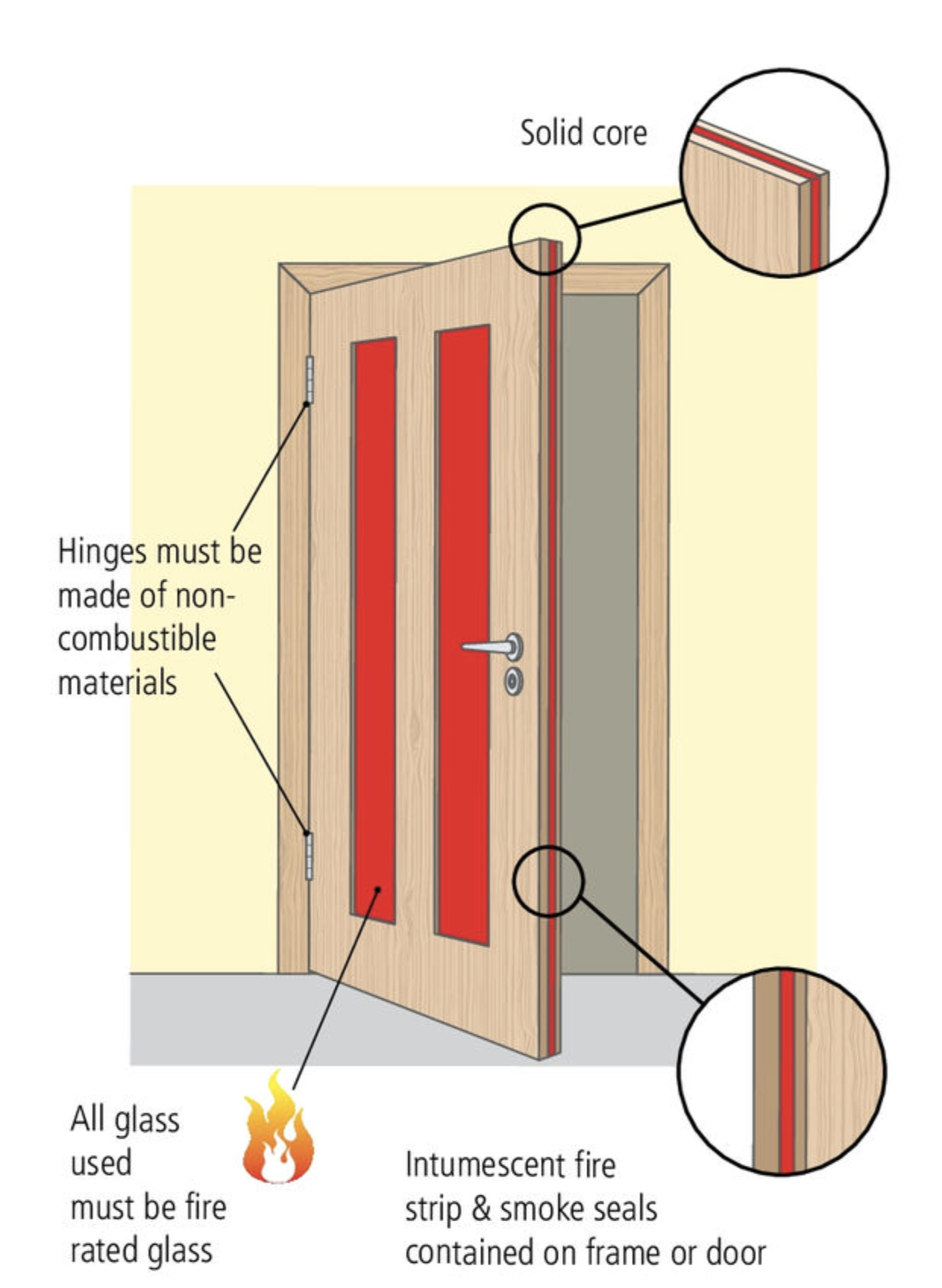
Fire door construction must meet strict standards to ensure effectiveness:
- Core materials: Include gypsum, steel, fire-retardant particle board, fibreglass, and specially treated timber
- Hardware: All hinges must be manufactured from non-combustible materials
- Glazing: Any glass components must be fire-rated glass specifically designed for fire door applications
- Sealing systems: Intumescent strips are built into either the door frame or door itself
Intumescent strips
These specialised sealing strips expand when exposed to high temperatures, creating an effective seal between the door and frame. This expansion serves two critical functions:
- Prevents oxygen from entering the room, which would fuel the fire
- Stops smoke from penetrating into adjoining areas
The strips are designed to activate automatically when temperatures reach dangerous levels, providing passive fire protection without requiring human intervention.
Summary
Key Points to Remember:
- Internal doors use softwood construction since they don't need weather protection like external doors
- Flush doors appear similar externally but vary significantly in internal construction - solid core offers maximum strength whilst hollow core provides adequate strength at lower weight
- Fire doors are classified by protection time - the FD number indicates minutes of fire resistance provided
- Sliding doors save space and require minimal maintenance, just keeping tracks clear of debris
- Intumescent strips automatically expand in high temperatures to seal gaps and prevent fire spread