Vanising points of inclined lines (Leaving Cert DCG): Revision Notes
📚Revision Notes
Vanising Points of Inclined Lines
Understanding inclined line projections
When we work with perspective drawing, we need to understand that different types of lines behave differently. Whilst horizontal lines that run parallel to each other will converge at vanishing points on the horizon line, inclined lines follow a different set of rules.
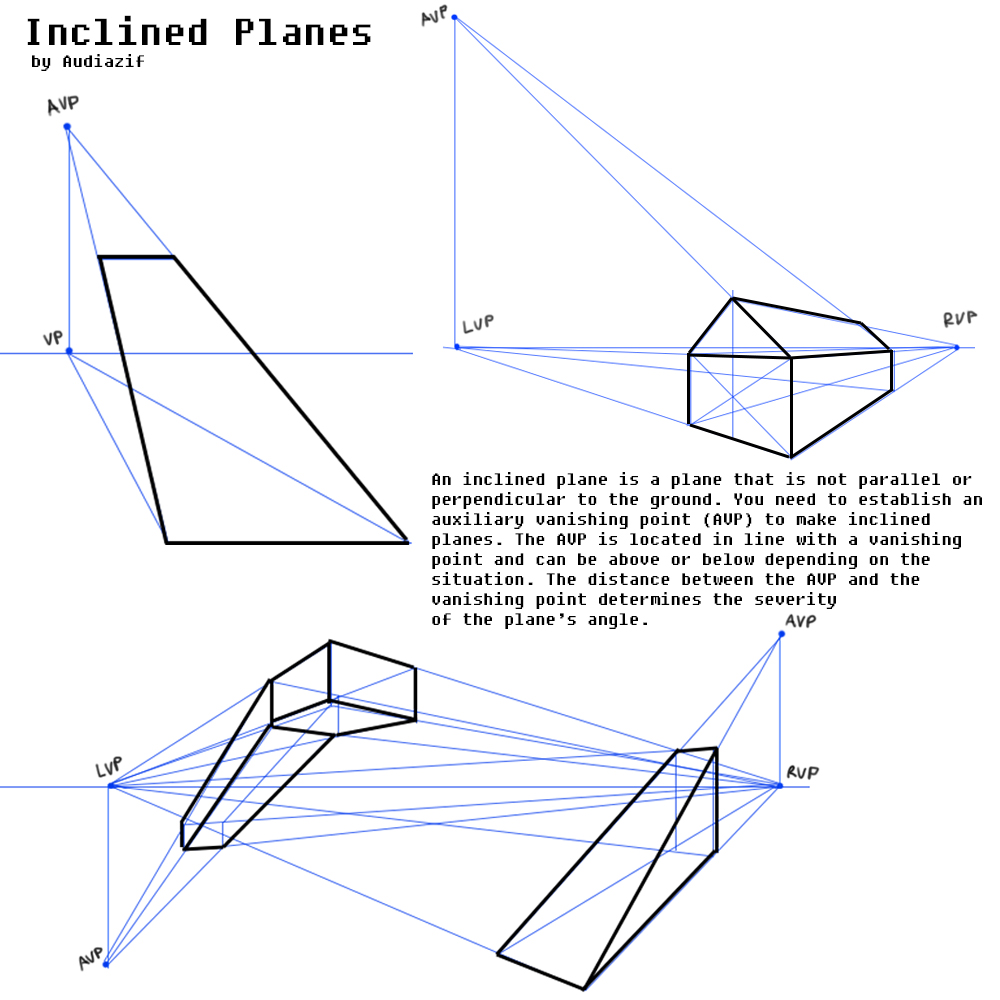
Inclined lines are lines that slope either upwards or downwards as they move away from the viewer. These lines create their own special vanishing points, which are called auxiliary vanishing points.
Note
The distinction between horizontal and inclined lines is fundamental to understanding perspective drawing. While horizontal lines follow the familiar rules of converging to vanishing points on the horizon line, inclined lines require their own separate system of vanishing points.
How auxiliary vanishing points work
The key principle for inclined lines is straightforward but crucial to remember:
Important
Lines sloping upwards as they move away from the spectator will have their auxiliary vanishing point above the horizon line.
Lines sloping downwards as they move away from the spectator will have their auxiliary vanishing point below the horizon line.
This creates a system where we can have multiple vanishing points in a single perspective drawing - some on the horizon line for horizontal edges, and others above or below the horizon line for inclined edges.
Practical application in drawing
When you're creating a perspective drawing that includes inclined surfaces or tilted objects, you'll need to:
Example
Step-by-Step Process for Drawing Inclined Lines:
- Identify which lines are horizontal (these go to vanishing points on the horizon)
- Determine which lines are sloping upwards or downwards
- Place auxiliary vanishing points accordingly - above the horizon for upward slopes, below for downward slopes
- Draw your inclined lines so they converge towards these auxiliary points
The relationship between parallel lines
Just like with horizontal lines, parallel inclined lines will all converge to the same vanishing point. This means that if you have several edges on an object that are all sloping at the same angle, they will all meet at the same auxiliary vanishing point.
Note
The spectator's position (marked as point S in technical drawings) determines how these vanishing points are positioned and how the perspective appears. Understanding the viewer's relationship to the subject is crucial for accurate perspective construction.
Exam tips for perspective drawing
Summary
Key Strategies for Success:
- Always establish your horizon line first
- Identify whether each edge is horizontal or inclined before drawing
- Use construction lines to find your auxiliary vanishing points
- Remember that parallel lines always share the same vanishing point
- Check that upward-sloping lines converge above the horizon, and downward-sloping lines converge below the horizon
Remember!
Summary
Essential Points to Remember:
- Inclined lines have their own vanishing points called auxiliary vanishing points
- Upward-sloping lines converge to points above the horizon line
- Downward-sloping lines converge to points below the horizon line
- Parallel inclined lines share the same auxiliary vanishing point
- This system allows for complex three-dimensional objects to be drawn accurately in perspective