Tone (Leaving Cert DCG): Revision Notes
📚Revision Notes
Tone
What is tone in drawing?
Tone refers to the lightness or darkness of surfaces and objects in your drawings. While lines are essential for creating outlines, shapes, and contours, they alone cannot fully capture all the visual qualities that make drawings look realistic and three-dimensional.
Note
Lines are fundamental to drawing, but they have limitations. Certain visual qualities of surfaces - like how light reflects off them or how they curve away from the viewer - require tonal techniques to represent effectively.
Understanding tone is crucial because it helps you represent how light falls on different surfaces, creating the illusion of depth and making your drawings appear more lifelike. Through careful use of tonal values, you can show the difference between a bright, illuminated surface and a dark, shadowed area.
Why tone matters in freehand drawing
When you look at objects in real life, you can see how light creates patterns of brightness and darkness across their surfaces. This interplay of light and shadow is what gives objects their three-dimensional appearance. In drawing, we recreate this effect using different tones.
Note
Tone allows you to:
- Show the three-dimensional form of objects
- Indicate the direction and quality of light sources
- Create depth and space in your drawings
- Distinguish between different surfaces and textures
- Make your drawings more realistic and engaging
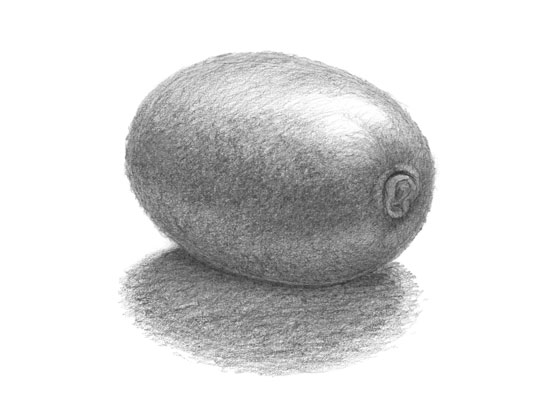
The fruit drawings above demonstrate how tone can transform simple outline drawings into realistic representations.
Practical applications
Understanding tone is essential for creating convincing representations of everyday objects. Whether you're drawing geometric shapes like cubes and cylinders or organic forms like fruit, the principles remain the same.
The plum drawing demonstrates how tone can be used to show the smooth, rounded surface of fruit. Notice how the darkest areas are in the shadows, while the lightest areas catch the most light.
Note
Exam Tips for Tone Work:
- Practice your hatching techniques regularly to develop smooth, consistent strokes
- Study real objects under different lighting conditions to understand how tone works
- Start with simple geometric shapes before moving to complex objects
- Remember that tone is relative - what appears dark in one area might be light compared to another
- Don't rush - building up tone takes time and patience
Summary
Key Points to Remember:
- Tone creates dimension: It transforms flat outlines into three-dimensional objects
- Four key techniques: Hatching, crosshatching, scribbling, and stippling are your main tools
- Control through variation: Change line spacing and darkness to achieve different tones
- Practice makes perfect: Regular sketching helps develop smooth, confident hatching strokes
- Observe real life: Study how light falls on objects around you to improve your tonal work