Focal Sphere (Leaving Cert DCG): Revision Notes
📚Revision Notes
Focal Sphere for a Hyperbola
Understanding hyperbolas and focal spheres
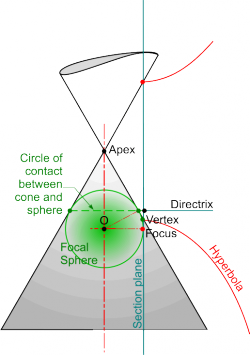
The focal sphere is a fundamental concept in conic sections, specifically when studying hyperbolas. When we create a hyperbola by cutting a cone with a plane, we can construct a special sphere that has unique geometric properties essential for understanding the hyperbola's formation and characteristics.
Note
The focal sphere concept bridges the gap between theoretical conic section mathematics and practical geometric construction, making it an essential tool for understanding three-dimensional geometric relationships.
What creates a hyperbola?
A hyperbola is formed when a cone is cut by a cutting plane in a specific way. The angle of the base (angle A) must be greater than 90°, and the angle of the axis of the cone (angle B) falls between and the angle of the side of the cone. This cutting method only intersects one side of the cone, no matter how far we extend the cone and plane.
The key feature is that the cutting plane cuts through the cone at such an angle that it creates the characteristic hyperbolic curve with its distinctive twin-branch shape.
Note
Unlike other conic sections, the hyperbola's unique formation requires the cutting plane to intersect only one nappe (side) of the cone, which is why the angle relationships are so critical to understand.
The focal sphere explained
Important
Definition of Focal Sphere:
The focal sphere is a specially positioned sphere with very precise geometric properties. Its position and size are determined so that it maintains tangential contact with both the cone's surface and the cutting plane simultaneously.
Essential properties of the focal sphere:
- Perfect fit: The sphere fits exactly into the upper portion of the cone
- Tangential contact: It touches the cutting plane at precisely one point
- Element relationships: All elements (the straight lines that form the cone's surface) are tangent to the sphere
- Unique positioning: The sphere's location creates specific intersection patterns that help define the hyperbola's geometric properties
The focal sphere creates a fundamental relationship where every element of the cone maintains tangency with the sphere, while the sphere simultaneously touches the cutting plane at a single point of contact.
Construction process
Example
Worked Example: Constructing Hyperbolas Using Focal Sphere Principles
The construction of hyperbolas using focal sphere principles follows a systematic approach:
Step 1: Initial setup Draw the plan view, elevation view, elements, and cutting plane with accurate proportions and angles.
Step 2: Auxiliary view creation Project the auxiliary view perpendicular to the cutting plane to show the true shape of the intersection.
Step 3: Element intersection analysis Identify and mark points where the cutting plane crosses the cone's elements, then project these points appropriately.
Step 4: Final construction Transfer width measurements from the plan view as needed to complete the hyperbola construction accurately.
Geometric relationships in focal spheres
The focal sphere creates several important geometric relationships that are crucial for accurate hyperbola construction.
Note
Understanding Tangential Properties
The sphere maintains tangent relationships with both the cone's sides and the cutting plane. This dual tangency is what makes the focal sphere so geometrically significant in conic section theory.
Element interactions: Every element of the cone is tangent to the focal sphere. This means that all the straight lines forming the cone's surface touch the sphere at specific points.
Intersection planes: The plane passing through the sphere and containing all the contact points between the sphere and cone creates crucial reference geometry when it intersects with the cutting plane.
These relationships ensure that the hyperbola maintains its precise mathematical properties and can be constructed accurately using geometric methods.
Practical applications
Understanding focal spheres is essential for several practical applications in technical drawing and engineering:
- Technical drawing accuracy: Enables precise construction of hyperbolic curves in engineering drawings
- Three-dimensional visualisation: Helps students understand complex spatial relationships in conic sections
- Problem-solving: Provides tools for solving geometric problems involving tangent planes and curved surfaces
- Engineering applications: Essential for designs involving hyperbolic shapes, such as cooling towers, satellite dishes, and architectural elements
Note
The principles learned through focal sphere construction translate directly to real-world applications where hyperbolic surfaces are used for their unique structural and optical properties.
Key takeaways
Summary
Key Points to Remember:
- The focal sphere has one unique property: it's tangent to both the cone's surface AND the cutting plane
- It fits perfectly into the cone's upper section while touching the cutting plane at exactly one point
- Every element (generator line) of the cone is tangent to the focal sphere
- The construction process follows similar principles to other conic sections but requires careful attention to tangential relationships
- Understanding focal spheres is crucial for accurate hyperbola construction and solving complex geometric problems involving conic sections