The Tetrahedron (Leaving Cert DCG): Revision Notes
📚Revision Notes
The Tetrahedron
What is a tetrahedron?
A tetrahedron is the most basic three-dimensional shape you can create. It's the simplest type of polyhedron, which means it's made up of flat surfaces called faces. Think of it as a pyramid with a triangular base - but all four faces are identical equilateral triangles.
Key properties of a regular tetrahedron:
- 4 faces - all equilateral triangles
- 4 vertices - corner points where edges meet
- 6 edges - lines where two faces join together
Important
This makes it the only polyhedron where every face, edge, and vertex is exactly the same as every other one.
Note
The tetrahedron belongs to the family of Platonic solids - the five regular polyhedra that have been studied since ancient times. Its perfect symmetry makes it fundamental to understanding 3D geometry.
Constructing a tetrahedron
When drawing a tetrahedron in technical drawing, you need to show it using orthographic projection. This means creating different 2D views that together represent the 3D shape.
Example
Construction Steps: Drawing a Tetrahedron
- Start by drawing the plan view, which shows the tetrahedron from above as an equilateral triangle
- Use this triangle to locate each vertex point accurately
- Draw the front elevation by projecting lines upward from the plan view
- Create the end elevation by projecting lines across from the front view
- Connect the vertices in each view to complete the tetrahedron's outline
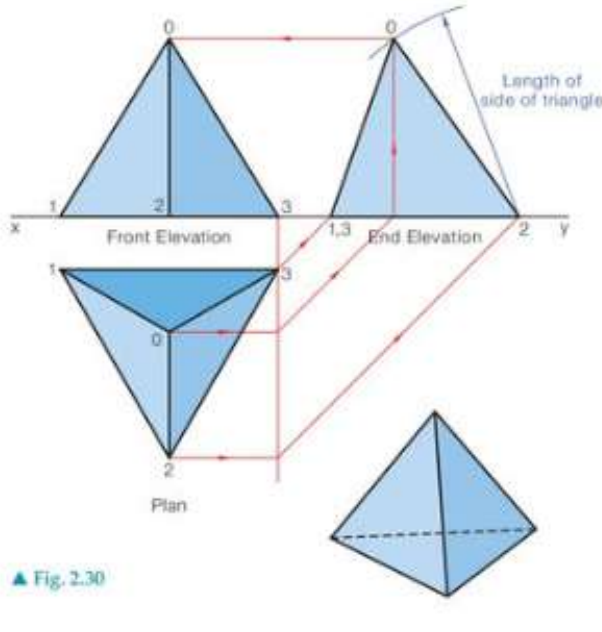
The construction requires careful attention to projection lines that connect the different views. These lines ensure that your tetrahedron is geometrically correct and that all dimensions match between the plan, front elevation, and end elevation.
Note
Accurate projection is crucial - any errors in your projection lines will result in a distorted tetrahedron that doesn't maintain the proper proportions of equilateral triangular faces.
Understanding duality
The tetrahedron has a special property called self-duality. This means it has a unique relationship with itself that no other polyhedron possesses.
Here's how duality works with tetrahedrons:
- If you find the centre point (centroid) of each triangular face
- Then connect these centre points to their neighbouring centre points
- You create another tetrahedron inside the original one
Important
This new tetrahedron has the same shape and proportions as the original - just smaller and rotated. The tetrahedron is the only 3D shape that creates an identical copy of itself through this process.
Inscribed and circumscribed spheres
One of the most important geometric relationships for tetrahedrons involves spheres. Every tetrahedron can have both an inscribed sphere (inside the shape) and a circumscribed sphere (outside the shape), and these spheres share the same centre point.
The inscribed sphere:
- Fits perfectly inside the tetrahedron
- Touches all four triangular faces
- Its centre is equidistant from all faces
The circumscribed sphere:
- Contains the entire tetrahedron
- Passes through all four vertices
- Its centre is equidistant from all vertices
Example
Construction Method: Drawing Both Spheres
- Draw orthographic views of the tetrahedron showing two faces at edge views
- Draw perpendiculars from the apex and bisect the two edge view faces
- Where the perpendiculars intersect marks the common centre point
- From this centre, draw both spheres - the inscribed sphere touching the faces, and the circumscribed sphere passing through the vertices
Important
This shared centre point is a unique property that makes tetrahedron calculations much simpler than other polyhedrons.
Exam tips
Note
Essential Study Points:
- Remember the numbers: 4 faces, 4 vertices, 6 edges - these are frequently tested
- Practice construction: You need to be able to draw tetrahedrons in orthographic projection accurately
- Understand duality: Be able to explain why the tetrahedron is self-dual
- Sphere relationships: Know that both inscribed and circumscribed spheres have the same centre
Remember!
Summary
Key Points to Remember:
- The tetrahedron is the simplest possible 3D shape with only 4 triangular faces, 4 vertices, and 6 edges
- It's the only polyhedron that is self-dual, meaning you can create an identical tetrahedron by connecting the centres of its faces
- Construction requires careful use of orthographic projection with plan view, front elevation, and end elevation
- The inscribed and circumscribed spheres always share the same centre point, making calculations easier
- All faces must be equilateral triangles for a regular tetrahedron