Double-curved Surfaces (Leaving Cert DCG): Revision Notes
📚Revision Notes
Double-curved Surfaces
What are double-curved surfaces?
Double-curved surfaces are three-dimensional shapes that curve in more than one direction. These surfaces are created when a curved line moves according to specific mathematical rules. The most common way to form these surfaces is by rotating a curve around an axis within a single plane.

Note
These surfaces are fundamental in engineering, architecture, and design because they appear frequently in real-world applications - from domes and spheres to complex architectural forms.
Types of double-curved surfaces
There are six main types of double-curved surfaces that you need to understand for your exam:
Sphere
A sphere is formed by rotating a semicircle around its diameter. Every point on the surface is the same distance from the centre. Think of a football or globe - these are perfect examples of spherical surfaces.
Torus
A torus has a distinctive doughnut shape. It's created by rotating a circle around an axis that doesn't pass through the circle itself. The result is a surface with a hole through the middle.
Oblate ellipsoid
An oblate ellipsoid looks like a flattened sphere - wider than it is tall. It's formed by rotating an ellipse around its shorter axis. The Earth is actually an oblate ellipsoid, slightly flattened at the poles.
Note
The Earth's oblate ellipsoid shape is caused by its rotation, which creates centrifugal forces that flatten it at the poles and bulge it at the equator.
Prolate ellipsoid
A prolate ellipsoid is the opposite of an oblate ellipsoid - it's taller than it is wide, like a rugby ball. This shape is created by rotating an ellipse around its longer axis.
Paraboloid
A paraboloid has a distinctive bowl or dome shape. It's formed by rotating a parabola around its axis. You'll see this shape in satellite dishes and some architectural domes.
Hyperboloid
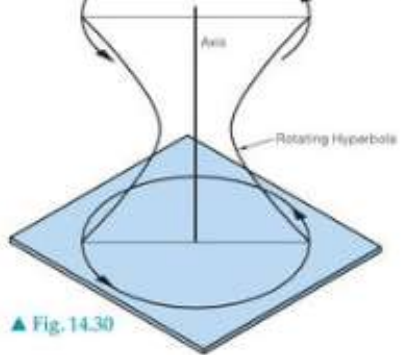
A hyperboloid has a distinctive waisted or saddle-like appearance. It's created by rotating a hyperbola around an axis. This creates an interesting shape that appears to curve inward in the middle.
Hyperboloid of revolution
The hyperboloid of revolution deserves special attention because it has unique properties that make it important in engineering and architecture.
Formation and characteristics
Important
A hyperboloid of revolution is what we call a ruled surface. This means you can draw straight lines across its curved surface - a fascinating property that seems contradictory but is mathematically true.
The surface is generated by revolving a straight line around another line that runs parallel to it but doesn't intersect with it. As the straight line rotates around this axis, it creates the characteristic waisted shape.
Key features
When you look at a hyperboloid of revolution from the side, the curves you see are called hyperbolas. The narrowest part of the surface is called the throat - this is where the surface curves inward most dramatically.
Note
Remarkable Properties of Hyperboloids:
The surface has some remarkable properties that make it unique among double-curved surfaces:
- It becomes more cylindrical as you move away from the throat
- At the throat circle, the surface reaches its minimum radius
- You can construct it by rotating either one arm or both arms of a double hyperbola around what's called the conjugate axis
Construction methods
There are two main ways to construct a hyperboloid of revolution:
Example
Construction Methods for Hyperboloids:
Method 1 - Straight line method: Revolve a straight line around a non-parallel, non-intersecting axis
Method 2 - Hyperbola method: Rotate one or both arms of a double hyperbola around the conjugate axis
Important
This dual construction method makes the hyperboloid particularly interesting for engineers, as they can use straight structural elements to create curved surfaces.
Summary
Key Points to Remember:
-
Six main types: Sphere, torus, oblate ellipsoid, prolate ellipsoid, paraboloid, and hyperboloid - each formed by rotating different curves around an axis
-
Formation principle: Double-curved surfaces are created by moving curved lines according to mathematical laws, most commonly by rotation around an axis
-
Hyperboloid is special: It's a ruled surface, meaning you can draw straight lines on its curved surface - making it useful for structural engineering
-
Throat is key: The narrowest part of a hyperboloid is called the throat, and the surface becomes more cylindrical as you move away from it
-
Real-world applications: These surfaces appear everywhere in engineering and architecture, from satellite dishes (paraboloids) to cooling towers (hyperboloids)