Market Structures (Leaving Cert Economics): Revision Notes
Market Structures

Why economists use market structures
Market structures are economic models that help us understand how firms and consumers interact in different types of markets. While these models simplify real-world complexity, they serve several crucial purposes for economists and policymakers.
These theoretical frameworks allow economists to analyse how firms make pricing and output decisions in various competitive environments. By understanding different market structures, economists can predict how businesses and consumers will behave under different conditions. This analysis helps identify potential causes of market failure - situations where markets don't allocate resources efficiently.
Market structure models provide a valuable framework for understanding economic behaviour, even though real-world markets rarely match theoretical models perfectly. The simplification allows for clearer analysis and policy recommendations.
Market structure models also provide valuable insights for policymakers. When economists compare real-world markets to these theoretical models, they can determine whether regulation is needed to reduce monopoly power and promote fairer competition. For example, if a market closely resembles a monopoly structure, regulators might intervene to protect consumer interests.
Main types of market structure
Perfect competition
Perfect competition represents the theoretical ideal of market efficiency. This structure includes several key characteristics that create intense competitive pressure.
In perfectly competitive markets, there are many buyers and sellers, meaning no single participant can influence market outcomes. All firms sell homogeneous (identical) products, so consumers see no difference between competitors' offerings. The market features free entry and exit, allowing new firms to join easily and unsuccessful firms to leave without significant costs.
Perfect information means all market participants have complete knowledge about prices, quality, and availability. Most importantly, all firms are price takers - they must accept the market price and cannot influence it through their individual actions.
Critical Limitation of Perfect Competition
While theoretically efficient, perfect competition rarely exists in reality - agriculture comes closest to this model. The structure ignores important factors like product variety and innovation, which benefit consumers in real markets.
Monopolistic competition
Monopolistic competition combines elements of both competition and monopoly. This structure is common in retail and service industries like restaurants, clothing stores, and hairdressers.
The market contains many firms, but each produces slightly differentiated products. This differentiation might involve quality, style, location, or brand image. Free entry and exit exists in the long run, though it may take time for new competitors to establish themselves.
Firms enjoy some degree of brand loyalty from customers who prefer their specific product variant. This loyalty gives firms limited price-making power - they can charge slightly higher prices than competitors without losing all customers.
The Efficiency vs. Variety Trade-off
While monopolistic competition appears inefficient in the long run due to excess capacity and advertising costs, consumers benefit significantly from the product variety this structure provides. The trade-off between efficiency and variety often favours consumer welfare.
Oligopoly
Oligopoly markets are dominated by a few large firms that must carefully watch each other's actions. This interdependence means each firm's decisions directly affect competitors' profits and market share.
Barriers to entry are typically high, often due to brand loyalty, economies of scale, or significant capital requirements. These barriers protect existing firms from new competition. Non-price competition through advertising, innovation, and customer service becomes crucial for maintaining market position.
Oligopoly Risks and Benefits
The oligopoly structure presents both risks and benefits. Firms may engage in collusion or form cartels to fix prices, leading to higher prices and reduced consumer choice. However, intense competition between oligopolists can drive innovation - as seen in smartphones and airline industries.
Monopoly
A monopoly exists when a single seller dominates the entire market for a particular product or service. The monopolist sells a unique product with no close substitutes, giving consumers few alternatives.
High barriers to entry prevent competitors from entering the market. The monopolist becomes a price maker, with significant power to set prices above competitive levels.
Monopolies can lead to inefficiency through higher prices and lower output than would exist in competitive markets. Unregulated monopolists may exploit consumers by charging excessive prices. However, natural monopolies in industries like water supply or electricity networks may actually be more efficient when operated by a single firm due to enormous economies of scale.
Changes in demand or supply
Regardless of market structure, changes in demand or supply affect equilibrium price and quantity. However, the magnitude and distribution of these effects vary significantly across different structures.
Oligopoly Example: Irish Airlines
Consider increased demand for flights in an oligopolistic airline industry like Ireland's (dominated by Ryanair and Aer Lingus). Higher demand leads to both increased prices and higher output as airlines can raise fares while expanding services.
Perfect Competition Example: Wheat Market
Contrast this with a supply shock in a near-perfectly competitive market like wheat farming. If a poor harvest reduces wheat supply, prices rise sharply but output falls because individual farmers cannot significantly increase production in the short term.
Graphical representations
Perfect competition
In perfect competition, firms face unique profit scenarios in different time periods. During the short run, firms can earn supernormal profits or losses depending on market conditions and their cost structure.
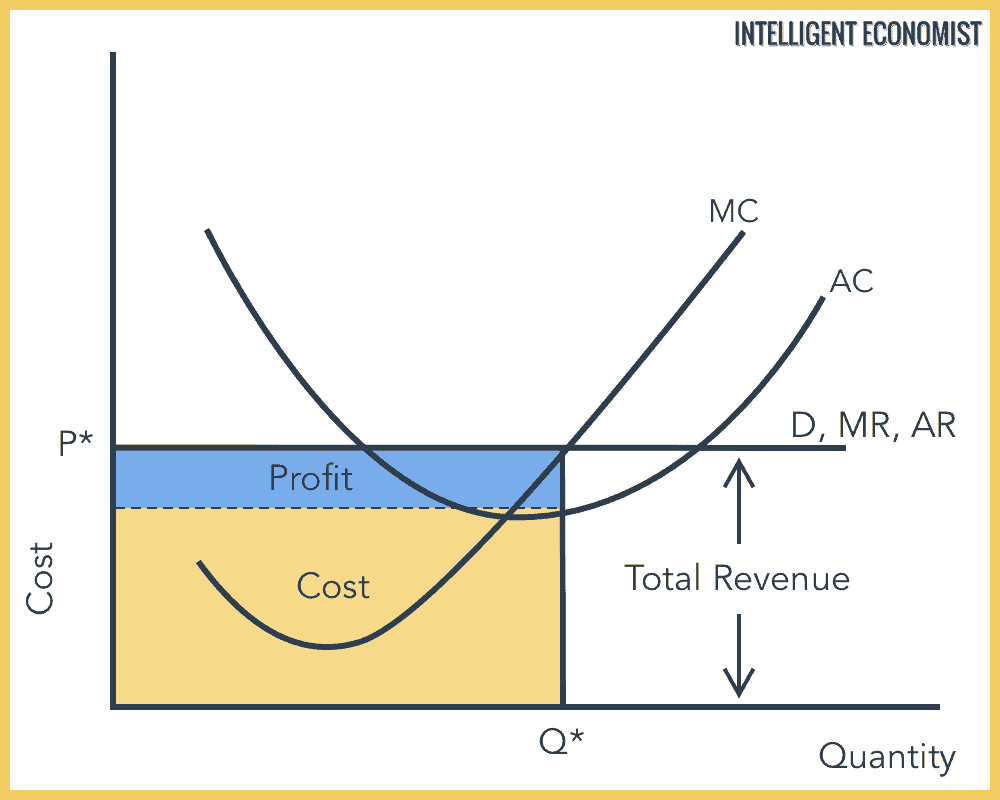
However, the long run tells a different story. Only normal profit remains as new firms enter profitable markets, driving prices down, while unprofitable firms exit, allowing prices to recover.
Monopoly
Monopoly profit maximisation occurs where MR = MC - the same rule followed by all profit-seeking firms. However, monopolists can set prices above marginal cost, creating allocative inefficiency.
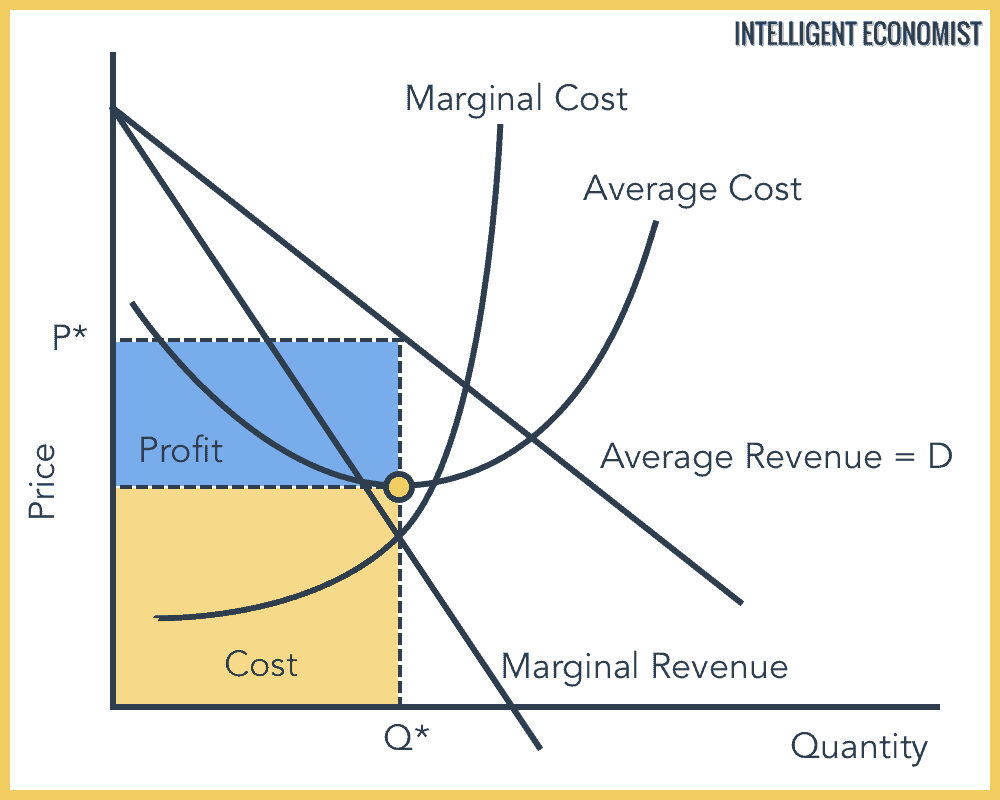
Unlike competitive firms, monopolists can earn supernormal profits in both short and long run because high barriers prevent new competitors from entering the market.
Monopolistic competition
Monopolistic competition shows similarities to both previous structures. In the short run, firms can earn supernormal profits through successful product differentiation or marketing.
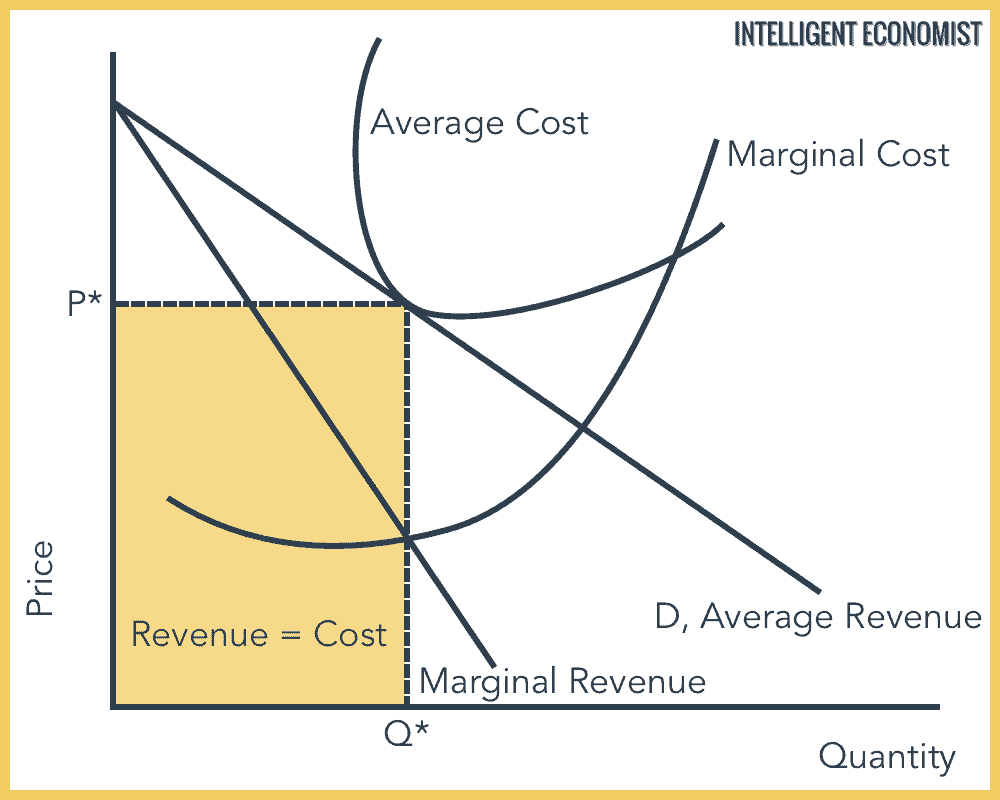
The long run resembles perfect competition as entry of new firms eliminates supernormal profits, leaving only normal profit for surviving businesses.
Profit maximisation
Universal Profit Maximisation Rule
The fundamental profit maximisation condition is MR = MC across all market structures. However, the implications differ dramatically depending on competitive conditions.
In perfect competition, this equilibrium occurs where the supply curve (representing marginal cost) intersects the demand curve (representing both average and marginal revenue). This intersection ensures allocative efficiency.
In monopoly, firms deliberately restrict output below the socially efficient level to maintain higher prices. The monopolist produces where MR = MC, but since marginal revenue lies below the demand curve, price exceeds marginal cost, creating inefficiency.
Economies of scale, competition and market power
Market structure directly influences the relationship between firm size, efficiency, and market outcomes. Perfect competition assumes many small firms with no market power, resulting in low prices and high output.
Monopoly represents the opposite extreme - one firm with high market power leading to higher prices and lower output. The monopolist restricts supply to maintain profitable pricing.
Oligopoly outcomes depend critically on firm behaviour. If firms collude, results resemble monopoly outcomes. If they compete aggressively, outcomes move closer to competitive levels.
Key Market Concentration Insight
The key insight is that more concentrated markets create greater risk of higher prices and reduced consumer welfare. This relationship drives much competition policy around the world.
Measuring market concentration
Regulators use several tools to assess market concentration and potential competition problems.
Concentration ratios measure the market share of the top firms in an industry. For example, a CR4 ratio shows the combined market share of the four largest firms. Higher ratios indicate more concentrated markets.
The Herfindahl-Hirschman Index (HHI) provides a more sophisticated measure. It calculates the sum of squares of all firms' market shares. The formula is:
where represents each firm's market share percentage.
HHI ranges from close to 0 (competitive market) to 10,000 (pure monopoly).
HHI Calculation Example
If three firms control 50%, 30%, and 20% of a market:
Step 1: Square each market share
- Firm 1:
- Firm 2:
- Firm 3:
Step 2: Sum the squares
This indicates high concentration, suggesting potential competition concerns.
Regulators use these measures to assess whether markets need intervention to protect consumer interests.
Competition regulation in Ireland and EU
High concentration can harm consumers through higher prices, reduced product choice, and stifled innovation. This creates a strong case for regulatory intervention.
Irish regulation falls under the Competition and Consumer Protection Commission (CCPC), which monitors market concentration and investigates anti-competitive practices in domestic markets.
EU regulation provides broader oversight through the European Commission, which investigates anti-competitive practices and reviews large mergers that might harm competition across member states.
Case Study: Irish Banking Market
The Irish banking market shows high concentration with three major players (AIB, Bank of Ireland, PTSB), raising ongoing concerns about lack of competition and consumer choice.
Case Study: EU vs Google (2018)
The European Commission imposed a €4.3 billion fine on Google for abusing market dominance in mobile search and advertising, demonstrating regulatory willingness to challenge even global technology giants.
Case Study: Ryanair-Aer Lingus Merger (2013)
The proposed merger was blocked by EU authorities on grounds that it would reduce competition in Irish air travel, protecting consumer interests in the domestic market.
Exam tips
Essential Exam Strategies
When tackling market structure questions, always define the structure before describing its features. This demonstrates clear understanding and provides a strong foundation for your answer.
Key Requirements:
- Diagrams are essential for higher marks - practice drawing carefully labelled graphs for perfect competition, monopoly, and monopolistic competition
- When comparing structures, highlight differences in output, price, and efficiency
- For HHI calculations, show each step clearly and interpret whether the market is competitive or concentrated
- Use Irish and EU case studies to demonstrate applied knowledge and earn higher evaluation marks
Success Tip: Real-world examples show you understand how theory connects to practice.
Remember!
Key Points to Remember
- Market structures help economists analyse pricing, efficiency, and competition in different competitive environments
- Perfect competition is efficient but rare in reality - agriculture provides the closest real-world example
- Monopolistic competition offers variety but creates long-run inefficiency through excess capacity and advertising costs
- Oligopoly interdependence can lead to collusion or intense competition depending on firm strategies
- Monopoly creates high prices and low output but may be efficient for natural monopolies like utilities
- MR = MC is the universal profit maximisation rule across all market structures
- Concentration measures (HHI, CR) help regulators assess market power and protect consumer welfare