Mass Movement (Leaving Cert Geography): Revision Notes
📚Revision Notes
Classification of Mass Movement
Mass movement involves the downhill transport of rock, soil and other loose materials under the influence of gravity. Understanding how these movements are classified helps us predict their behaviour and potential dangers to human activities.
Overview of mass movement types
Mass movement can be organised into four main categories based on the type of movement that occurs:
- Creeps - very slow movement of soil particles
- Slides - movement along distinct failure surfaces
- Flows - fluid-like movement of saturated materials
- Falls - rapid movement through the air on steep slopes
Note
The speed of movement varies greatly, from extremely slow soil creep at 0.5 cm per year to rapid avalanches reaching speeds over 300 km/h. Speed depends on factors such as slope angle, water content, vegetation cover, and the type of material involved.
Creeps
Soil creep
Important
Soil creep is the slowest type of mass movement, occurring on gentle slopes greater than 5 degrees. It typically happens at rates between 10-15 degrees slope angle.
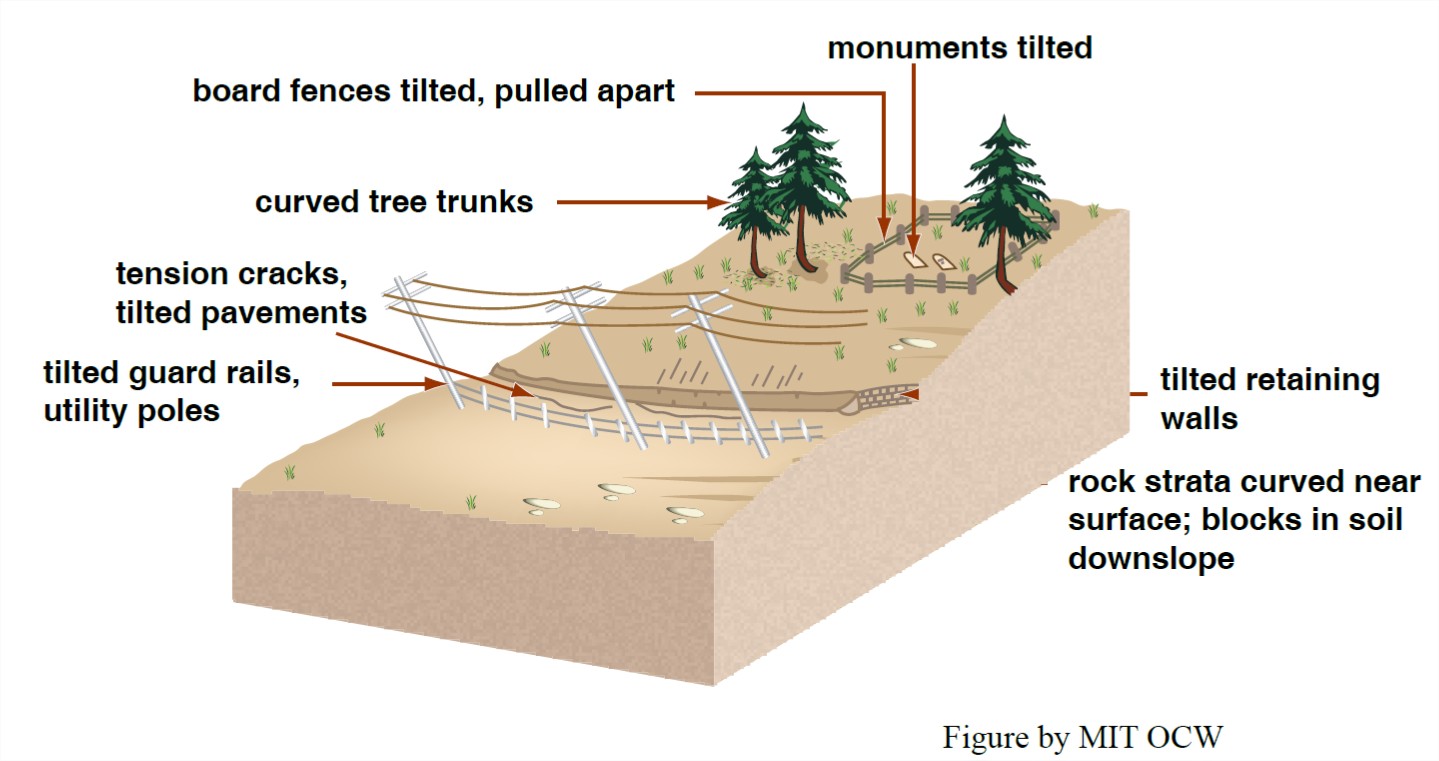
Soil creep occurs through two main processes that work together to gradually move particles downhill. The first process is freeze-thaw action, which happens when water in the soil freezes and expands by 9%, pushing soil particles upward. When the ice melts, gravity pulls these particles back down, but slightly further downhill than their original position.
The second process involves wetting and drying cycles. During rainfall, soil absorbs water and expands, pushing particles upward. When the soil dries, it shrinks and the particles sink back down under gravity's influence, again settling slightly further downslope.
Note
These processes are particularly common in Ireland due to our cool, wet climate with frequent rainfall and regular freeze-thaw cycles throughout winter months. The West of Ireland experiences some of the highest rates of soil creep, reaching maximum speeds of 0.5 cm per year.
Evidence of soil creep includes:
- Terracettes - small ridges that form parallel across slopes, creating a stepped appearance
- Tilted objects - trees, telephone poles, and fences lean downslope over time
- Curved tree trunks - trees continue growing vertically after being tilted, creating bent shapes
- Bulging walls - stone walls and retaining structures bow outward due to soil pressure
Vegetation cover significantly slows soil creep because plant roots bind the soil together, reducing the movement of individual particles.
Slides
Rockslides
Rockslides happen when large sections of rock break away and slide down slopes along distinct fracture lines. These fractures often develop along the bedding planes of sedimentary rocks, which are natural weak points in the rock structure.
Heavy rainfall can accelerate rockslides by acting as a lubricant, reducing friction between the bedrock and overlying material. This allows the loose rock to move more quickly and can lead to serious consequences for nearby settlements.
Example
Case Study: Vaiont Disaster, Italy 1963
The Vaiont rockslide demonstrates how human activities can trigger catastrophic mass movement. Engineers built a 260-metre high dam across the narrow Vaiont Valley to generate hydroelectric power. The valley contained sloping layers of sedimentary rock that naturally tilted towards the new reservoir.
As the reservoir filled, water saturated the clay soil overlying the bedrock. This saturation acted as a lubricant, allowing a massive section of the mountainside to slide into the water. Although the rockslide itself caused no direct fatalities, it displaced enormous volumes of water, creating a 250-metre high tsunami wave that destroyed towns in the valley below and killed over 2,600 people. This tragedy is considered a major engineering disaster that could have been prevented with better geological assessment.
Slumping
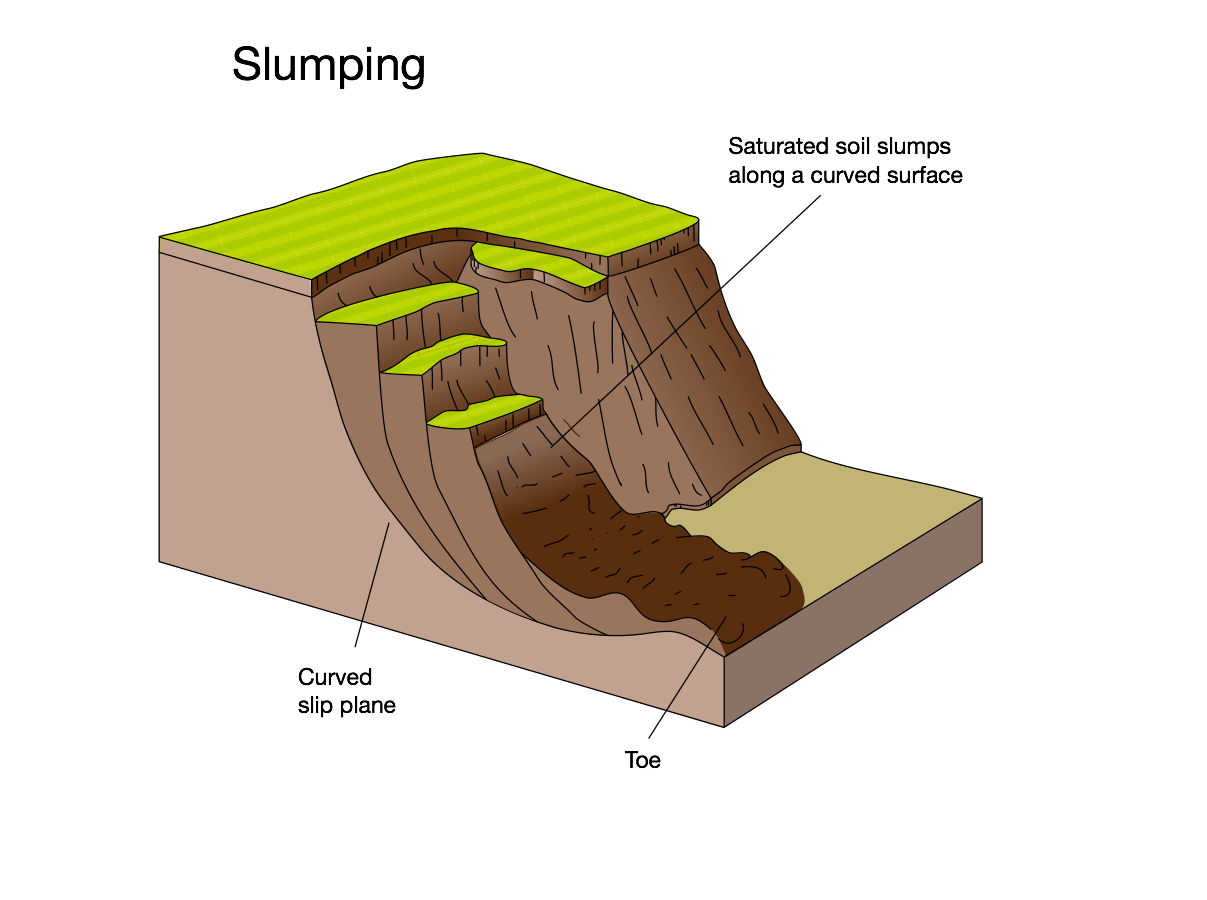
Slumping typically occurs on steep slopes when large blocks of regolith break away and move downward in a rotational motion. The movement follows an inward-curving surface, similar to the shape of a spoon, which is why it's sometimes called a rotational slide.
Note
Slumping often happens when the base of a slope is removed through weathering or human activities such as road construction. This removal leaves the upper portion of the slope unsupported, causing it to slide downward and outward under gravity's influence.
This type of mass movement commonly occurs on unconsolidated materials like sand, gravel, or boulder clay. It's particularly evident along coastlines and river banks where moving water causes undercutting at the slope's base. In Ireland, slumping is frequently observed along boulder-clay cliffs such as those at Cregg Beach in County Clare.
Flows
Earthflows
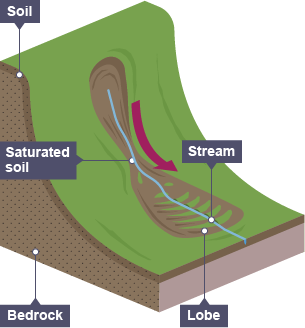
Earthflows are localised events that typically affect individual hills and valleys following periods of heavy rainfall. These movements occur on slopes composed of loose, weathered rock and soil that sit above an impermeable layer such as shale bedrock.
When heavy rain falls, water cannot drain through the impermeable rock layer, causing the overlying soil to become saturated. This high water content acts as a lubricant, allowing the saturated material to flow downslope like a thick liquid.
Important
Earthflows can also develop when forest cover is removed from hillsides. Tree removal eliminates the root systems that normally bind soil particles together and removes the protective canopy that shields soil from direct rainfall and weathering.
The speed of earthflows varies depending on water content and vegetation cover. While typically slow-moving and not dangerous to human life, they can cause significant damage to roads, property, and infrastructure. Evidence of earthflows includes small bulges in the landscape and areas where vegetation appears torn or disturbed.
Mudflows and lahars
Mudflows develop when regolith becomes severely saturated, containing more than 30% water content. At this saturation level, the material takes on fluid-like properties and can flow down slopes at speeds reaching 80 km/h.
The speed of mudflow depends on its water content and the amount of debris it collects. Higher water content creates lower viscosity, allowing the flow to move faster over longer distances. As mudflows travel downslope, they pick up additional debris including trees, rocks, and human-made structures, which increases their destructive power.
Note
Lahars represent the most dangerous type of mudflow, occurring in association with volcanic activity. When volcanic eruptions emit hot ash and lava onto snow-covered mountain slopes, the intense heat melts the snow rapidly. This meltwater mixes with the volcanic ash and lava to create boiling mud that flows down the mountainside at extremely high speeds.
Example
Case Study: Nevado del Ruiz, Colombia 1985
The eruption of Nevado del Ruiz volcano created one of history's most destructive lahars. The eruption melted snow on the mountain peak, and the resulting water mixed with volcanic ash and lava to form boiling mud. This lahar travelled rapidly down the valley, completely destroying the town of Armero and killing over 21,000 people. The disaster destroyed more than 5,000 homes and highlighted the extreme danger that lahars pose to communities near active volcanoes.
Bogflows
Bogflows occur when peat becomes saturated with water after heavy rainfall. These movements are particularly common on the blanket bogs found in mountainous regions of western Ireland.
During summer months, the upper layer of peat dries out, causing the sparse vegetation on the surface to wither. When heavy autumn and winter rains arrive, water saturates the dried peat, causing it to become liquefied and flow downslope.
Example
Case Study: Derrybrien, County Galway 2013
Human activity triggered a significant bogflow during construction work for a wind farm in the Slieve Aughty Mountains. Large quantities of peat were excavated and left in piles beside the construction site. Over summer, these peat piles dried and developed cracks, making them less stable.
During heavy rainfall in November 2013, the dried peat became saturated and liquefied. The bogflow travelled 3.4 kilometres down through a river valley. Although no human fatalities occurred, the incident contaminated water sources, killed large numbers of fish, destroyed several acres of forestry, and blocked numerous roads, demonstrating how human activities can trigger unexpected mass movement events.
Falls
Rockfalls
Rockfalls represent one of the fastest forms of mass movement, occurring on very steep or vertical slopes. These events happen when individual rocks or groups of rocks break free from cliff faces and fall or roll downslope at extremely high speeds, sometimes reaching up to 300 km/h.
Note
Rockfalls typically result from weathering processes, particularly freeze-thaw action. As weathering enlarges existing cracks and joints in the rock, pieces eventually become loose enough to break away under their own weight.
Over time, fallen rocks accumulate at the base of slopes in piles called scree. The largest pieces of scree are usually found furthest from the cliff because larger rocks have more momentum and travel greater distances.
Avalanches
Avalanches can be divided into two main types: rock avalanches and snow avalanches. Both occur on slopes between 25 and 60 degrees - slopes gentler than 25 degrees are too gentle to generate enough momentum, while slopes steeper than 60 degrees are too steep to allow sufficient material buildup.
Rock avalanches occur when accumulated scree begins moving downslope. As the moving rocks bounce and collide with other material, they dislodge additional rocks and scree, causing the avalanche to grow in size and speed as it travels down the slope. Rock avalanches pose serious dangers to roads and buildings located near the base of steep slopes, where protective mesh and fencing are often installed.
Snow avalanches form when a layer of weakly compacted snow lies beneath fresh snowfall. The weight of the new snow eventually causes the underlying weak layer to break free and slide down the mountainside. As the snow moves downslope, it picks up more loose snow, allowing the avalanche to increase in speed and volume.
Important
Contrary to popular belief, avalanches are not triggered by loud noises. Instead, they result from natural factors such as changing weather conditions or falling trees, or from human activities like winter sports.
'Dry snow' avalanches can travel at speeds of 300-500 km/h, while 'wet snow' avalanches move more slowly at around 40 km/h.
Example
Case Study: Titlis Ski Resort, Switzerland 2011
On 10th December 2011, an avalanche at the Titlis ski resort killed 11 people. The avalanche reached speeds of over 480 km/h and travelled nearly 1 kilometre down the slope, demonstrating the extreme danger these events pose to mountain communities and winter sports enthusiasts.
Summary
Key Points to Remember:
- Mass movement is classified into four main types: creeps, slides, flows, and falls, each with different speeds and characteristics
- Soil creep is the slowest movement (0.5 cm/year maximum) but affects the largest areas, while rockfalls and avalanches are the fastest (up to 500 km/h)
- Water content is crucial - materials become fluid-like and dangerous when water content exceeds 30%
- Human activities can trigger mass movement events, as shown by the Vaiont rockslide and Derrybrien bogflow disasters
- Slope angle determines which types of mass movement can occur - avalanches need slopes between 25-60 degrees to develop properly