Rock Classification (Leaving Cert Geography): Revision Notes
📚Revision Notes
Rock Classification
Rock Groups
-
Rocks are classified based on their origin, formation, and mineral composition.
-
The classification helps in understanding the geological processes involved in their formation. The three rock groups are:
-
Igneous Rocks (Example: Basalt, Granite)
-
Sedimentary Rocks (Example: Limestone, Sandstone)
-
Metamorphic Rocks (Example: Marble, Quartzite)
Igneous Rocks
Igneous Rocks are formed from cooled volcanic material
Types of Igneous Rocks:
- Intrusive/Plutonic Rocks:
- Formed from magma that cools and solidifies beneath the Earth's surface.
- Slow cooling allows large crystals to form.
- Extrusive Rocks:
- Formed from lava that cools and solidifies on the Earth's surface.
- Rapid cooling results in small or no crystals.
Granite
- Minerals: Quartz, mica, feldspar
- Colours: Dark grey, but can be pink-brown, depending on mineral content
- Texture: Coarse-grained, large crystals
- Formation:
- Forms from the slow cooling of magma deep within the Earth's crust.
- The slow cooling process allows the formation of large, visible crystals.
- Example: Leinster Batholith
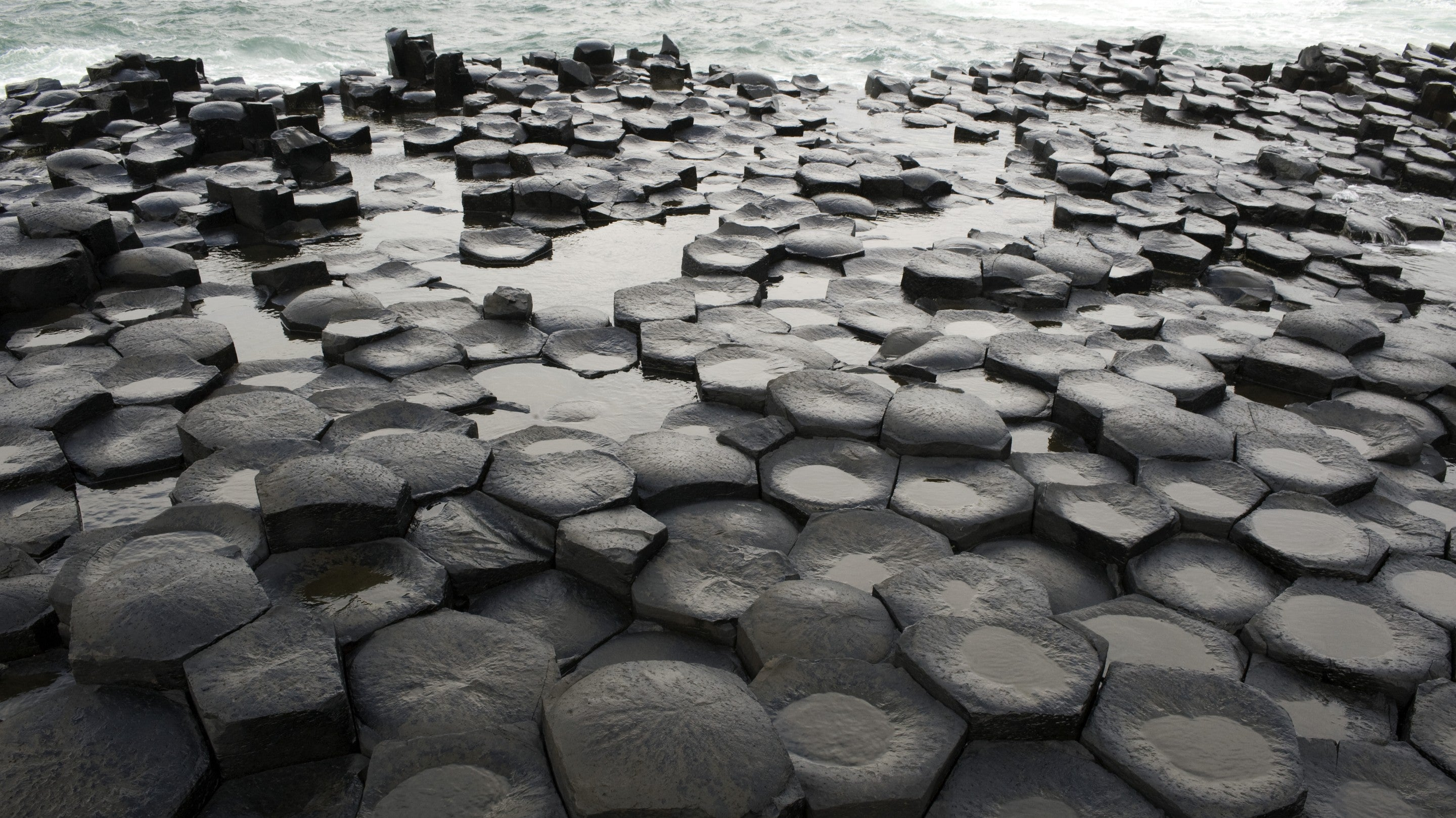
Basalt
- Colour: Dark-coloured, typically black or dark grey
- Texture: Fine-grained, small crystals
- Formation:
- Forms from the rapid cooling of lava at the Earth's surface, often through fissures or cracks.
- The rapid cooling results in the formation of small crystals.
- Special Feature: Often forms six-sided columns, known as columnar basalt
- Example: Antrim-Derry Plateau
Sedimentary Rocks
Sedimentary Rocks are formed of compressed sediment. They are formed through a process called lithification.
Lithification:
- Process of turning sediment into rock through compaction and cementation.
- Occurs as layers of sediment build up and the pressure causes the sediments to solidify.
Types of Sedimentary Rocks:
Organic Sedimentary Rocks:
-
Formed from the accumulation of plant and animal debris.
-
Often composed of the remains of once-living organisms.
-
Examples include limestone (formed from marine skeletal remains) and coal. Inorganic Sedimentary Rocks:
-
Formed from the deposition of mineral material.
-
Comprised of non-organic particles and fragments.
-
Examples include sandstone (formed from sand particles) and shale (formed from clay particles). Here are the revised notes based on the information in the image:
Limestone
- Composition: Composed almost entirely of calcium carbonate (CaCO₃).
- Appearance: Varies widely in appearance; can be white, grey, or contain other impurities.
- Texture: Fine to coarse-grained; may contain fossils.
- Formation:
- Organic Limestone: Formed from the skeletal remains (teeth, bones, shells) of marine creatures such as fish, sea urchins, and coral. These remains accumulate on the sea floor and are compacted over time to form solid rock.
- The process took place in warm, clear, shallow seas, as seen in Ireland about 350 million years ago.
- Types:
- Includes carboniferous limestone, dolomite, and chalk.
- Pure limestone is almost white.
- Carboniferous limestone is hard, grey, and consists of at least 50% calcium carbonate. It gets its grey colour from impurities like clay, sand, and carbon.
- Example: Limestone is formed in various locations, such as The Burren in Clare
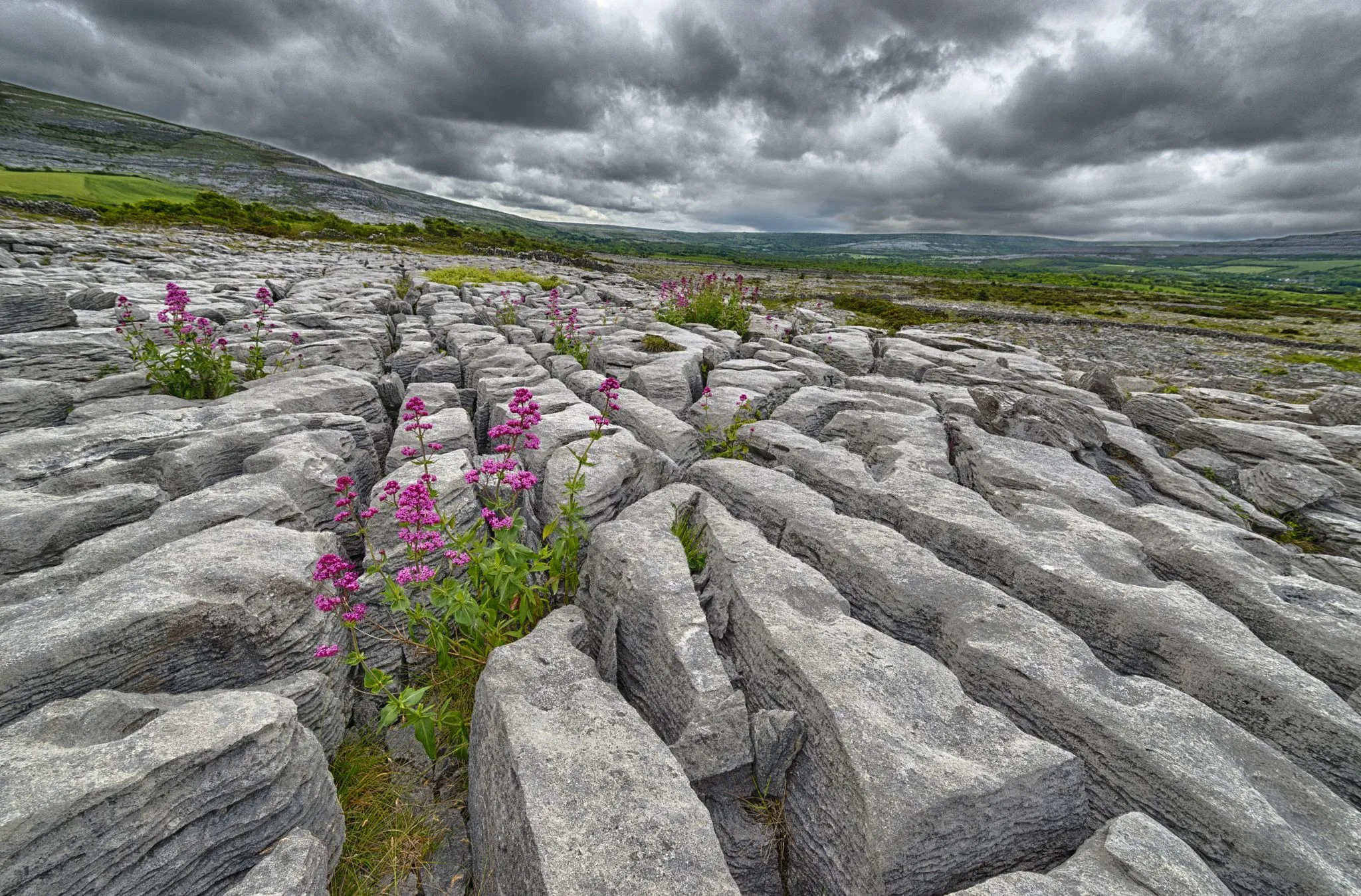
*The Burren, Co. Clare *
Metamorphic Rocks
Metamorphic Rocks are formed from igneous or sedimentary rocks that have changed due to heat and/or pressure.
- Changes can be physical (change in appearance) or chemical (change in composition).
- Occur at great depths below the Earth's surface.
Types of Metamorphism:
- Contact (Thermal) Metamorphism:
- Occurs when there is an intrusion of molten magma into the crust.
- Causes localised changes as the intrusion "cooks" the surrounding rock.
- Forms an altered zone called an aureole around the intrusion.
- Regional Metamorphism:
- Occurs over large areas during mountain-building events or at subduction zones.
- Rocks are subjected to extreme pressure and heat from colliding tectonic plates.
- This process results in folded and buckled rocks.
Quartzite
- Parent Rock: Sandstone
- Formation:
- Formed when sandstone is subjected to heat and pressure, often during tectonic folding.
- Quartz and silica in sandstone fuse together under extreme conditions, destroying the original stratification.
- Results in a new rock with larger grains than sandstone.
- Characteristics:
- Varies in colour depending on original rock impurities.
- Non-porous and much harder than sandstone, making it suitable for kitchen worktops.
- Extremely resistant to weathering and erosion.
- Occurrence:
- Found as a cap on distinctive mountains in Ireland, such as Croagh Patrick (Co. Mayo) and the Sugar Loaf (Co. Wicklow).