Weathering Processes and Landforms (Leaving Cert Geography): Revision Notes
📚Revision Notes
Karst Landscapes - Underground Features
Underground karst landscapes contain some of the most fascinating geological features on Earth. These features develop through complex chemical processes that occur beneath limestone surfaces, creating intricate cave systems and beautiful rock formations.
Cave and cavern formation
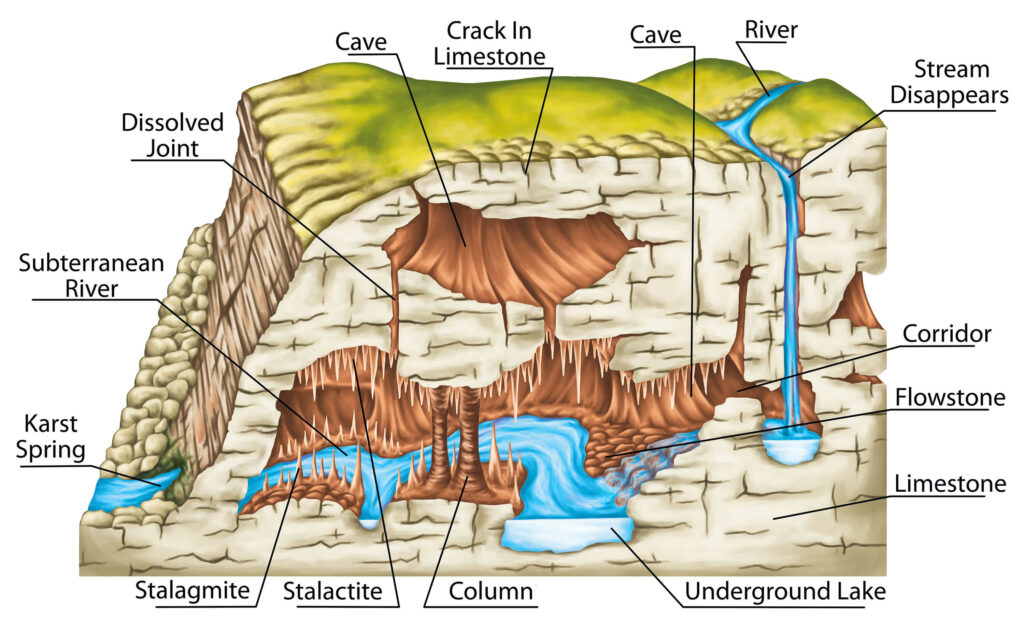
Caves and caverns represent the largest underground features in karst landscapes. These impressive spaces form through a combination of chemical and physical processes operating below ground level.
The zone of saturation
Important
Zone of saturation: The area of rock and soil that lies below the water table, where all available spaces are filled with groundwater.
Underground cave formation occurs primarily in the zone of saturation. This zone represents the boundary where limestone becomes fully saturated with water, creating ideal conditions for chemical weathering processes to operate effectively.
Chemical processes in cave formation
The primary process responsible for cave formation is carbonation. When rainwater combines with carbon dioxide in the atmosphere and soil, it forms weak carbonic acid. This acidic water has the ability to dissolve limestone rock through chemical reactions.
Note
As acidic water seeps through limestone, it converts the rock into calcium bicarbonate, which dissolves easily in water. Over thousands of years, this process removes large amounts of limestone, creating hollow spaces that eventually become caves and caverns.
Physical erosion processes
Alongside chemical weathering, physical processes also contribute to cave development:
- Hydraulic action occurs when flowing water exerts pressure on limestone rock, breaking it apart and carving underground passages
- Abrasion widens existing passages as broken limestone pieces scrape against cave walls, carried by moving water
When water table levels drop, caves that formed below ground become air-filled spaces that people can explore, such as the famous Aillwee Cave in County Clare.
Dripstone formations
Important
Dripstone features: Rock formations made from calcium carbonate that develop from dripping water in underground caves.
Once caves have formed, a fascinating secondary process begins creating decorative rock features inside them. This process is called dissolution, which works as the reverse of the original cave-forming process.
The dissolution process
Note
Dissolution: The process where calcium carbonate is washed away in solution by acidic water. When water evaporates, calcium carbonate remains and hardens into calcite.
Calcite: A hard mineral made of calcium carbonate that forms when limestone-rich water evaporates.
Water containing dissolved limestone seeps through cave roofs and walls. As this water drips into air-filled cave spaces, it begins to evaporate. When evaporation occurs, the dissolved limestone cannot remain in the air, so it gets deposited as solid calcite.
Over thousands of years, these tiny calcite deposits accumulate to create various types of dripstone features, each with distinct characteristics based on where and how the water deposits the minerals.
Types of dripstone features
Stalactites
Note
Stalactites: Icicle-shaped dripstone features that hang downwards from cave roofs.
Stalactites develop on cave roofs where water containing dissolved limestone seeps through cracks and joints. The formation process follows these stages:
- Water drops hang from the cave roof before losing carbon dioxide and evaporating
- Small amounts of calcite get left behind after each water drop evaporates
- This process repeats over thousands of years, gradually building calcite deposits
- Eventually, icicle-shaped features form that can grow several metres long
The pointed, downward-hanging shape of stalactites results from water droplets forming at specific points where gravity causes them to hang before falling.
Stalagmites
Note
Stalagmites: Shapeless mounds of dripstone that form from water dripping onto cave floors.
Stalagmites form on cave floors directly below stalactites. Their formation process differs slightly from stalactites:
- Water drops fall from cave roofs (often from stalactites) onto the floor below
- When water hits the solid cave floor, it splashes and spreads over a wider area
- The splashing action causes calcite to be deposited across a broader base
- Over time, calcite builds upwards to form rounded, mound-like structures
Important
Stalagmites typically have much thicker bases than stalactites because the splashing water spreads calcite over larger areas. Their irregular, shapeless appearance contrasts with the smooth, pointed form of stalactites.
Pillars
Note
Pillars: Formations that develop when stalactites and stalagmites grow towards each other and eventually join together.
In some cave locations, stalactites and stalagmites grow for so long that they meet in the middle of the cave space. When this happens, they form continuous columns called pillars that extend from floor to roof. Pillars are sometimes referred to as columns due to their structural appearance.
Curtains and flowstones
Cave water doesn't always drip from single points. Sometimes it flows along cracks or runs down walls, creating different types of dripstone features.
Note
Curtains: Ridge-like formations of dripstone that develop along roof cracks where water flows rather than drips.
Flowstones: Sheet-like formations that develop on cave walls and floors when limestone-rich water flows across surfaces.
When water containing dissolved limestone runs along a crack in a cave roof, it deposits calcite in a line rather than at individual points. This creates thin, sheet-like formations that resemble curtains hanging from the ceiling.
Flowstones form when water flows down cave walls or across floor areas. As the water moves, it deposits thin layers of calcite that build up over time to create smooth, sheet-like surfaces covering parts of cave walls and floors.
Key formation processes
Understanding the formation of underground karst features requires grasping several interconnected processes:
- Chemical weathering through carbonation dissolves limestone to create cave spaces
- Physical erosion through hydraulic action and abrasion enlarges caves
- Dissolution reverses the chemical process, depositing dissolved limestone as solid calcite
- Evaporation drives the dissolution process by removing water and concentrating minerals
- Gravity influences where and how dripstone features develop within cave systems
Important
These processes operate continuously over geological timescales, creating the complex and beautiful underground landscapes characteristic of karst regions like the Burren in County Clare.
Summary
Key Points to Remember:
- Caves form in the zone of saturation through carbonation, where acidic water dissolves limestone over thousands of years
- Dripstone features develop through dissolution - the reverse process where evaporating water deposits calcite in cave spaces
- Stalactites hang from cave roofs like icicles, while stalagmites grow upwards from floors in shapeless mounds
- Pillars form when stalactites and stalagmites join together, creating columns from floor to ceiling
- Curtains and flowstones develop when water flows along surfaces rather than dripping from points