The Growth of Fascism in Europe (Leaving Cert History): Revision Notes
📚Revision Notes
Assessing Mussolini's Contribution to Fascist Italy and Europe
These notes provide a general and overall assessment of Mussolini's time in power and his contributions in various areas. Think of the title of these notes as an essay question and each subheading as a paragraph title.
Mussolini's Contribution to Fascist Italy and Europe
Rise to Power
- Benito Mussolini's rise to power marked the beginning of Fascist Italy.
- In 1922, after the March on Rome, King Victor Emmanuel III appointed Mussolini as Prime Minister.
- Mussolini quickly dismantled the democratic system and established a dictatorship, cementing his authority through the use of propaganda, intimidation, and political violence.
Economic Policies
Mussolini implemented several economic policies aimed at self-sufficiency and reducing unemployment. Key initiatives included:
- Battle for Grain: Encouraged farmers to increase grain production, reducing dependence on foreign imports.
- Battle for Land: Reclaimed marshlands for agricultural use and provide incentives for large families to settle there.
- Public Works: Undertook large infrastructure projects, such as roads and bridges, reducing unemployment and modernising Italy's infrastructure.
Corporate State
- Mussolini introduced the concept of the Corporate State, where the economy was divided into sectors, each managed by a corporation representing workers and employers.
- The Council of Corporations was established in 1930 to advise the government on economic policy.
- However, these corporations had little real power in practice, as the state maintained strict control over the economy and suppressed labour unions.
Social Policies
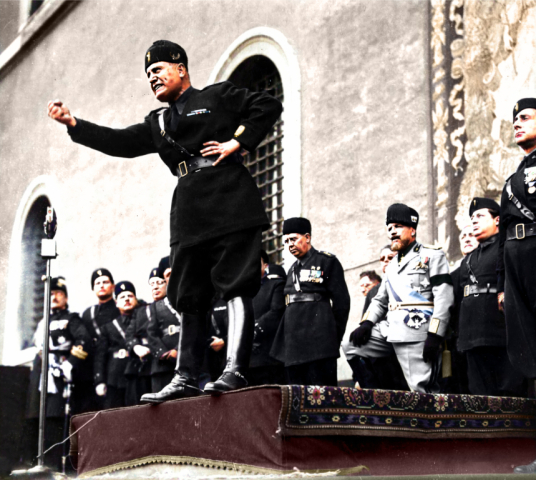
- Cult of Personality: Mussolini fostered a cult of personality, depicting himself as the embodiment of Italy's strength and greatness. The media pervasively portrayed him in various roles, from military leader to man of the people.
- Youth Organizations: Established groups like the Opera Nazionale Balilla (ONB) to indoctrinate the youth with fascist ideology and prepare them for military service.
- Race Laws: In 1938, Mussolini enacted anti-Semitic laws inspired by Nazi Germany, which restricted the rights of Jews in Italy, though these laws were less rigorously enforced than in Germany.
Foreign Policy and Expansionism
Mussolini aimed to restore Italy's historical grandeur by expanding its territories. His foreign policy was aggressive and expansionist:
- Invasion of Abyssinia (Ethiopia): In 1935, Mussolini invaded Abyssinia, leading to international condemnation and sanctions from the League of Nations. This aggression was part of his ambition to build a new Roman Empire.
- Spanish Civil War: Mussolini supported Francisco Franco's Nationalist forces, using the conflict as a testing ground for Italian military power.
- Alliance with Nazi Germany: Mussolini formed a close alliance with Hitler, formalised through the Rome-Berlin Axis in 1936 and the Pact of Steel in 1939. This alliance dragged Italy into World War II on the side of the Axis Powers, leading to disastrous consequences for Italy.
Impact on Europe
Mussolini's actions had significant repercussions across Europe:
- Facilitated Fascism's Spread: Mussolini's early success inspired other fascist movements, notably in Germany with the rise of Adolf Hitler.
- Destabilisation of Europe: His aggressive foreign policies and alliance with Hitler contributed to the destabilisation of Europe, leading to World War II.
- Human Rights Abuses: Mussolini's regime was marked by political repression, suppression of dissent, and human rights abuses, including the persecution of Jews and political opponents.
Legacy
- Mussolini's legacy is complex. While he modernised parts of Italy's infrastructure and briefly restored a sense of national pride, his policies ultimately led to economic hardship, military defeat, and social division.
- The collapse of the Fascist regime in 1945 marked the end of Mussolini's vision for Italy and left a lasting impact on the country and Europe as a whole.
- His rule serves as a cautionary tale about the dangers of totalitarianism and aggressive nationalism.