Géibheann (Leaving Cert Irish): Model Answers
📚Model Answers
Géibheann, 2021 (H1 Sample Answer)
Note
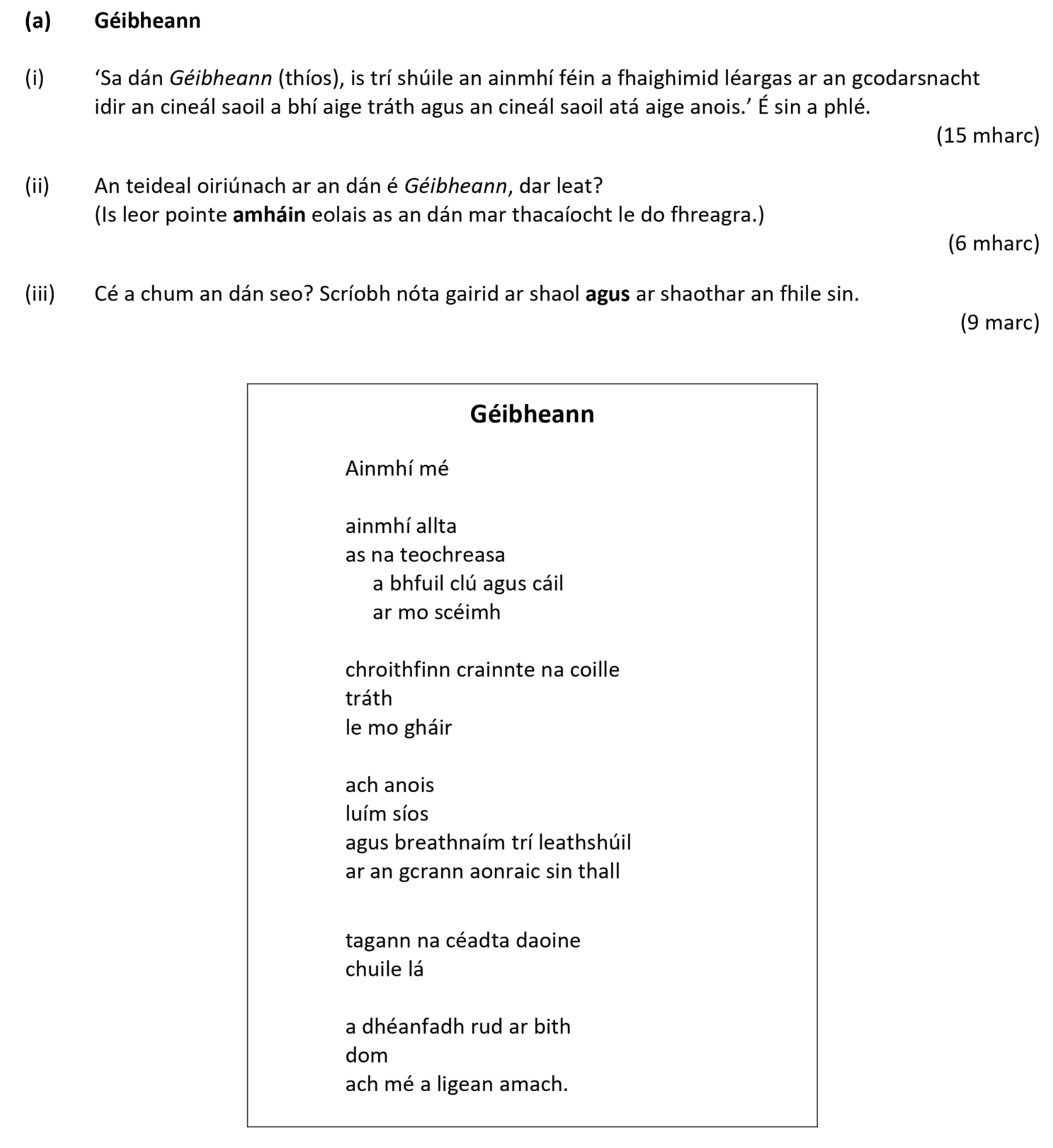
(i) "In the poem Géibheann (below), through the eyes of the animal itself, we gain insight into the contrast between the kind of life it once had and the kind of life it has now." Discuss this. (15 marks)
(ii) Is Géibheann a suitable title for the poem, in your opinion? (One piece of information from the poem is sufficient as support for your answer.) (6 marks)
(iii) Who composed this poem? Write a short note on the life and works of this poet. (9 marks)
Note
Approaching the Question
Planning your answer will keep you focused and help you include all the key information.
Marking for the Prós, Filíocht and Litríocht Breise questions:
- 30 marks available
- 5 marks for the quality of Gaeilge.
- 25 marks for eolas (knowledge-how well you know and understand the text).
- Make sure you have a solid understanding of the poems– know the key images, themes and poetic techniques.
- Practice exam questions - they are very repetitive!
- However, it's important to avoid reciting a memorised answer. You must answer the question in front of you to score highly. Don't just summarise the text!
- Refer to the question frequently throughout your answer. This is easier than it sounds! All you need is a few key phrases that you can adapt to tie in any exam question, such as:
- Aontaím leis an ráiteas seo. (I agree with this statement.)
- Is léir go bhfuil… (It is clear that)
- Léiríonn sé seo go… (This shows that)
- Tá sé seo an soiléir ón gcaoi… (This is very clear from the way…)
- Feicimid go… (We see that…)
- Gan aon amhras ar bith… (Without any doubt…)
- Tip: Refer back to the question at the end of each paragraph!
- Personal response shows that you understand and are engaged with the text. You could use phrases like:
- Dar liom… (According to me…)
- Creidim go bhfuil…. (I believe that…)
Freagra
Note
(i) 'Sa dán Géibheann (thíos), is trí shúile an ainmhí féin a fhaighimid léargas ar an gcodarsnacht idir an cineál saoil a bhí aige tráth agus an cineál saoil atá aige anois.' É sin a phlé. (15 mharc)
(i) "In the poem Géibheann (below), through the eyes of the animal itself, we gain insight into the contrast between the kind of life it once had and the kind of life it has now." Discuss this. (15 marks)
Trí bhéal ainmhí a labhraíonn Caitlín Maude, an file, sa dán seo. Tugann an file léargas dúinn ar shaol an ainmhí atá i ngéibheann sa zú agus taispeánann sí go mbriseann an daoirse spiorad an ainmhí. Trí íomhá éifeachtach agus pearsantú cumhachtach, cuireann an file an codarsnacht idir an cineál saoil a bhí ag an ainmhí agus an cineál saoil atá aige anois ós ár gcomhair.
The poet, Caitlín Maude, speaks through the mouth of an animal in this poem. The poet gives us an insight into the life of an animal in captivity in a zoo and shows that slavery breaks the animal's spirit. Through effective image and powerful personification, the poet presents us with the contrast between the kind of life the animal had and the kind of life he has now.
Tá dhá phríomh-íomha sa dán seo. Sa chéad leath, faighimid léargas ar an gcineál saoil a bhí ag an ainmhí roimh an zú. Feicimid ainmhí atá fiáin, bríomhar, neamhspleách agus lán le fuinneamh. Chaith sé na laethanta fada ag seilg agus ag spaisteoireacht timpeall a ríochta, an teochreasa.
'Ainmhí allta
As na teochreasa'
There are two main images in this poem. In the first half, we get an insight into the kind of life the animal had before the zoo. We see an animal that is wild, energetic, independent, and full of energy. He spent the long days hunting and wandering around his kingdom, the tropics.
"A wild animal
From the tropics"
Bhí sé sona sásta agus bhain sé taitneamh as a shaol. Sa chéad leath, cuimhníonn sé ar an am sin, nuair a bhí sé cumhachtach agus saor. B'ainmhí bródúil é agus ba léir go raibh uaisleacht ag baint leis. Sna trópaicí, scanraigh sé na hainmhithe eile nuair a lig sé béic as in ard a chinn is a ghutha.
'Chroithfinn crainnte na coille
Tráth
Le mo gháir
Bhí an t-ainmhí seo i mbarr a mhaitheasa.
He was happy and he enjoyed his life. In the first half, he remembers that time, when he was powerful and free. He was a proud animal and it was clear that there was a sense of nobility about him. In the tropics, he frightened the other animals when he let out a roar at the top of his voice.
"I would shake the trees of the forest
Once
With my roar"
This animal was at his prime.
Áfach, a mhalairt ar fad de phictiúr a haon a fhaighimid sa dara leath. Tá codarsnacht truamhéalach idir an saol a bhí ag an ainmhí agus a shaol sa zú. Críochnaíonn cuimhní an ainmhí agus déanann sé cur síos ar an réadúil, ar an saol atá aige anois. Tá a chumhacht agus a fhuinneamh imithe go deo. Tá sé bréan bailithe den saol. Bhí sé neamhspleách uair amháin ach anois, tá sé ag brath ar dhaoine eile mar níl sé in ann dul ag seilg. Is codarsnacht brónach é seo. Caitheann sé na laesthanta ina luí ar an talamh, ag féachaint ar an gcrann aonraic. Tá a spiorad briste-níl aon neart nó fuinneamh fágtha aige. Tá sé éirithe as an saol.
'luím síos
agus breathnaím trí leathshúil
ar an gcrann aonraic sin thall'
However, we get the complete opposite of the first image in the second half. There is a pitiful contrast between the life the animal once had and his life in the zoo. The animal's memories come to an end and he describes reality, the life he has now. His power and energy are gone forever. He is fed up with life. He was once independent, but now he depends on others because he is not able to go hunting. This is a sad contrast. He spends his days lying on the ground, looking at the lone tree. His spirit is broken—he has no strength or energy left. He is resigned from life.
"I lie down
and look through one half-open eye
at that lone tree over there"
Níl sé feargach. Tá sé sáraithe, glan amach agus glacann sé a chinniúint. Tá sé in ísle-brí. Tagann na céadta duine gach lá go dtí an zú ag féachaint ar an ainmhí. Is taispeántas é anois.
'tagann na céadta daoine
chuile lá
a dhéanfadh rud ar bith
Dom'
He is not angry. He is outright exhausted and he accepts his fate. He is in low spirits. Hundreds of people come to the zoo every day to look at the animal. He is now just an exhibit.
"hundreds of people come
every single day
who would do anything for me
Tá an codarsnacht noctaithe go gléineach sa dán. Tá an difríocht idir an saol a bhí aige tráth agus an saol atá aige anois an-bhrónach.
The contrast is clearly revealed in the poem. The difference between the life he once had and the life he has now is very sad.
Note
(ii) An teideal oiriúnach ar an dán é Géibheann, dar leat? (Is leor pointe amháin eolais as an dán mar thacaíocht le do fhreagra.) (6 mharc)
(ii) Is Géibheann a suitable title for the poem, in your opinion? (One piece of information from the poem is sufficient as support for your answer.) (6 marks)
I mo thuairim, is teideal oiriúnach é 'Géibheann'. | Immediately answer the question.
In my opinion, 'Géibheann' is a suitable title.
Ar an gcéad dul síos, déanann an ainmhí cur síos ar a shaol sa zú. Ní féidir a sheanadh go bhfuil sé i ngéibheann. Tráth, bhí sé fiáin, neamhspleách agus cumhachtach ach anois, caitheann sé a laethanta ina luí faoin gcrann sa zú. Níl aon saoirse aige-tá sé faoi ordóg an zú. Gach lá, tagann daoine chun é a fheiceáil, ach ní thugann siad saoirse dó. Tá sé i ngéibheann.
'tagann na céadta daoine
chuile lá
a dhéanfadh rud ar bith
dom
ach mé a ligean amach.'
First of all, the animal describes his life in the zoo. It cannot be denied that he is in captivity. Once, he was wild, independent, and powerful but now, he spends his days lying under the tree in the zoo. He has no freedom—he is under the thumb of the zoo (i.e. under the zoo's control). Every day, people come to see him, but they do not give him freedom. He is in captivity.
"hundreds of people come
every single day
who would do anything for me
but let me be free."
Ina theannta sin, is dán fáthchiallach é an dán seo. D'fhulaing an file ón ailse agus ceapaim go léiríonn an teideal an daoirse a bhraith sí agus í go dona tinn. De bharr a tinneas, bhí sí i ngéibheann freisin. Cosúil leis an leon, bhí cuairteoirí aici an t-am ar fad agus mhothaigh sí srianta ina saol.
In addition, this poem is an allegory. The poet suffered from cancer and I think the title reflects the oppression she felt when she was seriously ill. Because of her illness, she was in captivity too. Like the lion, she had visitors all the time and she felt restricted in her life.
Mar sin, is léir gur teideal oiriúnach é 'Géibheann' don dán seo. | Refer to the question in your conclusion.
Therefore, it is clear that "Géibheann" is a suitable title for this poem.
Note
Is dán fáthchiallach é an dán seo = this poem is an allegory.
Allegory: a story, poem, or picture that can be interpreted to reveal a hidden meaning.
Note
(iii) Cé a chum an dán seo? Scríobh nóta gairid ar shaol agus ar shaothar an fhile sin. (9 mharc)
(iii) Who composed this poem? Write a short note on the life and works of this poet. (9 marks)
Chum Caitlín Maude an dán seo.
Rugadh i Ros Muc i gConamara í sa bhliain 1941. Cáilíodh í mar mhuinteoir. Bhain sí céim BA amach ó Choláiste na hOllscoile, Gaillimh. Chaith sí tréimhsí mar mhúinteoir in áiteanna éagsúla, mar shampla i nGaillimh.
Bhí cliú agus cáil uirthi mar amhránaí ar an sean-nós, aisteoir, file agus gníomhaí teanga. Bhí an-suim aici sa Ghaeilge. Bhí baint aici leis an eagraíocht 'Coiste Cearta Sibhialta na Gaeltachta'.
D'fhulaing sí ón ailse agus gan aon agó, bhí tionchar mór ag an mbreoiteacht ar a cuid filíochta.
Tá dhá fhoilisiúchán déanta ar a cuid scríbhneoireachta:
Caitlín Maude- Dánta (1984).
Caitlín Maude- Dramaíocht agus Prós (1988).
Scríobh sí an dráma 'An Lasair Choille' le Micheál Ó hAirtnéide i 1962.
Caitlín Maude composed this poem.
She was born in Ros Muc in Connemara in the year 1941. She qualified as a teacher. She earned a BA degree from University College Galway. She spent periods working as a teacher in various places, for example in Galway.
She was renowned as a sean-nós singer, actress, poet, and language activist. She had a great interest in the Irish language. She was involved with the organisation 'Coiste Cearta Sibhialta na Gaeltachta'.
She suffered from cancer and without a doubt, her illness had a major impact on her poetry.
Two collections of her writings have been published:
Caitlín Maude- Dánta (1984).
Caitlín Maude- Dramaíocht agus Prós (1988).
She wrote the drama 'An Lasair Choille' with Micheál Ó hAirtnéide in 1962.