Rates of Change (Leaving Cert Mathematics): Revision Notes
📚Revision Notes
Rates of Change
What is a rate of change?
The rate of change is a fundamental concept that tells us how quickly one quantity changes compared to another. The notation represents the rate of change of y with respect to x.
Note
If , this means that is increasing by 2 units for every 1 unit that increases. This gives us a precise way to measure how quantities change relative to each other.
For linear functions, the rate of change is constant and equals the slope of the line. However, for curved functions, the rate of change varies at different points.
Average rate of change
The average rate of change between two points on a graph tells us the overall rate of change over an interval. This is calculated as the slope of the straight line joining the two points (called a secant line).
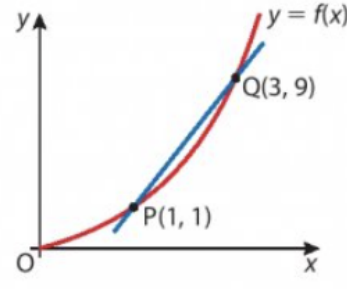
For points P and Q, the average rate of change is:
Using the points P(1,1) and Q(3,9) from the graph:
Note
This average rate of change gives us the overall change between two specific points, but doesn't tell us what's happening at any particular moment - it's like knowing your average speed for a whole journey without knowing how fast you were going at any specific time.
Instantaneous rate of change
The instantaneous rate of change at a specific point is found by calculating and evaluating it at that point. This represents the slope of the tangent line to the curve at that specific point.
The slope of the tangent to the curve at point P is found by calculating and finding its value when .
Important
The key difference: Average rate of change uses a secant line between two points, while instantaneous rate of change uses the tangent line at a single point. This is fundamental to understanding calculus!
We refer to the rate of change at a specific point as the instantaneous rate of change.
Real-world applications
Motion and speed
One of the most important applications of rates of change is in studying the motion of objects. Consider how this applies to distance and time relationships.
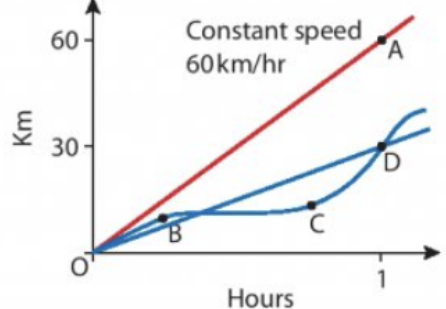
When a car moves at constant speed, the rate of change of distance with respect to time is constant. The straight red line shows constant speed of 60 km/hr. However, most objects don't travel at constant speed - their rate of change varies continuously, as shown by the curved blue line.
The average speed over a journey can be calculated as:
From the graph, the average speed for the curved path is 30 km/hr, even though the instantaneous speed varies throughout the journey.
Displacement, velocity and acceleration
When studying motion, we encounter three interconnected concepts that are all related through rates of change:
Displacement
Displacement () is the distance travelled from a starting point, usually measured in metres. For an object moving in a straight line, displacement is generally given by a formula like .
Velocity (speed)
Velocity is the rate of change of displacement with respect to time:
Note
Key points about velocity:
- If is positive, the particle is moving away from a fixed point
- If is negative, the particle is moving towards the fixed point
- Velocity is measured in metres per second (m/s)
Acceleration
Acceleration is the rate of change of velocity with respect to time:
Important
Important facts about acceleration:
- Acceleration is measured in metres per second per second (m/s²)
- If is negative, then the speed is decreasing
- We obtain by differentiating
Key relationships summary
For motion problems involving displacement (in metres) after seconds:
- = speed (in m/s) after seconds
- = acceleration (in m/s²) after seconds
Worked examples
Example
Worked Example 1: Rate of volume change
Water is being collected in a water tank. The volume, cubic metres, of water in the tank after time minutes is given by .
Find the rate of change of volume with respect to time when .
Solution:
When :
Therefore, the rate of change of volume is 16 m³/min when .
Example
Worked Example 2: Motion analysis
A body moves along a straight line and its distance, metres, from a fixed point on the line after seconds is given by .
Find: (i) Its speed after seconds (ii) Its speed after 2 seconds (iii) After how many seconds the body is at rest (iv) Its acceleration after 3 seconds
Solution:
(i) The speed is represented by :
Therefore, the speed is m/s.
(ii) To find the speed after 2 seconds, substitute :
(iii) The body is at rest when the speed is zero:
Therefore, the body is at rest after of a second.
(iv) Acceleration is represented by :
At : m/s²
Example
Worked Example 3: Projectile motion
A rocket is fired vertically upwards. After seconds, its height, metres, is given by the formula .
Find:
(i) The height of the rocket after 2 seconds
(ii) The velocity of the rocket after 3 seconds
(iii) After how many seconds the rocket is momentarily at rest
(iv) The maximum height reached by the rocket
Solution:
(i) To find the height after 2 seconds, substitute :
(ii) Velocity = :
(iii) The rocket is at rest when the speed is zero:
Therefore, the rocket is momentarily at rest after 10 seconds.
(iv) The maximum height is reached after 10 seconds (when the body is at rest):
Therefore, the maximum height reached is 500 metres.
Summary
Key Points to Remember:
- Rate of change tells us how fast changes with respect to
- Average rate of change is the slope between two points (secant line)
- Instantaneous rate of change is the slope at one specific point (tangent line)
- For motion problems: velocity = and acceleration =
- When velocity is positive, the object moves away from a fixed point; when negative, it moves towards the point
- Remember the units: velocity in m/s, acceleration in m/s²