Corollaries of the Angle-Sum Property of a Triangle (Leaving Cert Mathematics): Revision Notes
📚Revision Notes
Corollaries of the Angle-Sum Property of a Triangle
Overview
The Angle-Sum Property of a Triangle states that the sum of the three interior angles of any triangle is always . This fundamental property leads to several important corollaries that describe relationships between angles and sides in specific types of triangles.
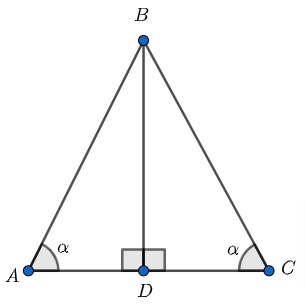
Corollary 1: Isosceles Triangle
- Statement: If two angles in a triangle are equal, the triangle is isosceles.
- Why It Works:
- If two angles are equal, the sides opposite those angles must also be equal, making the triangle isosceles.
- This follows directly from the Angle-Sum Property since the third angle is uniquely determined by the other two angles.
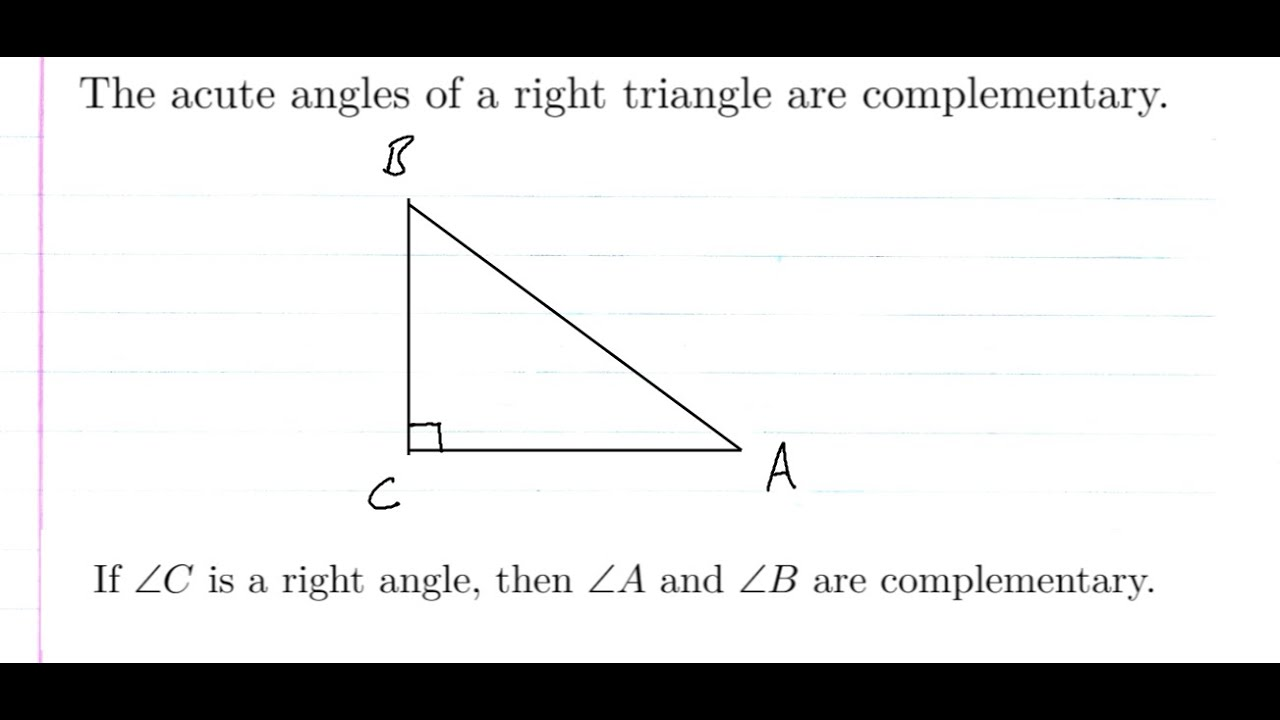
Corollary 2: Acute Angles in a Right Triangle
- Statement: In a right triangle, the two acute angles are complementary, meaning their measures add up to
- Why It Works:
- A right triangle has one angle equal to
- By the Angle-Sum Property:
- Therefore, the two acute angles must add up to
Worked Examples
Note
Example 1: Using Corollary 1
Problem: A triangle has two angles measuring and
Prove that the triangle is isosceles.
Solution:
Step 1: The two angles are equal, so by Corollary 1, the sides opposite these angles are also equal.
Step 2: The triangle is therefore isosceles.
Answer: The triangle is isosceles.
Note
Example 2: Using Corollary 2
Problem: In a right triangle, one of the acute angles measures
Find the other acute angle.
Solution:
Step 1: The two acute angles are complementary:
Answer: The other acute angle is
Summary
- Angle-Sum Property: The sum of the angles in a triangle is
- Corollary 1: If two angles are equal, the triangle is isosceles, as the sides opposite those angles are also equal.
- Corollary 2: In a right triangle, the two acute angles are complementary (add up to ). These corollaries simplify the analysis and classification of triangles in geometry.