Formal Proofs of Theorems (Leaving Cert Mathematics): Revision Notes
📚Revision Notes
Formal Proofs of Theorems
What are formal proofs?
Formal proofs are structured methods of proving geometric results using previously established facts and logical reasoning. This approach was developed by the ancient Greek mathematician Euclid around 300 BC in his famous work called Elements.
Important
Key Definitions
Axiom: A statement that we accept as true without needing proof. For example, "the angles in a straight line add to 180°" is an axiom.
Theorem: A statement that can be proven to be true using axioms and logical reasoning.
Structure of formal proofs
Every formal proof follows the same clear structure that provides a logical framework for mathematical reasoning:
Note
The Four Components of Every Formal Proof:
- Given: What information we start with
- To Prove: What we need to show is true
- Construction: Any additional lines or points we need to draw
- Proof: The logical steps that lead to our conclusion
The ten fundamental theorems
Understanding these theorems helps you solve geometry problems, even though you won't need to reproduce the full proofs in your exam. Each theorem reveals fundamental relationships in geometric figures.
Triangle theorems
Theorem 1: Angles and sides relationship
In any triangle, the angle opposite the longer side is always greater than the angle opposite the shorter side.
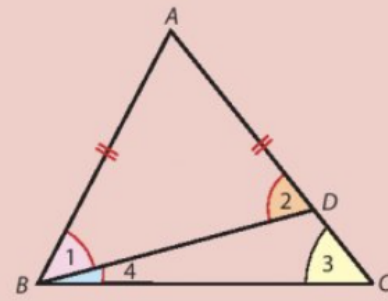
This makes intuitive sense - if one side is stretched longer, the angle opposite it must open wider.
Theorem 2: Triangle inequality
The sum of the lengths of any two sides of a triangle must be greater than the length of the third side.
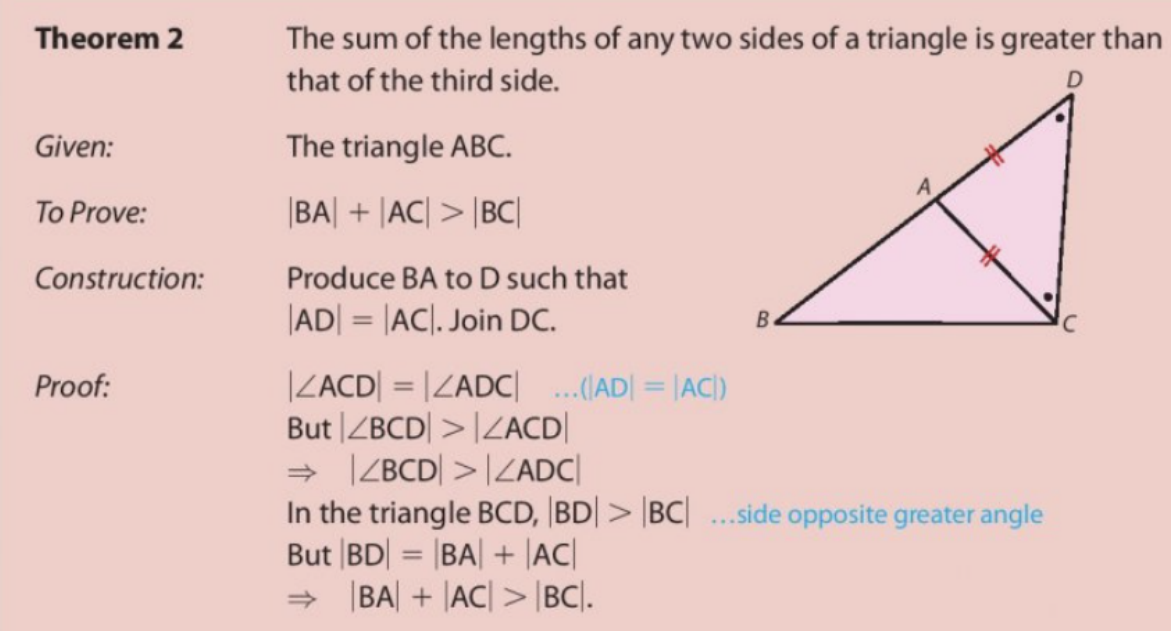
Example
Key Formula Application
For triangle ABC, we need:
This must be true for all three combinations:
Important
Exam Tip: This theorem helps you determine if three given lengths can form a triangle. Check that the sum of any two sides is always greater than the third side.
Theorem 6: Base times height is constant
For any triangle, the product of base length and height remains the same regardless of which side you choose as the base.
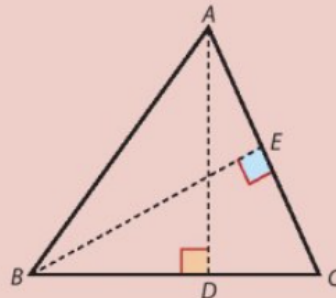
This means where AD and BE are the heights to those respective bases.
Parallel lines theorems
Theorem 3: Equal segments on transversals
When three parallel lines create equal segments on one transversal, they will create equal segments on any other transversal.
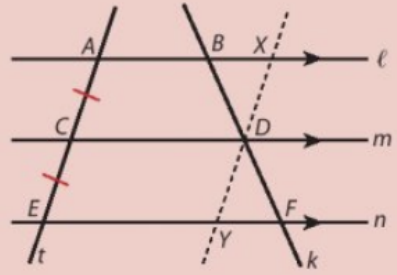
Note
This principle is extremely useful for dividing line segments into equal parts using parallel lines - a technique frequently used in geometric constructions.
Theorem 4: Basic proportionality theorem
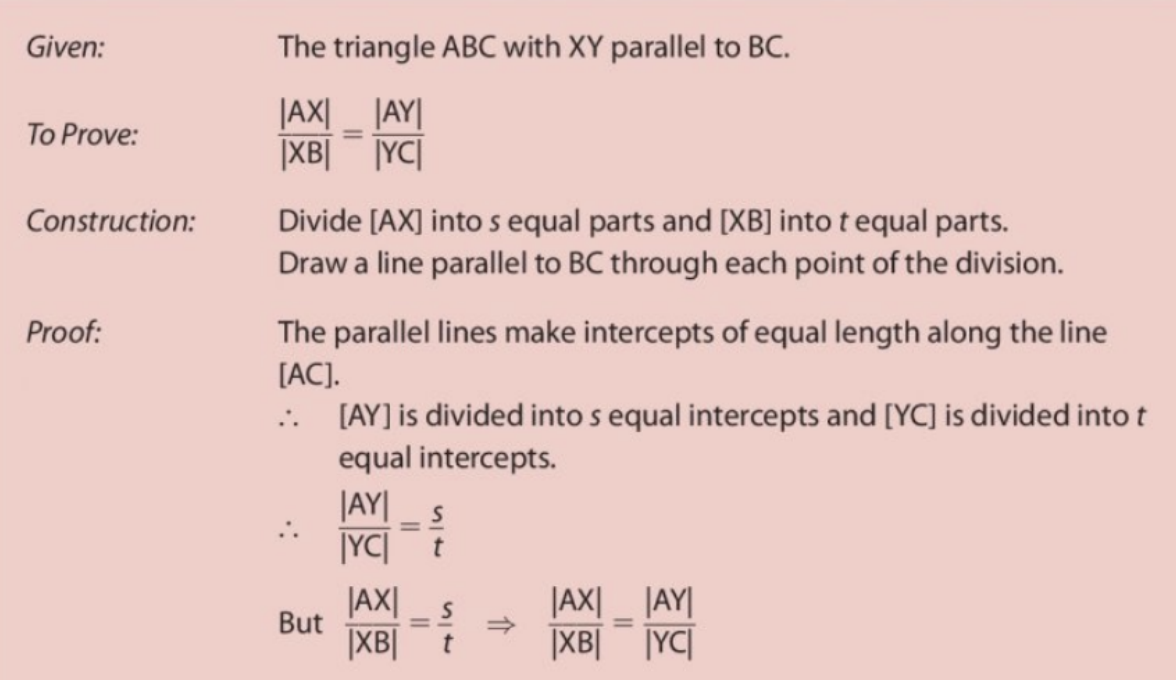
When a line is drawn parallel to one side of a triangle, it divides the other two sides in the same proportion.
Example
Key Formula: Basic Proportionality
If XY is parallel to BC in triangle ABC, then:
Important
Exam Tip: This theorem is fundamental for solving problems involving similar triangles and proportional segments.
Similar triangles theorem
Theorem 5: Proportional sides
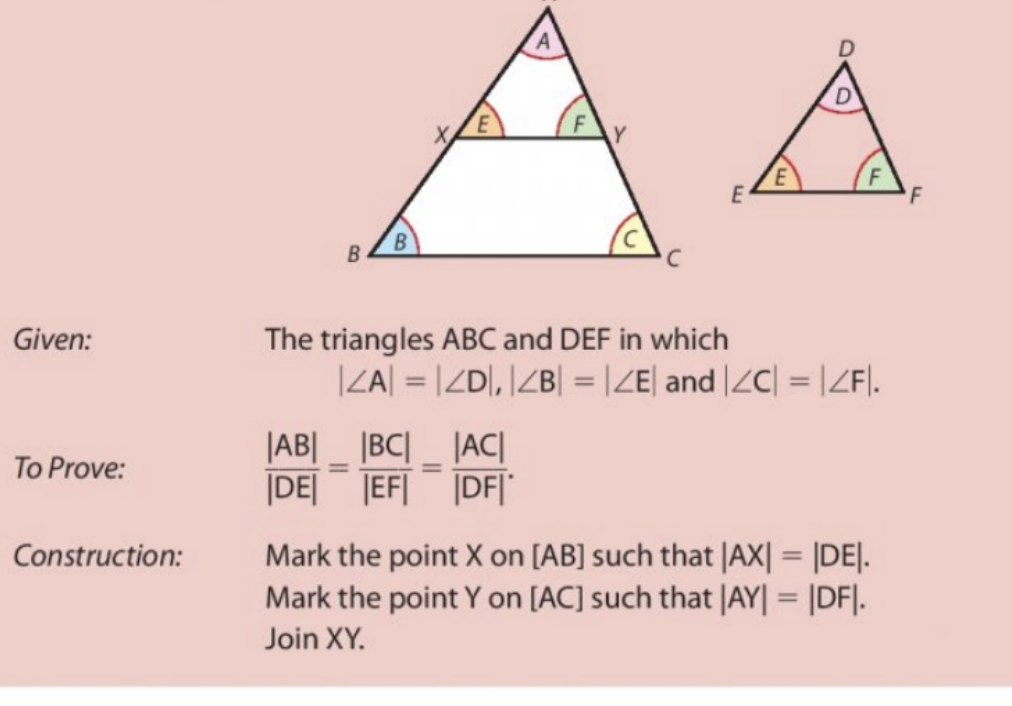
If two triangles are similar (same shape, different size), their corresponding sides are proportional.
Example
Proportional Relationships in Similar Triangles
For similar triangles ABC and DEF:
Important
Exam Guidance: Remember that similar triangles have equal corresponding angles and proportional corresponding sides.
Parallelogram theorems
Theorem 7: Diagonal bisects area
Any diagonal of a parallelogram divides it into two triangles of equal area.
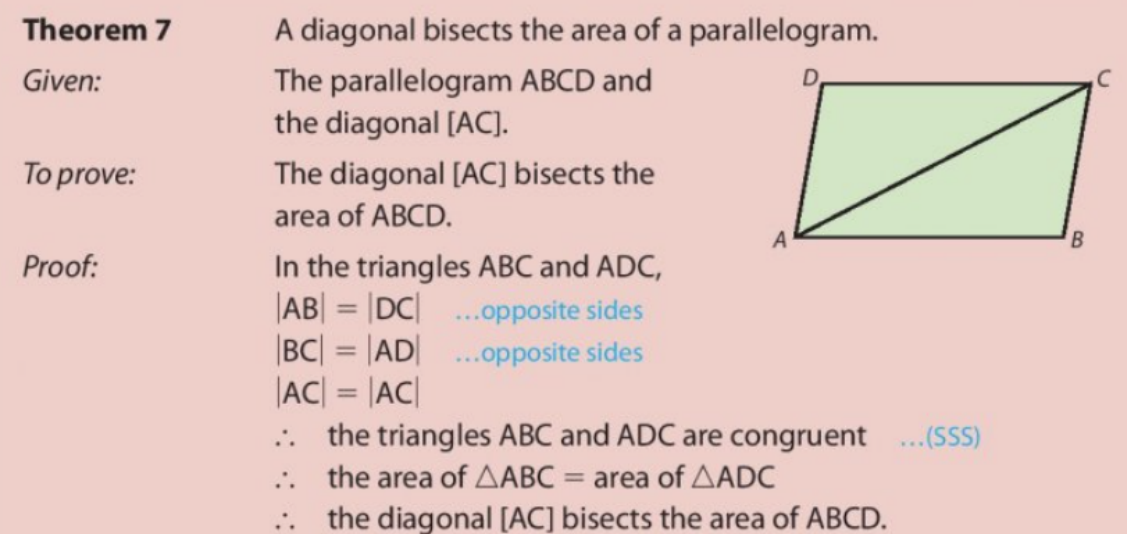
This works because the diagonal creates two congruent triangles using the SSS (Side-Side-Side) rule.
Theorem 8: Area formula
The area of a parallelogram equals base times height.
Example
Area Formula
This is proven using the fact that the diagonal bisects the parallelogram's area.
Circle theorems
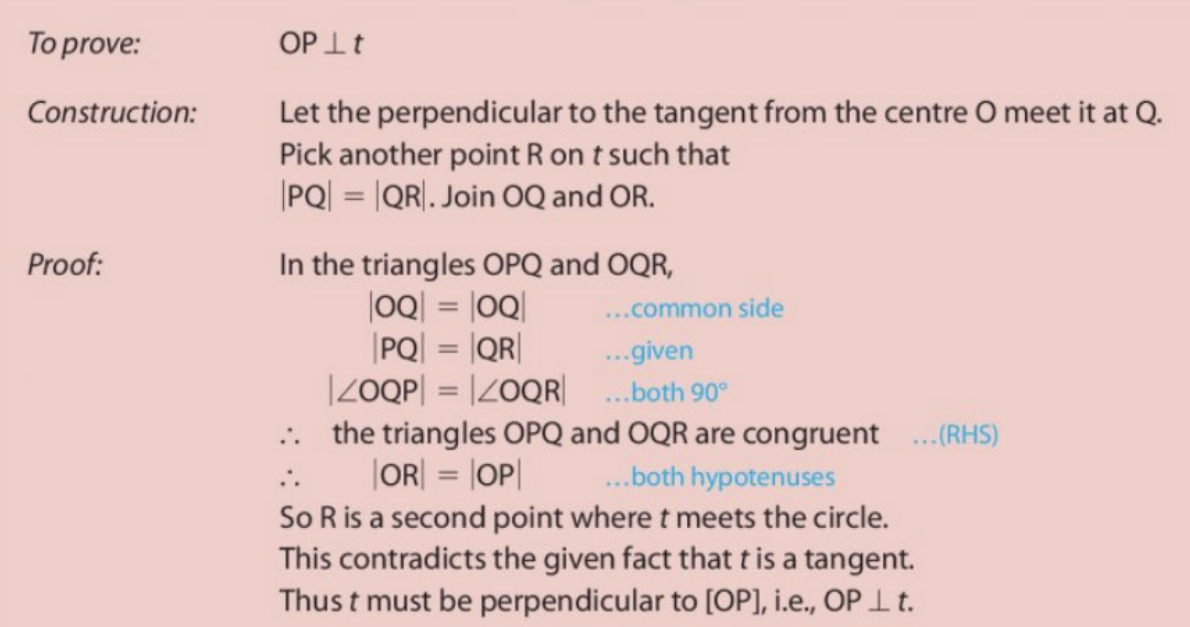
Theorem 9: Tangent perpendicular to radius
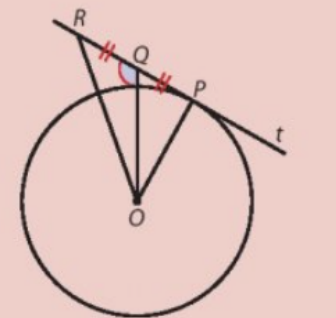
A tangent line to a circle is always perpendicular to the radius at the point of contact.
Note
This theorem is proven using proof by contradiction - we assume the opposite is true and show this leads to an impossible situation.
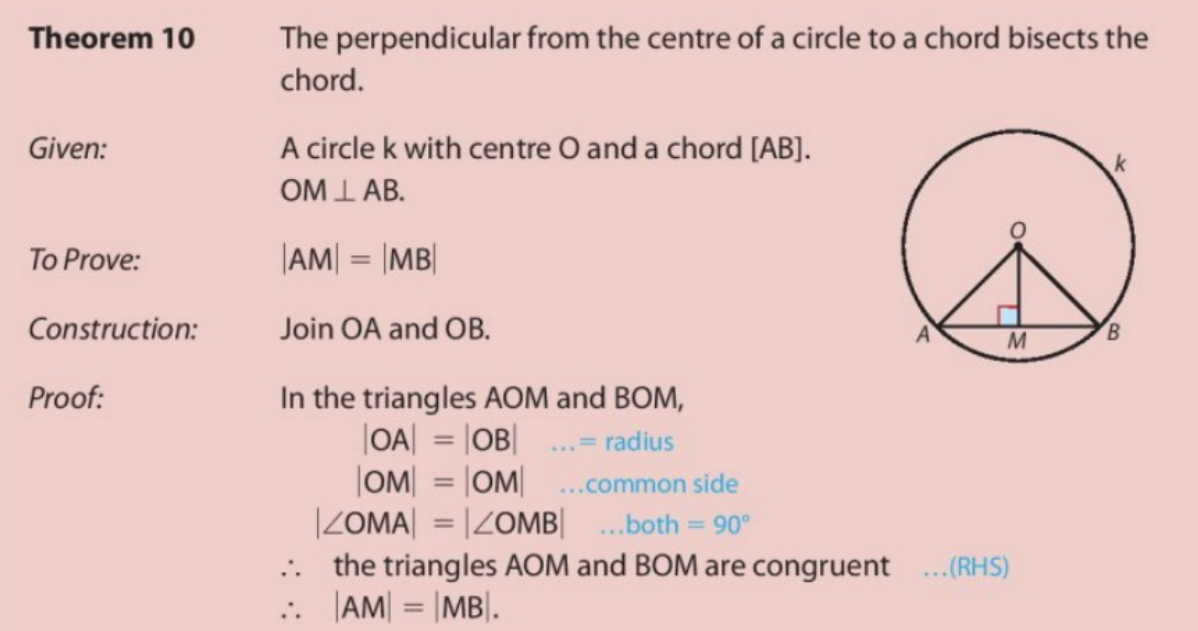
Theorem 10: Perpendicular bisects chord
A line drawn from the centre of a circle perpendicular to a chord will bisect that chord.
Example
Key Relationship
If OM ⊥ AB, then:
This is proven using congruent triangles and the RHS (Right angle-Hypotenuse-Side) rule.
Understanding proof techniques
The power of formal proofs lies in their systematic approach to establishing mathematical truth through logical reasoning.
Direct proof
Most theorems use direct proof - starting with given information and using logical steps to reach the conclusion.
Proof by contradiction
Sometimes we assume the opposite of what we want to prove and show this leads to an impossible situation. Theorem 9 uses this method.
Congruent triangles
Many proofs rely on showing that triangles are identical in size and shape using established rules:
Note
Congruence Rules for Triangles:
- SSS: Side-Side-Side
- SAS: Side-Angle-Side
- RHS: Right angle-Hypotenuse-Side
These rules allow us to prove that two triangles are exactly the same size and shape.
Summary
Key Points to Remember:
- Axioms are accepted without proof; theorems must be proven using logical reasoning
- The triangle inequality ensures that any three lengths can only form a triangle if the sum of any two sides exceeds the third
- Parallel lines create proportional segments on transversals - this is the foundation for similar triangles
- Similar triangles have equal angles and proportional corresponding sides
- Circle theorems involving tangents and chords follow predictable perpendicular relationships