Circle Theorems (Leaving Cert Mathematics): Revision Notes
📚Revision Notes
Circle Theorems
Overview
Circle theorems describe the properties and relationships of lines, angles, and segments in and around a circle. These theorems are essential for solving problems and proving geometric relationships involving circles.
Intersecting Chords Theorem
- Statement: If two chords intersect inside a circle, the product of the lengths of the segments of one chord is equal to the product of the lengths of the segments of the other chord.
- Why It Works: This arises from the similarity of triangles formed by the intersecting chords.
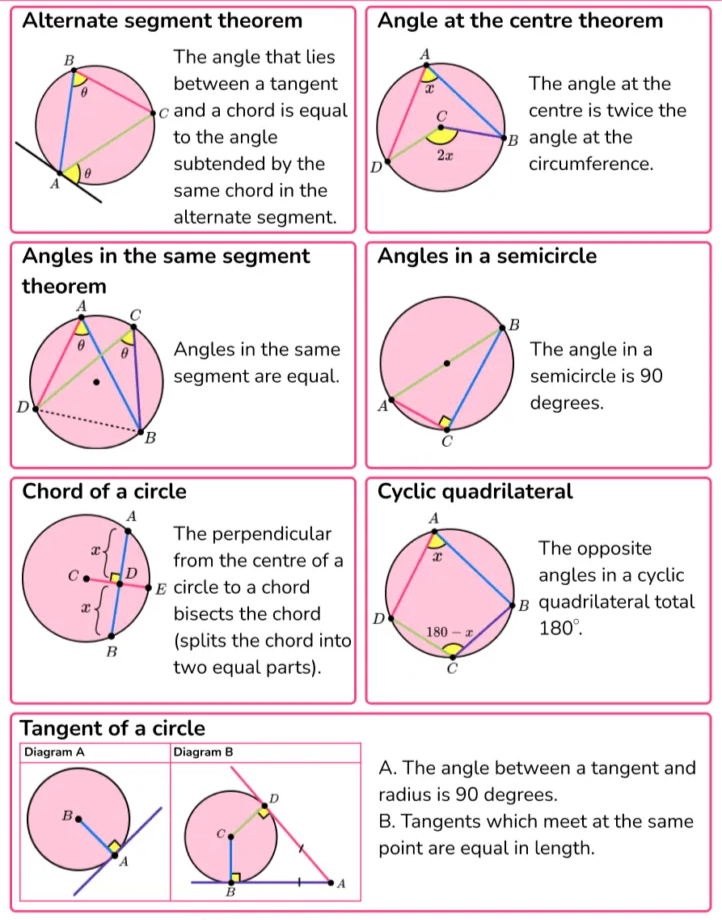
Angles in a Semicircle
- Statement: The angle subtended by a diameter at the circumference of a circle is always a right angle ().
- Why It Works: The diameter subtends a semicircle, and the angle formed at the circumference completes the triangle with two radii. The result is a right triangle.
Cyclic Quadrilateral Theorem
- Statement: Opposite angles of a cyclic quadrilateral (a quadrilateral inscribed in a circle) are supplementary.
- Why It Works: The opposite angles subtend arcs that together form the full circle (), leading to their sum being
Tangent to a Circle
- Statement: A tangent to a circle is perpendicular to the radius drawn to the point of contact.
- Why It Works: A tangent touches the circle at exactly one point, forming a right angle with the radius at that point.
Alternate Segment Theorem
- Statement: The angle between the tangent and a chord drawn at the point of contact is equal to the angle in the alternate segment of the circle.
- Why It Works: This results from the angles subtended by the chord in different segments being equal.
Circle Theorems Overview Diagram
Worked Examples
Note
Example 1: Intersecting Chords Theorem
Problem: Two chords and intersect at inside a circle.
If , , and , find .
Solution:
Step 1: Apply the Intersecting Chords Theorem:
Step 2: Substitute the known values:
Step 3: Solve for
Answer:
Note
Example 2: Angles in a Semicircle
Problem: A triangle is inscribed in a circle with one side as the diameter. Prove that the triangle is a right triangle.
Solution:
Step 1: The side as the diameter subtends an angle at the circumference.
Step 2: By the Angles in a Semicircle Theorem, this angle is
Answer: The triangle is a right triangle.
Note
Example 3: Cyclic Quadrilateral
Problem: In a cyclic quadrilateral, one pair of opposite angles measures and . Find .
Solution:
Step 1: Opposite angles in a cyclic quadrilateral are supplementary:
Step 2: Solve for :
Answer: .
Note
Example 4: Tangent to a Circle
Problem: A radius is drawn to point where a tangent meets the circle.
Prove that
Solution:
Step 1: Tangent to a Circle Theorem
According to the theorem, the tangent at a point of contact is perpendicular to the radius drawn to that point.
Step 2: Hence:
Answer:
Note
Example 5: Alternate Segment Theorem
Problem: A tangent touches a circle at point . A chord is drawn, and the angle between the tangent and the chord is .
Find the angle in the alternate segment subtended by .
Solution:
Step 1: By the Alternate Segment Theorem, the angle between the tangent and the chord is equal to the angle in the alternate segment.
Step 2: Hence, the angle in the alternate segment is
Answer: The angle in the alternate segment is
Summary
- Intersecting Chords Theorem: The products of the lengths of the segments of intersecting chords are equal.
- Angles in a Semicircle: The angle subtended by a diameter at the circumference is
- Cyclic Quadrilateral: Opposite angles are supplementary.
- Tangent to a Circle: A tangent is perpendicular to the radius at the point of contact.
- Alternate Segment Theorem: The angle between a tangent and a chord equals the angle in the alternate segment. These theorems provide powerful tools for solving problems involving circles and their properties.