The Cosine Rule (Leaving Cert Mathematics): Revision Notes
📚Revision Notes
The Cosine Rule
What is the Cosine Rule?
The Cosine Rule is a fundamental formula in trigonometry that helps us solve triangles when the Sine Rule cannot be used. Unlike the Sine Rule, which requires specific angle-side pairs, the Cosine Rule works when we have different combinations of known information.
Note
The Cosine Rule becomes essential when we encounter triangles where we cannot form the angle-opposite side pairs needed for the Sine Rule. This makes it a powerful alternative tool for triangle solving.
The Cosine Rule formula
For any triangle with sides , , and , and angles , , and opposite to these sides respectively, the Cosine Rule states:
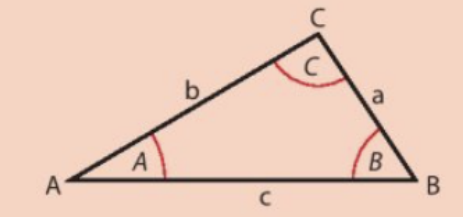
The three forms of the Cosine Rule are:
Each form allows us to find a different unknown element of the triangle, depending on what information we already have.
When to use the Cosine Rule
The Cosine Rule is used in two specific situations:
Important
Critical Applications of the Cosine Rule:
1. Finding a side when two sides and the included angle are given
When you know two sides of a triangle and the angle between them (the included angle), you can find the third side.
2. Finding an angle when all three sides are given
When you know the lengths of all three sides, you can rearrange the Cosine Rule formula to find any angle.
Example
Worked Example 1: Finding a Missing Side
Problem: In triangle ABC, , , and . Find to the nearest integer.
Solution: Let . Using the Cosine Rule formula :
Step 1: Substitute the known values
Step 2: Calculate each term
Step 3: Find the final answer
Answer: (to the nearest integer)
Example
Worked Example 2: Finding a Missing Angle
Problem: Find in a triangle where the sides are , , and .
Solution: To find angle , we rearrange the formula :
Step 1: Substitute known values
Step 2: Solve for cosine B
Step 3: Find the angle Using the inverse cosine function:
Answer: (to the nearest degree)
Important
When to use Sine Rule vs Cosine Rule:
- Generally, try the Sine Rule first when solving triangles
- Use the Cosine Rule when the Sine Rule cannot be applied
- The Cosine Rule is essential for the two scenarios described above
Key points to remember:
- When the cosine of an angle is negative, the angle lies between 90° and 180° (obtuse angle)
- Always check your calculator is in degree mode when working with degrees
- Round your final answer as specified in the question
Example
Worked Example 3: Step-by-Step Process
Problem: In triangle ABC with sides , , and included angle , find side .
Step 1: Identify what you know and what you need to find
- Known: two sides and included angle
- Unknown: third side
- Method: Cosine Rule
Step 2: Choose the correct form of the formula
Step 3: Substitute the values
Step 4: Solve for the unknown
Summary
Key Points to Remember:
- The Cosine Rule connects all three sides and one angle in a triangle
- Use it when you have two sides and the included angle, or when you have all three sides
- The Sine Rule should be tried first - use Cosine Rule when Sine Rule fails
- Negative cosine values indicate obtuse angles (between 90° and 180°)
- Always show your working clearly in exam solutions, substituting values step by step