The Theorem of Pythagoras (Leaving Cert Mathematics): Revision Notes
📚Revision Notes
The Theorem of Pythagoras
What is a right-angled triangle?
A right-angled triangle is a triangle that contains one angle of exactly 90 degrees. This special triangle has three sides, each with its own name based on its position relative to the right angle.
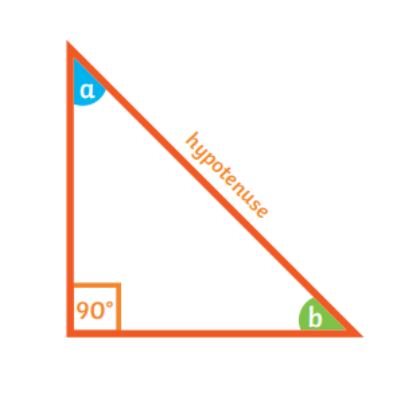
The most important side in a right-angled triangle is called the hypotenuse. This is the side that sits directly opposite the right angle, and it is always the longest side of the triangle.
Note
The hypotenuse is crucial for applying the Pythagorean theorem. Always identify this side first when working with right-angled triangles, as it forms the foundation for all calculations.
The theorem of Pythagoras
The theorem of Pythagoras is named after a Greek mathematician called Pythagoras, who is credited with proving this fundamental relationship in right-angled triangles. This theorem is one of the most important concepts in mathematics and has countless practical applications in engineering, construction, navigation, and many other fields.
Statement of the theorem
Important
The theorem of Pythagoras states: In a right-angled triangle, the area of the square drawn on the hypotenuse is equal to the sum of the areas of the squares drawn on the other two sides.
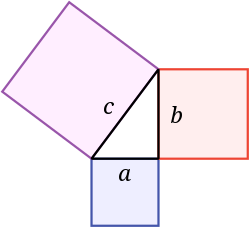
The pythagorean formula
This relationship can be written as a mathematical formula. If we label the sides of a right-angled triangle as , , and (where is the hypotenuse), then:
This formula tells us that when we square the length of the hypotenuse, it equals the sum of the squares of the other two sides.
Note
Remember that this formula only applies to right-angled triangles. The presence of a 90° angle is essential for the theorem to work.
Using the theorem - worked example
The Pythagorean theorem becomes much clearer when we see it applied to real problems. Let's work through a practical example to demonstrate the step-by-step process.
Example
Worked Example: Finding the Hypotenuse Length
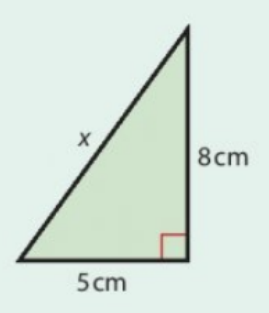
Given: Find the length of the side marked in the right-angled triangle where one side is 5 cm and another side is 8 cm.
Step 1: Identify which side is the hypotenuse Since is opposite the right angle, is the hypotenuse.
Step 2: Apply the pythagorean formula Using where (hypotenuse):
Step 3: Calculate the squares
Step 4: Find the square root
Check: The hypotenuse (9.4 cm) is indeed longer than both other sides (8 cm and 5 cm) ✓
Key points for exam success
Understanding the theory is important, but applying it correctly in exams requires following systematic approaches and avoiding common mistakes.
Summary
Essential Points to Remember:
- Always identify the hypotenuse first - it's the side opposite the right angle and the longest side
- Make sure you square each length before adding or subtracting
- Remember to take the square root at the end to find the actual length
- Check your answer makes sense - the hypotenuse should be longer than the other two sides
- Give your answer to the required number of decimal places as specified in the question
Common exam techniques
When solving pythagorean problems, follow this systematic approach to ensure accuracy and completeness:
Note
Step-by-Step Problem-Solving Method:
- Identify the right angle and mark it clearly
- Label the hypotenuse (longest side, opposite right angle)
- Write the formula
- Substitute the known values
- Calculate step by step
- Check your answer is reasonable
This methodical approach helps prevent errors and ensures you don't miss important steps during exam pressure.
Important
Common Mistakes to Avoid:
- Don't forget to take the square root at the final step
- Never assume which side is longest without checking the right angle position
- Always verify your answer makes geometric sense
- Be careful with calculator rounding - check the required precision
Remember!
Summary
Key Takeaways:
- The hypotenuse is always the longest side and sits opposite the right angle
- The pythagorean formula is where is the hypotenuse
- Always square the lengths first, then add or subtract, then take the square root
- The theorem only works for right-angled triangles- check for the 90° angle first
- Your final answer should be the longest side if you're finding the hypotenuse