Latent Heat (Leaving Cert Physics): Revision Notes
📚Revision Notes
Latent Heat
What is latent heat?
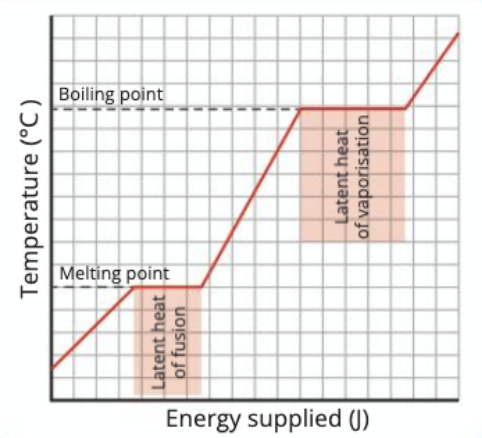
When a substance changes from one state to another (like ice melting into water), something interesting happens. Even though you keep adding heat energy, the temperature stays exactly the same during the change. This might seem strange, but it's a fundamental property of matter.
Note
Latent heat is the energy needed to change the state of a substance without changing its temperature. The word "latent" means "hidden" - the heat energy is being used to break or form bonds between molecules rather than making them move faster (which would increase temperature).
Understanding the process
Think about boiling water. When water reaches 100°C, it starts turning into steam. Even if you keep heating it vigorously, the water temperature stays at 100°C until all the water has turned to steam. All that extra heat energy is going into changing liquid water molecules into gas molecules.
The same thing happens in reverse. When steam condenses back into water, it releases the same amount of energy that was needed to turn it into steam in the first place.
Types of latent heat
There are two main types of latent heat, depending on which phase change is occurring:
Latent heat of fusion
- This is the energy needed to change a substance from solid to liquid (melting)
- Or the energy released when changing from liquid to solid (freezing)
- For water, this happens at 0°C
Latent heat of vaporisation
- This is the energy needed to change a substance from liquid to gas (boiling/evaporation)
- Or the energy released when changing from gas to liquid (condensation)
- For water, this happens at 100°C
The symbol for latent heat is L, and it's measured in joules (J).
Specific latent heat
Since different amounts of substance require different amounts of energy to change state, scientists use specific latent heat to make calculations easier.
Specific latent heat (symbol: l) is the amount of heat energy needed to change the state of 1 kg of a substance without changing its temperature.
Important
The key formula is:
Where:
- Q = heat energy needed (J)
- m = mass of substance (kg)
- l = specific latent heat (J kg⁻¹)
This formula allows you to calculate the energy required for any phase change when you know the mass and specific latent heat of the substance.
Thermal equilibrium and phase changes
When ice, water, and air are all at 0°C, they're in thermal equilibrium. This is a special temperature where ice can exist alongside liquid water.
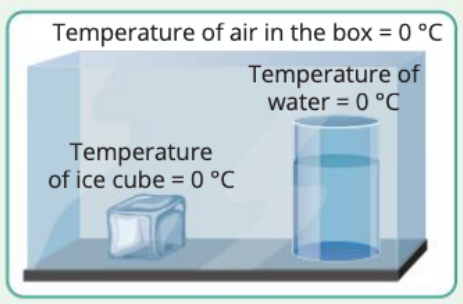
At this point, if you add heat energy, the ice will start to melt but the temperature won't change until all the ice has melted. This demonstrates latent heat of fusion in action.
Worked example: calculating latent heat
Example
Worked Example: Analysing a Heating Curve
Let's look at a practical problem. The graph below shows what happens when energy is added to 150g of crushed ice at -3°C.
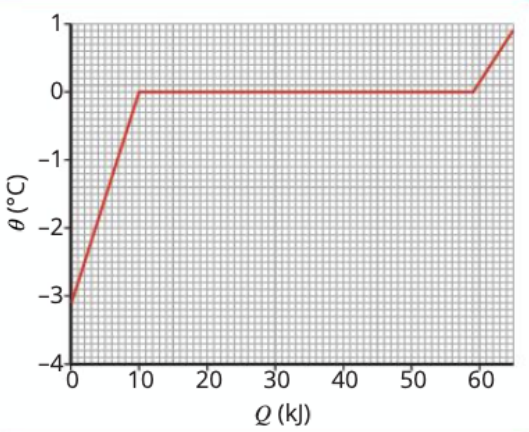
Step 1: Analyse the graph sections From this graph, you can see:
- The temperature rises from -3°C to 0°C (heating the ice)
- The temperature stays at 0°C while the ice melts (latent heat of fusion)
- The temperature rises again once all ice has melted (heating the water)
Step 2: Identify the latent heat section To find the latent heat of fusion, you look at the horizontal section where temperature stays constant while energy is still being added.
Step 3: Apply the formula Use with the energy absorbed during the horizontal section to calculate the specific latent heat of fusion.
Real-world applications
Understanding latent heat is crucial for:
- Calorimetry experiments - calculating final temperatures when ice is added to warm water
- Weather patterns - understanding why coastal areas have milder temperatures
- Cooking - knowing why food takes longer to cook at high altitudes where water boils at lower temperatures
- Refrigeration - how fridges and air conditioners work
Note
The large amount of energy required for phase changes makes latent heat particularly important in weather systems. When water vapour condenses to form clouds, it releases enormous amounts of energy that can fuel storms and weather patterns.
Important values to remember
Summary
Key Values for Water:
- Specific latent heat of fusion: 334,000 J kg⁻¹ (or 3.34 × 10⁵ J kg⁻¹)
- Specific latent heat of vaporisation: 2,260,000 J kg⁻¹ (or 2.26 × 10⁶ J kg⁻¹)
Important observation: Notice that it takes much more energy to turn water into steam than it does to melt ice into water.
Key takeaways
Summary
Essential Points to Remember:
- Latent heat is the energy needed to change state without changing temperature
- There are two types: fusion (solid↔liquid) and vaporisation (liquid↔gas)
- The formula lets you calculate energy needed for any mass of substance
- Specific latent heat is measured in J kg⁻¹ and is different for each substance
- During phase changes, temperature stays constant even though energy is being added or removed