Fission and Fusion (Leaving Cert Physics): Revision Notes
📚Revision Notes
Fission and Fusion
Nuclear fission and fusion are two fundamental nuclear processes that involve changes in atomic nuclei and release enormous amounts of energy. Understanding these processes is crucial for grasping modern nuclear physics and their applications in both peaceful energy generation and weapons.
Nuclear fission
Nuclear fission occurs when a large, heavy nucleus splits into two smaller nuclei of roughly similar size. This process releases tremendous energy along with neutrons that can trigger further reactions.

Key characteristics of nuclear fission:
- Large nuclei (like uranium-235) break apart when struck by neutrons
- Energy is released because the binding energy per nucleon is greater in medium-sized nuclei than in very heavy ones
- Typically releases 2-3 neutrons per fission event
- Each fission releases about 200 MeV of energy
Note
The energy released in nuclear fission comes from the conversion of a small amount of mass into energy, following Einstein's famous equation E=mc². This mass-energy conversion is what makes nuclear reactions so much more powerful than chemical reactions.
Fission of uranium
Natural uranium consists mainly of two isotopes: uranium-238 (99.3%) and uranium-235 (0.7%). When uranium-235 is bombarded with slow neutrons (called thermal neutrons), it readily undergoes fission.
The fission process:
- A slow neutron collides with a uranium-235 nucleus
- The nucleus becomes unstable and splits into two smaller nuclei (fission fragments)
- Additional neutrons are released
- Large amounts of energy are given out
Example
Worked Example: Typical Fission Reaction
A typical fission reaction can be written as:
In this reaction:
- One uranium-235 nucleus absorbs one neutron
- It splits into barium-144 and krypton-90 fragments
- Two additional neutrons are released
- About 200 MeV of energy is released
The fission fragments are usually highly radioactive, and their masses vary from one fission event to another, though they are roughly similar in size.
Chain reactions
The neutrons produced during fission can go on to cause further fission reactions in other uranium-235 nuclei. This creates a chain reaction where each fission event potentially triggers more fissions.
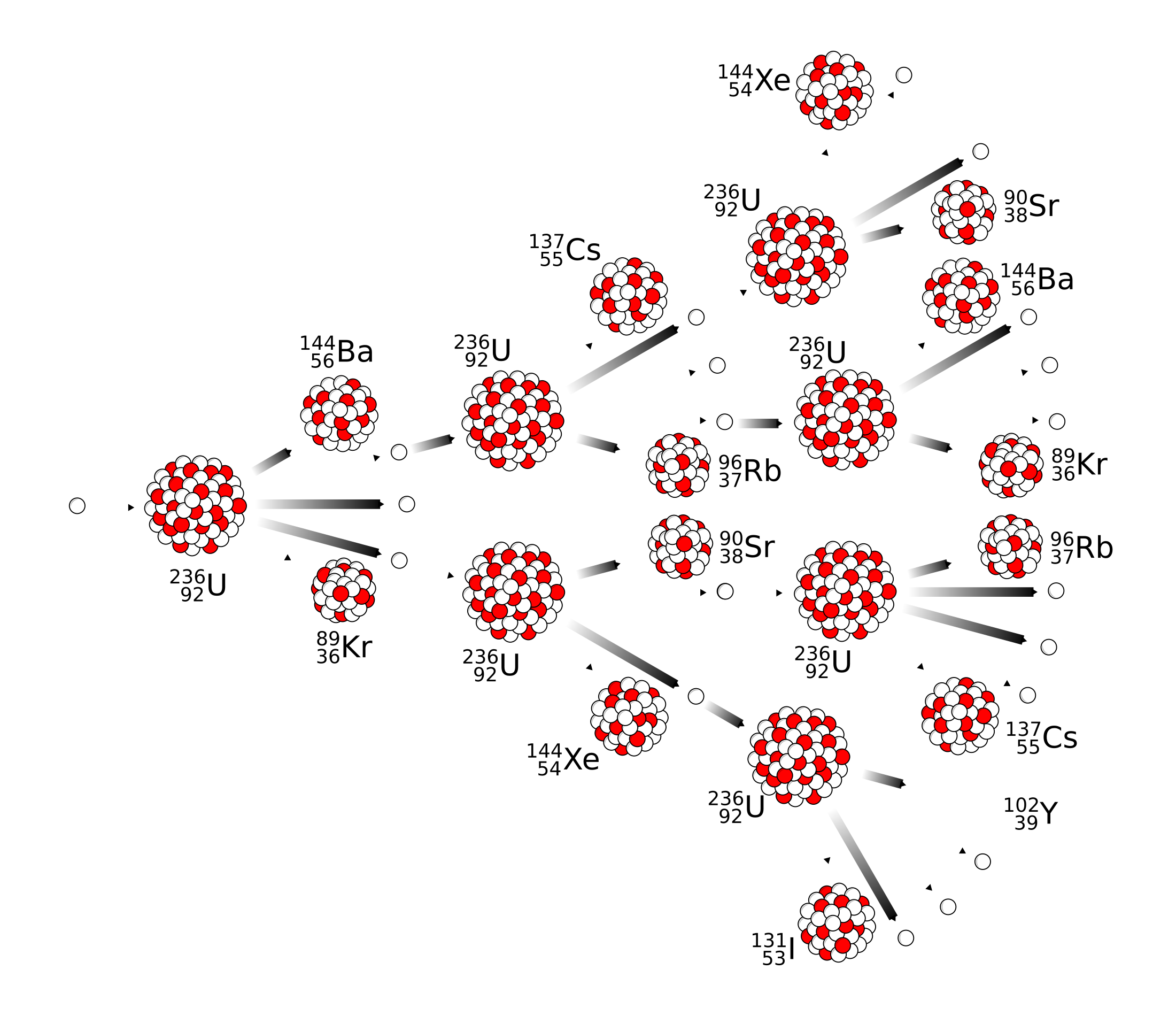
Important
Critical Mass and Size:
In small samples of fissile material, many neutrons escape without causing further fission. As the sample size increases, more neutrons are available to trigger additional reactions. The critical size is reached when the chain reaction becomes self-sustaining. For uranium-235, this critical mass is about 10 kg.
Chain reaction outcomes:
- Controlled chain reaction: Used in nuclear reactors for electricity generation
- Uncontrolled chain reaction: Results in nuclear explosions (atomic bombs)
Nuclear reactors (controlled fission reaction)
Nuclear reactors harness the energy from controlled fission reactions to generate electricity safely and efficiently.
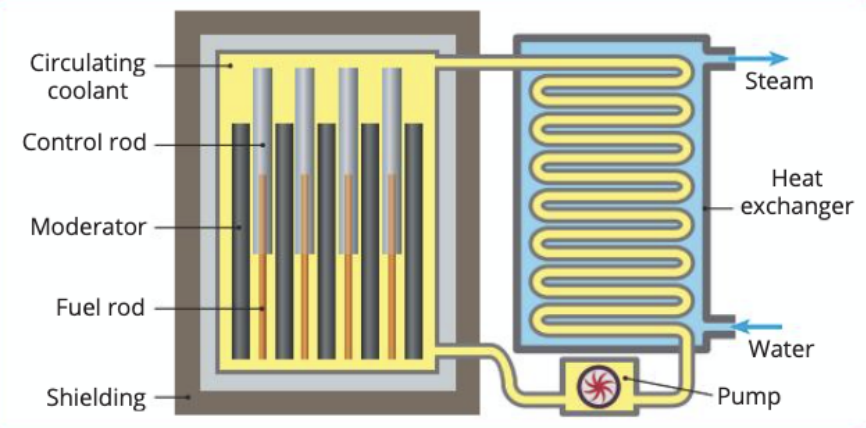
The thermal nuclear reactor
Nuclear reactors contain several essential components that work together to maintain safe, controlled nuclear reactions:
Key components of a nuclear reactor:
Fuel rods: Contain uranium slightly enriched with uranium-235. Since the majority of natural uranium atoms are uranium-238, neutrons are captured without producing fission.
Note
The fuel used in most commercial reactors is only about 3-5% uranium-235, compared to the 0.7% found in natural uranium. This enrichment process is complex and requires significant technology and resources.
Moderator: Made of graphite or heavy water (D₂O), containing deuterium isotopes. The moderator slows down fast neutrons, converting them to thermal neutrons that are more likely to cause fission in uranium-235.
Control rods: Usually made from steel containing cadmium or boron. These materials absorb neutrons effectively. Moving control rods in or out of the reactor core controls the reaction rate:
- Inserting them deeper slows the reaction
- Removing them increases the reaction rate
Coolant: Takes heat from the reactor core where steam is produced. The circulating coolant transfers heat to a heat exchanger where steam drives turbines to generate electricity.
Shielding: Prevents radiation from escaping since fission fragments are highly radioactive.
Important
Safety Features:
Even if the chain reaction stops, the reactor core continues producing heat from radioactive decay. Efficient cooling systems must operate continuously after shutdown, and multiple backup systems ensure safe operation. This is why nuclear accidents can occur even after a reactor is "shut down."
The atomic bomb (uncontrolled fission reaction)
In an atomic bomb, large masses of fissile material (uranium-235 or plutonium-239) are suddenly brought together to achieve supercritical mass. This results in an uncontrolled chain reaction with enormous energy release.
Important
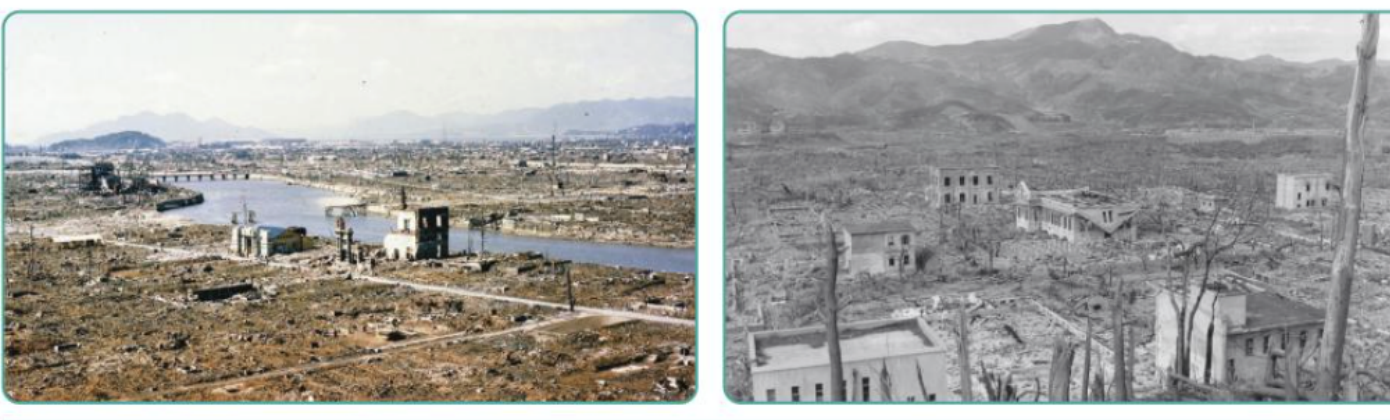
The devastating effects of atomic bombs were demonstrated when they were used on Hiroshima and Nagasaki during World War II. These weapons showed the incredible destructive potential of uncontrolled nuclear fission, with long-lasting consequences for the affected populations.
Environmental impact of fission reactors
While nuclear power provides clean electricity generation, several environmental challenges exist:
Mining uranium ore: Extracting uranium releases radon gas, which can cause lung cancer in miners. Areas around mines may contain radioactive materials that pose long-term health risks.
Important
Major Nuclear Accidents:
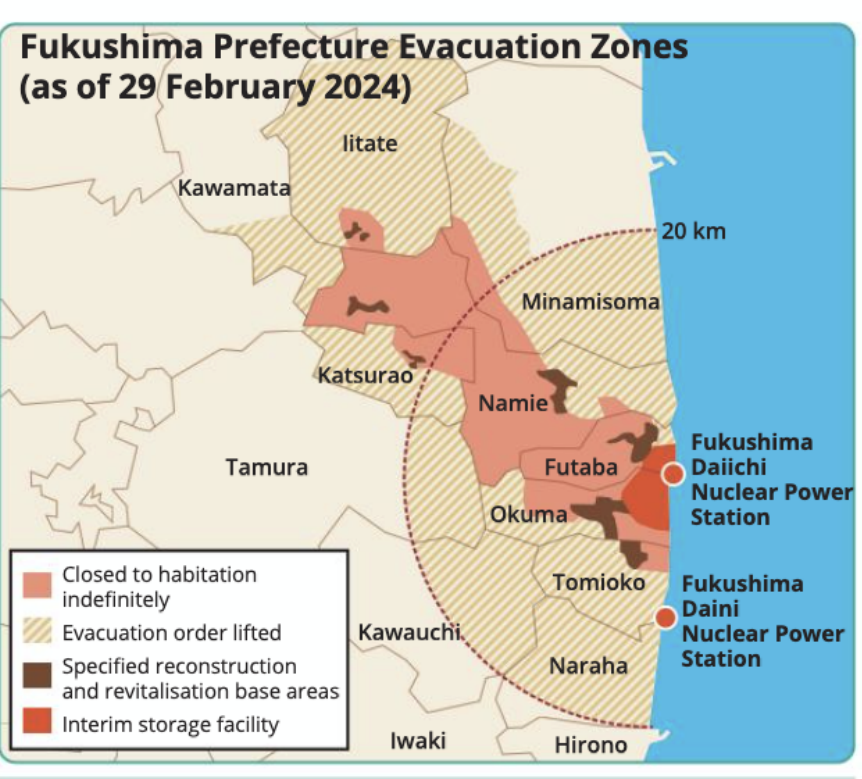
Accidents involving reactor components have occurred, with serious consequences when radioactivity escapes into the atmosphere or leaks from cooling systems. Major accidents like Chernobyl (1986) and Fukushima (2011) demonstrate these risks and their long-term impact on surrounding communities and ecosystems.
Waste disposal challenges:
- Spent fuel rods: Must be removed and transferred to cooling ponds, then transported to reprocessing plants to separate uranium and plutonium from fission fragments
- Radioactive waste: Highly toxic waste products require secure storage for extremely long periods
- Long-term storage: This presents significant challenges for future generations
Note
Advantages of Nuclear Power:
Despite these challenges, fission reactors produce no carbon dioxide emissions, making them valuable for low-carbon electricity generation and helping address climate change.
Nuclear fusion
Nuclear fusion involves joining two small, light nuclei together to form a larger nucleus, releasing energy in the process.
Common fusion reactions:
- Deuterium + tritium fusion:
- Deuterium + deuterium fusion:
Note
Why fusion releases energy: Light nuclei have lower binding energy per nucleon than medium-sized nuclei. When light nuclei fuse, the products are more tightly bound, releasing the excess energy.
Fusion process requirements
Overcoming coulomb repulsion: Since all nuclei are positively charged, they naturally repel each other. Fusion can only occur when nuclei are forced together with sufficient energy to overcome this electrical repulsion.
Important
Extreme conditions needed:
- Very high temperatures: Typically greater than 10⁸ K
- High pressure: To force nuclei close enough together
- Sustained conditions: Energy must be continuously supplied to maintain the reaction
These conditions are so extreme that they have proven extremely difficult to achieve and maintain in a controlled way on Earth.
Advantages of fusion over fission
Safety benefits:
- Less radioactive waste: Fusion produces much less long-lived radioactive waste
- No possibility of runaway reactions: Unlike fission chain reactions, fusion stops immediately if conditions aren't maintained
- Abundant fuel supply: Deuterium is readily available in seawater and can be extracted relatively cheaply
Current challenges:
- Technical difficulties: No one has yet achieved a sustained, controlled fusion reaction that produces more energy than it consumes
- Engineering challenges: Creating and maintaining the extreme conditions required for fusion
- Research investment: Significant research effort continues worldwide to develop practical fusion power
Note
Natural fusion: The Sun's energy comes from nuclear fusion reactions in its interior, where hydrogen nuclei fuse to form helium under the extreme conditions of temperature and pressure found there.
Remember!
Summary
Key Points to Remember:
-
Nuclear fission splits heavy nuclei into smaller fragments, releasing energy and neutrons that can sustain chain reactions
-
Controlled fission in nuclear reactors generates electricity safely using moderators, control rods, and cooling systems
-
Nuclear fusion joins light nuclei to form heavier ones, potentially offering cleaner energy but requiring extreme conditions
-
Environmental challenges of fission include radioactive waste disposal, mining hazards, and accident risks, though it produces no carbon emissions
-
Fusion advantages include abundant fuel, minimal radioactive waste, and no possibility of runaway reactions, but technical challenges remain unsolved