Speed and Displacement (Leaving Cert Physics): Revision Notes
📚Revision Notes
Speed and Displacement
What is speed?
Speed tells us how fast something is moving. In physics, we define speed as the rate at which distance changes with respect to time. Think of it as how much distance you cover in a certain amount of time.
Speed is what we call a scalar quantity. This means it only tells us the magnitude (how much) but not the direction. The standard unit for measuring speed is metres per second, written as m s⁻¹ or m/s.
The basic formula for speed is:
Note
A scalar quantity has magnitude but no direction - it tells us "how much" but not "which way". This is different from vector quantities which we'll explore with displacement.
Understanding average speed
When you're travelling, your speed rarely stays exactly the same throughout your journey. Sometimes you speed up, sometimes you slow down. For example, when you drop something, it moves downwards with increasing speed due to gravity.
Average speed gives us a way to describe the overall speed for an entire journey, even when the actual speed varies. We calculate it using:
This is particularly useful when analysing journeys where speed changes frequently, such as a car trip through varying traffic conditions.
Note
Average speed is especially important in real-world scenarios where constant speed is rare. It gives us a single value that represents the overall performance of a journey, regardless of speed variations during the trip.
Instantaneous speed
Sometimes we want to know the exact speed of an object at one specific moment in time. This is called instantaneous speed.

When you look at a speedometer in a car, the reading shows you the instantaneous speed at that precise moment. If the reading shows 10 m s⁻¹, it doesn't necessarily mean the car travelled 10 m in the previous second, nor does it guarantee it will travel 10 m in the next second.
Measuring instantaneous speed
To measure instantaneous speed accurately, we need to measure the average speed over a very short time interval or a very small distance. The shorter the time interval, the more accurate our measurement becomes.
Important
If we measure average speed over a very short time interval or distance, the calculated value approximates the instantaneous speed to a high degree of accuracy at any moment during that brief interval.
Constant speed
An object has constant speed when it travels at exactly the same rate throughout its journey - it neither speeds up nor slows down. When speed is constant, the average speed equals the instantaneous speed at any point during the journey.
The term "steady" or "uniform" speed is sometimes used instead of "constant speed" to describe this type of motion.

What is displacement?
While speed tells us how fast something moves, displacement tells us about position and direction. Displacement is the distance measured in a specific direction from a starting point to an ending point.
Key characteristics of displacement:
- It's a vector quantity (has both magnitude and direction)
- The symbol for displacement is s
- It's measured in metres (m)
- Direction matters - displacement can be positive or negative depending on the chosen direction
Note
The key difference between scalar and vector quantities becomes clear when comparing speed and displacement. While speed only tells us "how fast," displacement tells us both "how far" and "in which direction."
The difference between distance and displacement
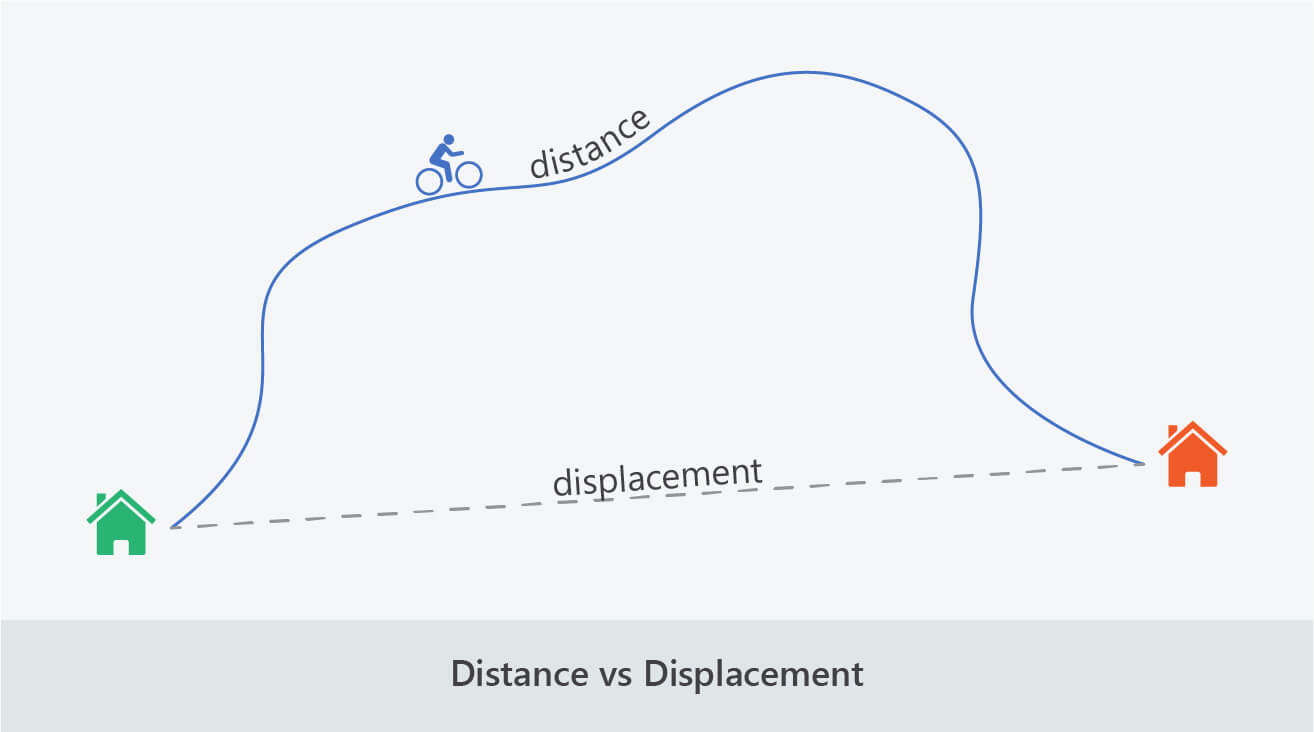
This is a crucial concept to understand. Distance is the total length of the path travelled, while displacement is the straight-line distance from start to finish in a particular direction.
Example
Practical Example: Distance vs Displacement
Imagine walking from point A to point B. If you take a winding path that covers 100 metres total, your distance travelled is 100 m. However, if points A and B are only 40 metres apart in a straight line, your displacement is 40 m in the direction from A to B.
This shows why distance (scalar) and displacement (vector) can have very different values for the same journey.
Worked examples
Example
Worked Example 1: Average speed calculation
Problem: A sprinter runs 200 metres in 22 seconds. Calculate her average speed over the 200 m.
Solution:
Example
Worked Example 2: Time calculation using speed
Problem: A man walks with an average speed of 2 m s⁻¹. How long will it take him to walk 1 km?
Solution:
Example
Worked Example 3: Speed and time calculations
Problem: A dog runs along a road at a constant speed of 3 m s⁻¹. a) How far will it travel in 10 s? b) How far will it travel in ½ hour?
Solution: a) Distance = speed × time = 3 × 10 = 30 m
b) First convert hours to seconds: 0.25 hours = 15 minutes = 900 seconds Distance = speed × time = 3 × 900 = 2700 m
Summary
Key Points to Remember:
- Speed is scalar - it only tells us how fast, not which direction
- Displacement is vector - it includes both distance and direction
- Average speed = total distance ÷ total time taken
- Instantaneous speed is the speed at one specific moment
- Constant speed means the speed never changes during the journey
- The unit for speed is m s⁻¹ (metres per second)
- Distance travelled is often different from displacement when the path isn't straight