Time and Distance (Leaving Cert Physics): Revision Notes
📚Revision Notes
Time and Distance
Time and distance are fundamental quantities in physics that we use to describe motion and measure the physical world around us. Both are scalar quantities, meaning they have magnitude but no specific direction associated with them.
Time
Time is one of the most basic measurements in physics, allowing us to quantify how long events take to occur and to sequence when things happen.
The SI unit and measurement
The International System of Units (SI) defines the second (s) as the standard unit for measuring time. Time is represented by the symbol t and is classified as a scalar quantity, which means it only has magnitude and no directional component.
When working with different time scales, you'll encounter various units:
- Milliseconds (ms):
- Microseconds (μs):
- Nanoseconds (ns):
Measuring time in practice
Different situations require different timing instruments depending on the precision needed:
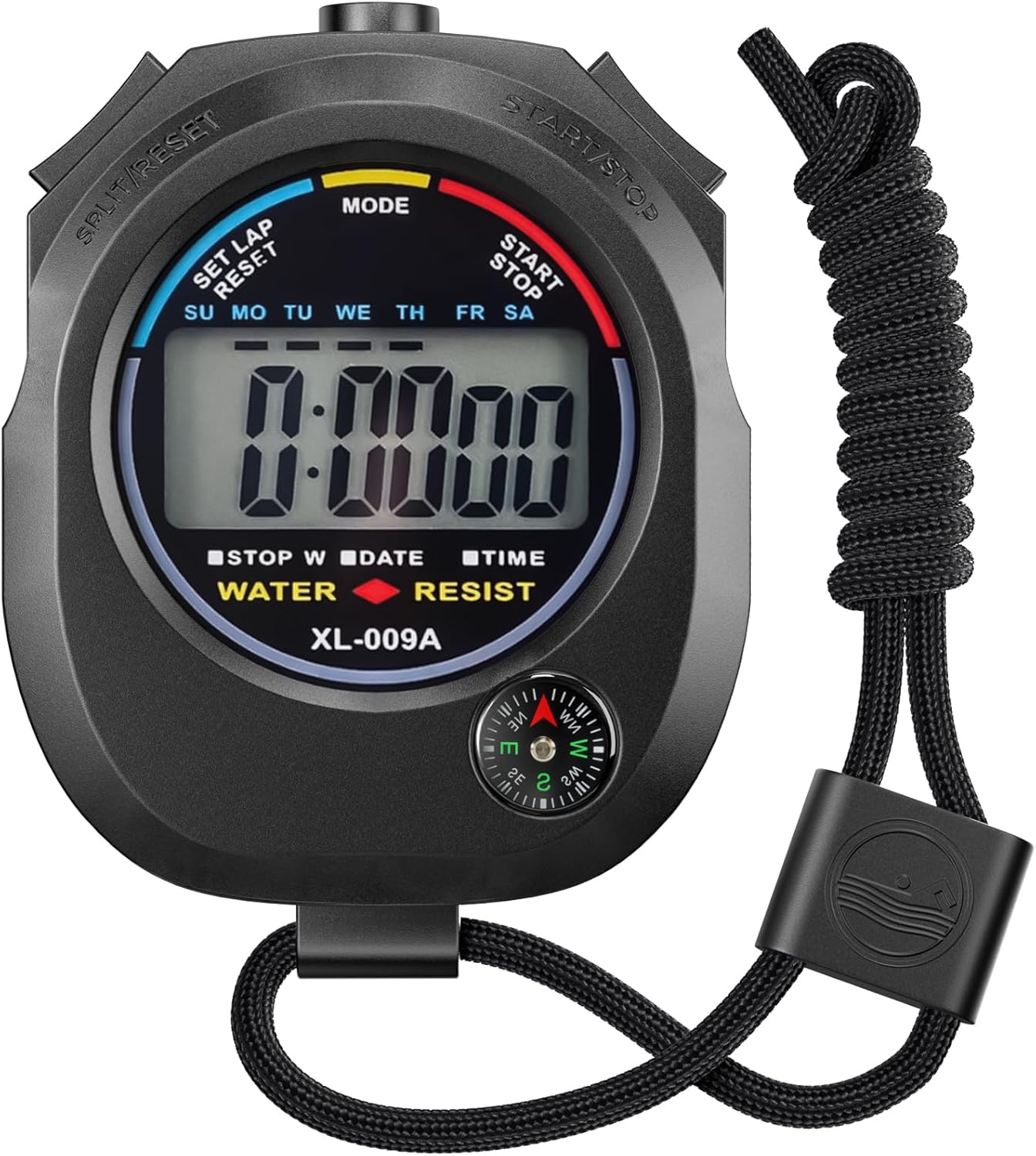
For everyday timing, mechanical stopwatches can measure time intervals with reasonable accuracy for sports and general laboratory work.
Digital electronic timers provide greater precision and can measure very short time intervals, making them essential for accurate scientific measurements.
Note
The choice of timing device depends on the precision required for your specific measurement. When solving numerical problems in physics, always express your final time measurements in seconds to maintain consistency with SI units.
Worked example: time conversions
Example
Worked Example: Converting Years to Seconds
Let's look at converting between different time units. If we want to know how many seconds are in one year:
Step 1: Start with the basic conversion
- 1 year = 365 days
Step 2: Convert days to hours
- 365 days × 24 hours/day = 8,760 hours
Step 3: Convert hours to minutes
- 8,760 hours × 60 minutes/hour = 525,600 minutes
Step 4: Convert minutes to seconds
- 525,600 minutes × 60 seconds/minute = 31,536,000 seconds
Answer: 1 year ≈ 3.15 × 10⁷ seconds
Distance
Distance tells us how much space separates two points, regardless of the path taken between them. Understanding how to measure distance accurately is crucial for many physics calculations.
The SI unit and properties
The metre (m) serves as the SI unit for measuring distance. Distance can be represented by the symbol s or d and is also a scalar quantity - it describes only how far apart things are, not the direction between them.
Different distance scales require different measurement approaches:
- Small distances: centimetres (cm), millimetres (mm)
- Medium distances: metres (m)
- Large distances: kilometres (km)
Laboratory measurement techniques
The method you choose for measuring distance depends on the scale and precision required:
For longer distances, use a measuring tape or metre stick. These tools work well when measuring distances of several centimetres to metres, such as the length of a laboratory bench or the dimensions of a room.
Note
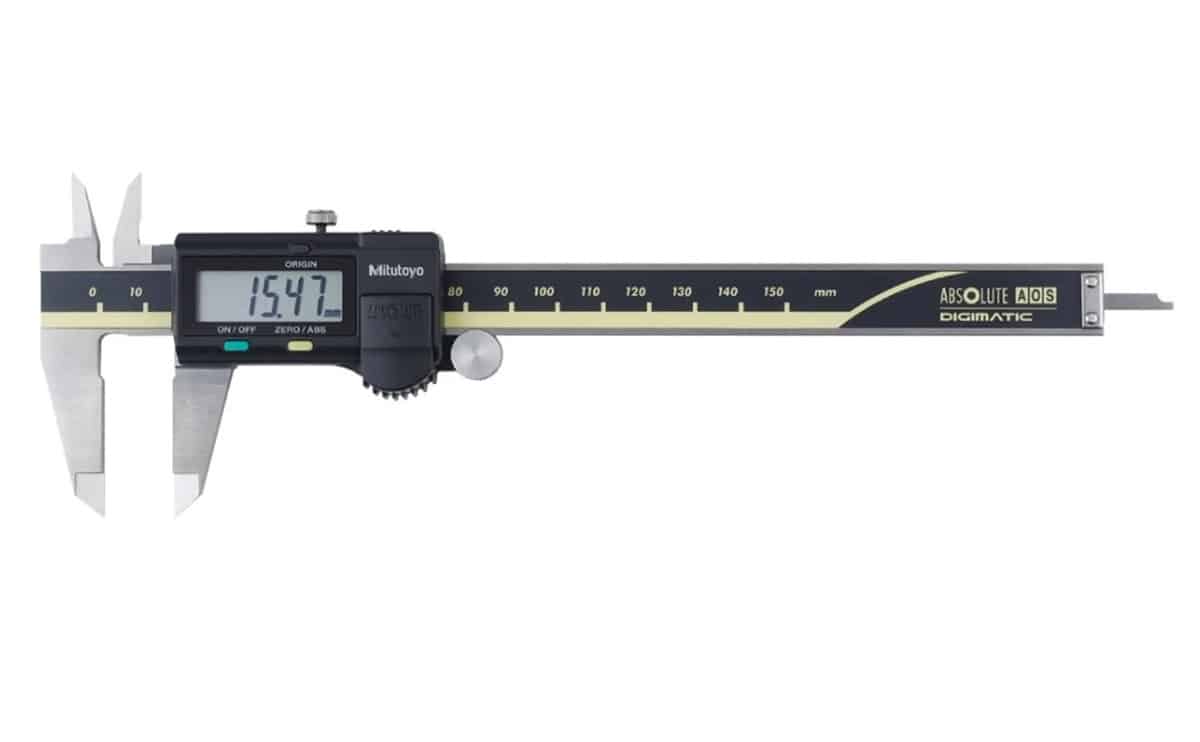
For precise small measurements, vernier callipers (also called digital callipers) can measure both internal and external dimensions with high accuracy, typically to 0.01 cm or even 0.001 cm precision.
Both analogue and digital versions of vernier callipers are available. Digital versions display measurements directly on an LCD screen, while analogue versions require reading scales manually but can be just as accurate when used correctly.
Measurement considerations
Important
When conducting laboratory measurements, consider these important points:
- Always choose the most appropriate measuring instrument for your required precision
- Take multiple measurements when possible and calculate an average to reduce random errors
- Be aware of the limitations of your measuring device - a metre stick cannot provide the same precision as vernier callipers
- For very small time intervals or distances, direct measurement may be impractical, requiring indirect measurement techniques
Practical measurement challenges
Note
Sometimes direct measurement isn't feasible. For example, if you need to measure the time for a mass to complete one oscillation of a pendulum, the time interval might be too short to measure accurately with a standard stopwatch.
In such cases, you might measure the time for multiple oscillations and then divide by the number of complete cycles to find the period of one oscillation.
Summary
Key Points to Remember:
-
Time is measured in seconds (s) and distance is measured in metres (m) - these are the SI units you should use in calculations
-
Both time and distance are scalar quantities, meaning they have magnitude but no specific direction
-
Choose your measuring instruments based on the precision required: stopwatches and metre sticks for general measurements, electronic timers and vernier callipers for precision work
-
When dealing with very small or very large time intervals, use scientific notation and appropriate unit prefixes (ms, μs, ns for time)
-
Always express final answers in SI units for consistency in physics problems and calculations