Travelling Waves and Transfer of Energy (Leaving Cert Physics): Revision Notes
📚Revision Notes
Travelling Waves and Transfer of Energy
What are travelling waves?
Note
A travelling wave is a disturbance that moves from one place to another, carrying energy without transferring matter. Think of it like a ripple spreading across a pond - the wave moves outward, but the water itself doesn't travel with the wave.
Waves can be found everywhere in physics, from water waves and sound waves to light waves and radio signals. Understanding how they work is essential for explaining many natural phenomena.
Types of travelling waves
Mechanical waves
Mechanical waves need a medium (a substance) to travel through. This medium can be:
- A solid (like waves on a rope or string)
- A liquid (like water waves)
- A gas (like sound waves in air)
Important
The key point is that mechanical waves cannot travel through empty space (a vacuum). When a mechanical wave passes through a medium, it creates vibrations that pass from one molecule to the next, allowing the wave to propagate.
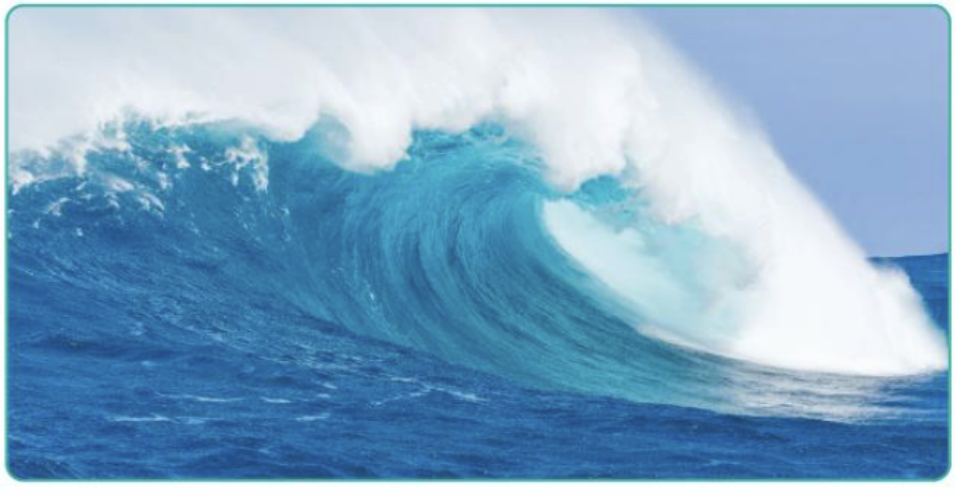
Examples of mechanical waves include:
- Waves on a rope or string
- Water waves
- Sound waves
- Seismic waves from earthquakes
Electromagnetic waves
Electromagnetic waves are quite different from mechanical waves. They can travel through a vacuum and don't need any medium at all. In empty space, all electromagnetic waves travel at the same incredible speed: metres per second (300 million metres per second). This speed is called the speed of light.
Examples of electromagnetic waves include:
- Light waves
- Radio waves
- Microwaves
- X-rays
- Gamma rays
How waves transfer energy
Energy transfer without matter transfer
Important
One of the most important concepts about waves is that they transfer energy from one place to another without transferring matter. This might seem confusing at first, so let's break it down.
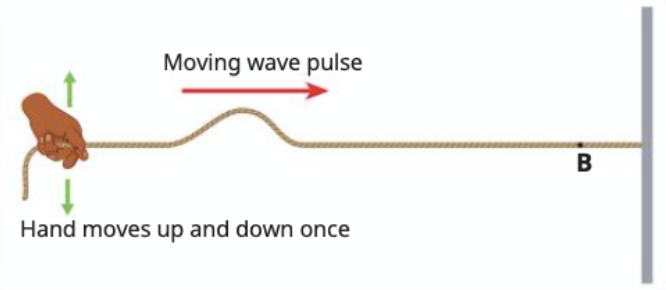
When you move the end of a rope up and down, you create a wave pulse that travels along the rope. The rope itself doesn't move from your hand to the other end - instead, each part of the rope moves up and down in its own position, passing the disturbance along.
The role of kinetic energy
When a wave passes through a medium, the particles in that medium vibrate around their normal rest position. As they vibrate, they gain and lose kinetic energy. This energy gets passed from particle to particle, allowing the wave to travel forwards while the particles themselves stay roughly in the same place.
Example
Real-World Example: The Stadium Wave
Think of it like a crowd doing "the wave" at a sports stadium - each person stands up and sits down in their own seat, but the wave effect travels around the stadium. The people (like particles in a medium) stay in their positions, but the energy and motion pattern moves through the crowd.
Examples of wave motion
Waves on a rope
If you shake one end of a rope up and down once, you create a single wave pulse that travels along the rope. This demonstrates a transverse wave, where the particles of the rope move perpendicular (at right angles) to the direction the wave is travelling.
Compression waves on a spring
When you push and pull one end of a spring back and forth, you create compression waves that travel along the spring. These are longitudinal waves, where the coils of the spring move parallel to (in the same direction as) the wave's travel.
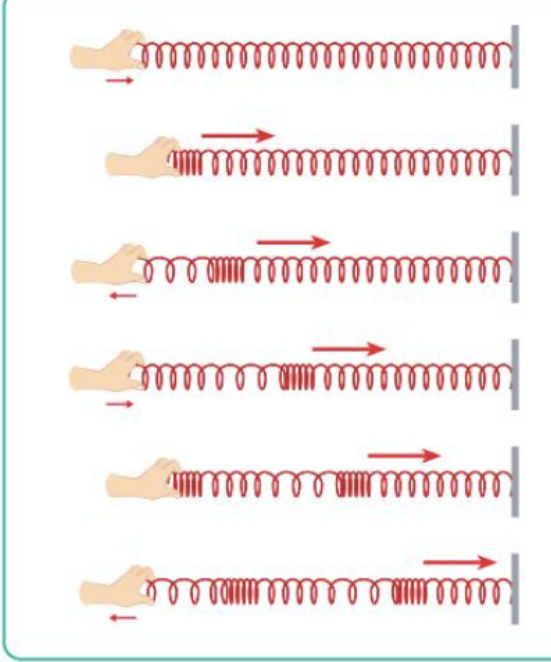
The spring alternates between:
- Compression - where the coils are squeezed together
- Rarefaction - where the coils are stretched apart
Water waves
Water waves are a good example of mechanical waves. When you drop a stone into calm water, the disturbance creates circular waves that spread outward from the point of impact. The water molecules move up and down, but they don't flow outward with the wave.
Periodic travelling waves
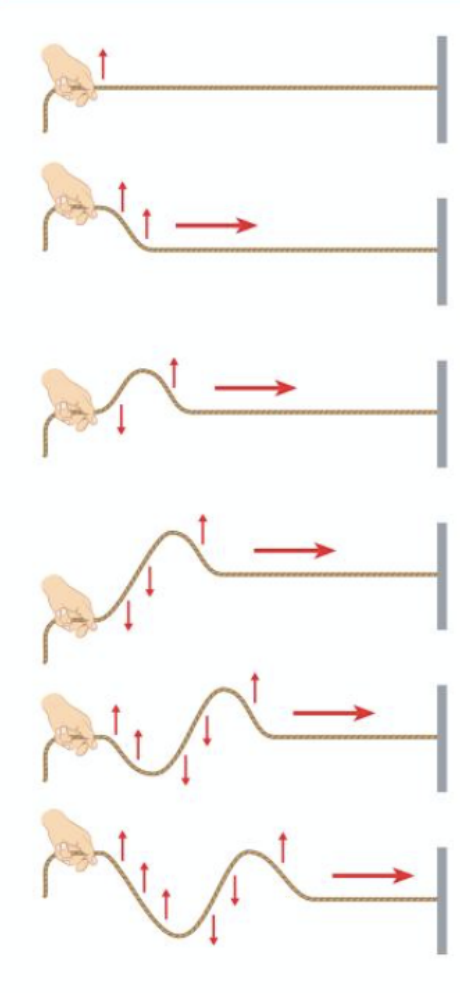
When you continuously move the end of a rope or spring up and down in a regular pattern, you create periodic travelling waves. These are waves that repeat the same pattern over and over again as they travel.
Note
Key Wave Characteristics
Periodic waves have several important characteristics:
- Wavelength - the distance between two identical points on the wave
- Frequency - how many complete waves pass a point per second
- Amplitude - the maximum displacement from the rest position
- Period - the time taken for one complete wave to pass a point
Key differences: mechanical vs electromagnetic
Note
The following table summarises the key differences between mechanical and electromagnetic waves:
| Property | Mechanical Waves | Electromagnetic Waves |
|---|---|---|
| Medium needed? | Yes - solid, liquid, or gas | No - can travel through vacuum |
| Speed | Varies depending on medium | m/s in vacuum |
| Examples | Sound, water waves, seismic waves | Light, radio waves, X-rays |
| Energy transfer | Through particle vibrations | Through electric and magnetic fields |
Summary
Key Points to Remember:
- Travelling waves transfer energy, not matter - the wave moves but the medium stays in place
- Mechanical waves need a medium to travel through (solid, liquid, or gas)
- Electromagnetic waves can travel through empty space at the speed of light ( m/s)
- Wave pulses are single disturbances, while periodic waves repeat continuously
- Energy is transferred through particle vibrations in mechanical waves, allowing the disturbance to propagate from place to place