Wave Behaviour (Leaving Cert Physics): Revision Notes
📚Revision Notes
Wave Behaviour
When waves travel through different environments or encounter obstacles, they exhibit several fascinating behaviours. Understanding these behaviours helps us explain many phenomena we observe in everyday life, from echoes to rainbows to radio reception.
Reflexion
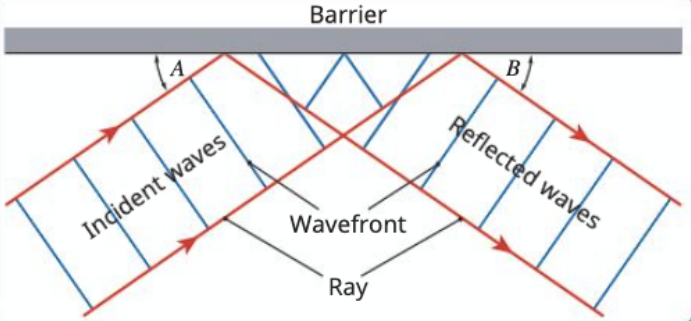
When a wave encounters an obstacle in its path, it bounces off that obstacle. This bouncing behaviour is called reflexion. All types of waves can undergo reflexion, whether they are sound waves, light waves, water waves, or any other form of wave motion.
Note
Key Definition: Reflexion is the bouncing of waves off an obstacle in their path. This fundamental wave behaviour occurs with all wave types and follows predictable patterns.
The key points about wave reflexion include:
- Direction change: The wave reverses its direction of travel after hitting the obstacle
- Frequency unchanged: The wave maintains its original frequency after reflexion
- Speed unchanged: In the same medium, the wave speed remains constant
- Wavelength unchanged: Since frequency and speed stay the same, wavelength also remains constant
Examples of reflexion in different wave types
Water waves can easily be demonstrated using a ripple tank. When straight water waves hit a barrier, they reflect back following predictable patterns. The reflected waves travel back through the same medium at the same speed.
Sound waves undergo reflexion when they bounce off walls, creating echoes. This is why you hear your voice bounce back in large empty rooms or when shouting in mountains.
Longitudinal waves also reflect. When a compression travels along a spring and hits a fixed end, it reflects back as a compression. However, if it hits a free end, the compression reflects as a rarefaction.
Refraction
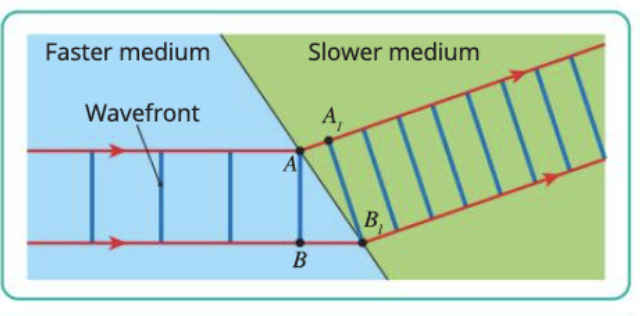
Refraction occurs when waves travel from one medium into another medium where their speed changes. This change in speed causes the waves to change direction, creating the bending effect we observe.
Important
The frequency of the wave remains constant throughout refraction since it depends only on the source producing the waves. Only the speed and wavelength change when moving between media.
Waves changing speed
The speed at which a wave travels depends on the properties of the medium through which it moves. When waves move from one medium to another, their speed generally changes. However, the frequency of the wave remains constant throughout this process since it depends only on the source producing the waves.
Since the wave equation tells us that (speed = frequency × wavelength), and frequency stays constant:
- If the wave speeds up, the wavelength increases
- If the wave slows down, the wavelength decreases
Understanding refraction
When waves enter a second medium at an angle (not perpendicular to the boundary), they change direction. This happens because different parts of the wavefront enter the new medium at slightly different times, causing one side to slow down or speed up before the other side.
Example
How Refraction Works Step-by-Step:
Step 1: One side of the wavefront crosses the boundary first and changes speed
Step 2: The other side continues at the original speed until it also crosses
Step 3: This creates a turning effect, bending the wave towards or away from the boundary
Step 4: The wave then continues in its new direction through the second medium
Key point: The changing of direction when a wave enters a region where its speed changes is called refraction.
Diffraction
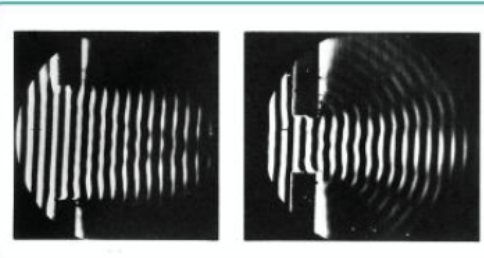
Diffraction is the sideways spreading of waves into the region beyond a gap or around an obstacle. This behaviour is particularly noticeable when the size of the gap or obstacle is similar to the wavelength of the waves.
Note
The amount of diffraction depends on the relationship between the gap size and the wavelength. When these are similar in size, dramatic spreading effects occur.
How diffraction works
When parallel waves encounter a gap:
- If the gap is much larger than the wavelength: Most waves pass straight through, with only slight spreading at the edges
- If the gap is similar in size to the wavelength: Significant spreading occurs, and the waves spread out into the whole region beyond the gap
- If the gap is much smaller than the wavelength: Very little wave energy passes through
This phenomenon explains why:
- You can hear someone talking around a corner (sound waves diffract around the corner)
- Radio waves can reach areas behind hills (they diffract around the obstacles)
- Light doesn't noticeably bend around everyday objects (light wavelengths are very small compared to most objects)
Principle of superposition of waves
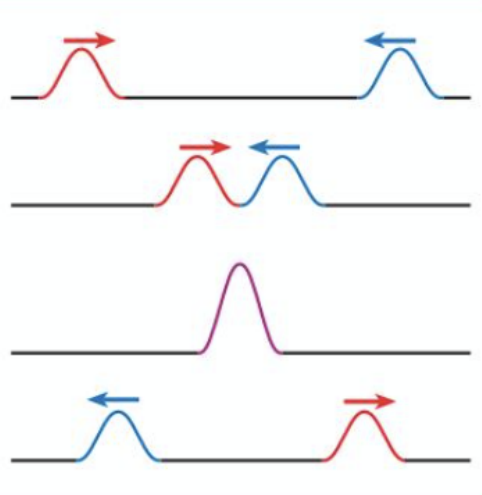
When two or more waves meet at the same point, something interesting happens. The principle of superposition states that the displacement produced at any point by overlapping waves is the algebraic sum of the displacements that each wave would produce on its own.
Important
Principle of Superposition: The displacement at any point where waves overlap equals the algebraic sum of individual wave displacements. This fundamental principle governs all wave interactions.
This means that waves can combine in two main ways:
Constructive interference
When waves from two sources meet in phase (crest meets crest, trough meets trough):
- The amplitudes add together
- The resulting wave has a larger amplitude than either original wave
- This creates regions of maximum disturbance
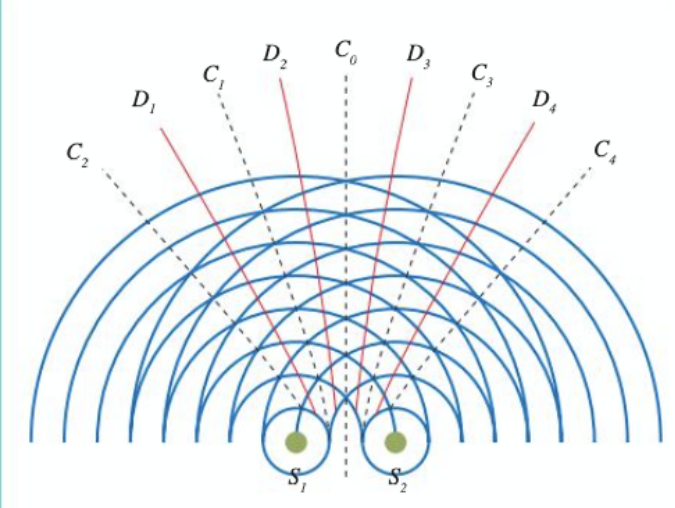
- These regions are called antinodal lines
Destructive interference
When waves from two sources meet completely out of phase (crest meets trough):
- The amplitudes subtract from each other
- If the waves have equal amplitude, they can completely cancel out
- This creates regions of minimum disturbance (or no disturbance)
- These regions are called nodal lines
Interference patterns from two point sources
When two coherent point sources (sources maintaining a constant phase relationship) produce waves of the same frequency, they create a distinctive interference pattern. This can be demonstrated beautifully in a ripple tank with two vibrating sources.
Note
Coherent Sources: For clear interference patterns to form, the sources must be coherent - they must maintain a constant phase difference and have the same frequency.
The pattern consists of:
- Antinodal lines: Where constructive interference occurs, showing maximum wave activity
- Nodal lines: Where destructive interference occurs, showing calm water or no wave motion
- Alternating pattern: The lines alternate between maximum and minimum disturbance
Polarisation
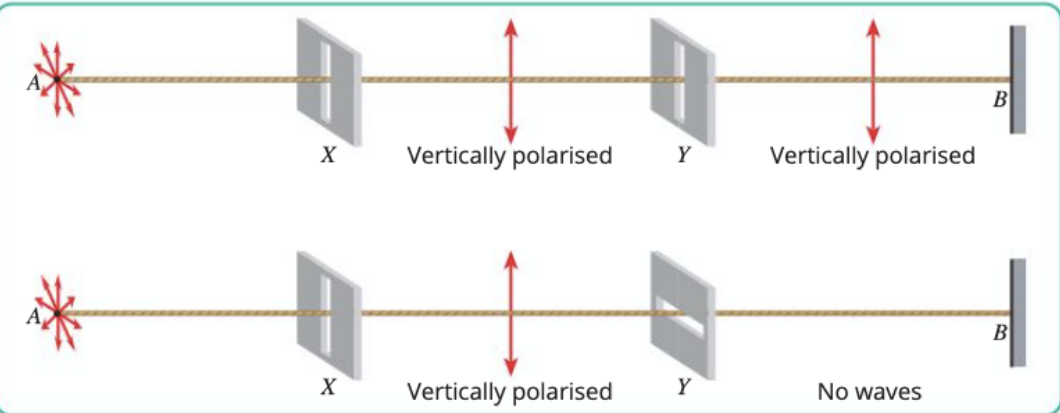
Polarisation is a property that applies only to transverse waves. It describes the orientation of the wave's vibrations relative to the direction of wave travel.
Understanding polarised waves
In an unpolarised transverse wave:
- The vibrations occur in all possible planes perpendicular to the direction of travel
- Think of it like a skipping rope being wiggled randomly in all directions
In a plane polarised wave:
- The vibrations are confined to just one plane
- The wave vibrates in only one direction perpendicular to its travel
- Think of a skipping rope that only moves up and down, never left and right
Note
Remember: Only transverse waves can be polarised. Longitudinal waves (like sound) cannot be polarised because their vibrations are already confined to the direction of travel.
Polarisation experiments
You can demonstrate polarisation using two polarising philtres:
- Parallel filters: When both philtres are aligned the same way, polarised light passes through both easily
- Perpendicular filters: When the philtres are at 90° to each other, no light gets through the second philtre
- Rotating filter: As you rotate one philtre, the light intensity gradually changes from maximum to zero
Summary
Key Points to Remember:
- Reflection: All waves bounce off obstacles, maintaining their frequency, speed, and wavelength in the same medium
- Refraction: Waves change direction when entering a new medium where their speed changes, but frequency stays constant
- Diffraction: Waves spread out through gaps or around obstacles, with the effect being most noticeable when the gap size equals the wavelength
- Superposition: When waves meet, their displacements add algebraically, creating constructive interference (amplitudes add) or destructive interference (amplitudes subtract)
- Polarisation: Only transverse waves can be polarised, meaning their vibrations can be confined to a single plane perpendicular to the direction of travel