The Internet (Grade 10 NSC Matric Computer Application Technology): Revision Notes
📚Revision Notes
The Internet
What is the internet?
The internet is a massive global network that connects computers all around the world. Think of it as a giant web where computers can talk to each other using cables, telephone lines, and communication satellites. This incredible system allows billions of devices to share information instantly, no matter where they are located on Earth.
When you connect your computer, tablet, or smartphone to the internet, you gain access to an enormous amount of information and services. You can send emails, watch videos, listen to music, view pictures, play games, and access countless websites. When someone is using the internet, we say they are "working online" or "connected online".
Note
The beauty of the internet lies in its ability to make the world smaller by allowing people to communicate and share information across vast distances in seconds. This global connectivity has revolutionised how we work, learn, and interact with others.
Internet addresses - how devices find each other
Have you ever wondered how an email you send from your phone in Cape Town reaches your friend's computer in Durban? The answer lies in something called an IP address (Internet Protocol address).
What is an IP address?
Every device connected to the internet receives a unique IP address - think of it as a postal address for your device. Just like your home has a unique physical address so the postman knows where to deliver your mail, your computer needs a unique digital address so data knows where to go on the internet.
Note
With billions of emails, messages, and data packets being sent every day, IP addresses ensure that information reaches the correct destination. Without them, the internet would be like a postal service without addresses - complete chaos!
IPv4 addresses
Most IP addresses you'll encounter today are called IPv4 addresses. These are made up of four groups of numbers, with each group separated by dots (periods). For example, you might see an IP address like 197.98.0.86.
Example
IP Address Format Example:
A typical IPv4 address: 197.98.0.86
Breaking it down:
- 197 - First group (0-255)
- 98 - Second group (0-255)
- 0 - Third group (0-255)
- 86 - Fourth group (0-255)
Each group of numbers can range from 0 to 255, giving us millions of possible combinations. However, with so many devices connecting to the internet worldwide, we're starting to run out of IPv4 addresses!
IPv6 - the future of internet addressing
To solve the problem of running out of addresses, computer scientists developed IPv6. This new system can create many more unique addresses than IPv4, ensuring we'll have enough addresses for all future devices. However, many devices still show "IPv6: Not detected" because the transition is still happening gradually.
Important
IPv6 can provide approximately 340 undecillion unique addresses (that's a 3 followed by 38 zeros!), ensuring we'll never run out of internet addresses for future devices.
IP address geolocation
One fascinating aspect of IP addresses is that they can reveal information about your location. When you connect to the internet, websites can often determine which city, region, and country you're connecting from.
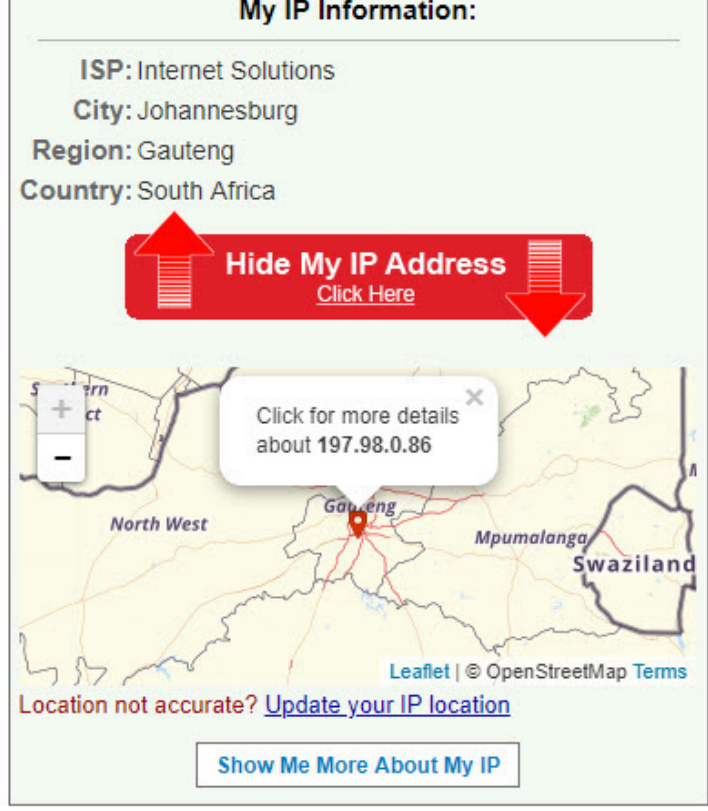
In the example above, we can see that an IP address (197.98.0.86) reveals that the user is connecting from:
- ISP: Internet Solutions (the company providing internet access)
- City: Johannesburg
- Region: Gauteng
- Country: South Africa
This geolocation information is useful for many purposes, such as showing you local weather, news, or advertisements relevant to your area. However, it also raises privacy concerns, which is why some people use VPN services to hide their real IP address.
Important
Privacy Consideration: Your IP address can reveal your approximate location to websites you visit. If privacy is a concern, consider using a VPN (Virtual Private Network) to mask your real IP address and location.
Real-world applications
Understanding IP addresses helps you appreciate how the internet works behind the scenes. Every time you:
- Send a WhatsApp message
- Stream a video on YouTube
- Check your email
- Browse social media
- Play an online game
Your device is using its IP address to communicate with servers around the world, ensuring your data reaches the right destination and responses come back to you.
Note
Modern tools like QR codes can even contain website addresses, making it easy to share internet locations without typing long web addresses. This demonstrates how technology continues to make internet access more convenient and user-friendly.
Summary
Key Points to Remember:
- The internet is a global network connecting computers worldwide through cables, phone lines, and satellites
- Every internet-connected device has a unique IP address - like a postal address for digital communication
- IPv4 addresses consist of four number groups separated by dots (e.g., 197.98.0.86)
- IP addresses enable geolocation - websites can often determine your city and country from your IP address
- IPv6 is the future - it provides many more possible addresses than IPv4 to meet growing internet demands
- Being "online" means your device is connected to the internet and can access global information and services