The Participants in the Economy (Grade 10 NSC Matric Economics): Revision Notes
📚Revision Notes
The Participants in the Economy
Who are the economic participants?
In any economy, there are five main groups that play important roles in how money, goods, and services move around. These groups are called economic participants and they include:
- Households (families and individuals)
- Businesses (companies and firms)
- Financial institutions (banks and other lending organisations)
- Government (national, provincial, and local government)
- Foreign sector (other countries we trade with)
Each of these participants is actively involved in three key economic activities: production (making things), earning income (getting paid), and spending (buying things).
Understanding flows in the economy
When we study how the economy works, we look at two types of flows between participants:
Real flow
This refers to the actual movement of goods and services between economic participants. For example, when a bakery delivers bread to a shop, or when a teacher provides education to students, these are examples of real flows.
Monetary flow
This refers to the movement of money and payments between economic participants. This includes wages paid to workers, money spent on groceries, or taxes paid to government. Monetary flow is essentially all the money changing hands in the economy.
The circular flow model
The circular flow model is a useful way to understand how these participants interact with each other. Let's look at each participant's role:
Households
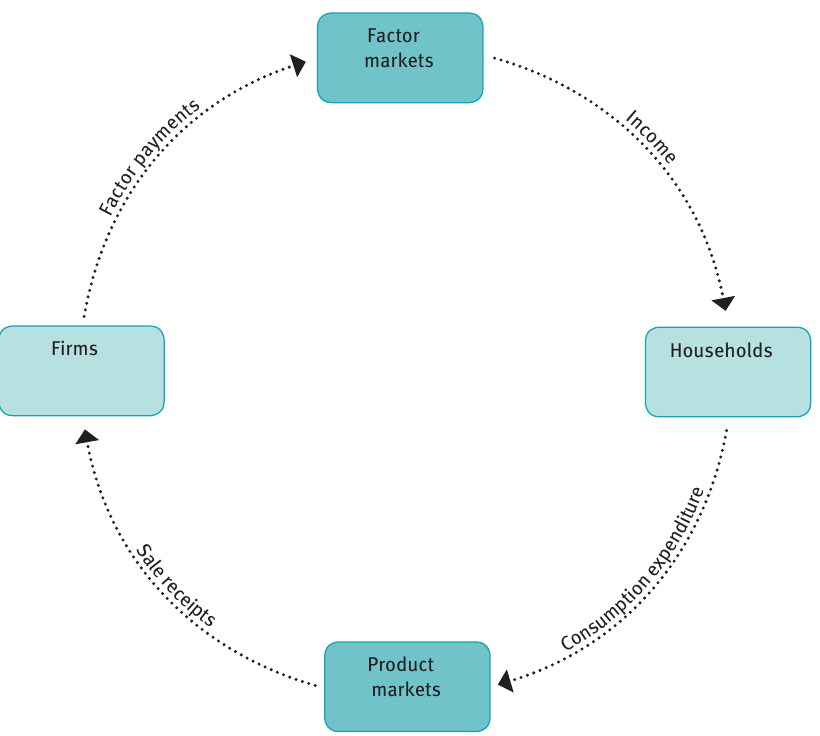
Households play a crucial role in the economy as both suppliers and consumers. In a basic circular flow model that includes just households and businesses, we can see how they interact:
- Households provide labour (their work) to businesses through factor markets
- In return, they receive income (wages and salaries) for their work
- Households then spend this income to buy goods and services from businesses
- This creates a continuous flow of money and resources between households and firms
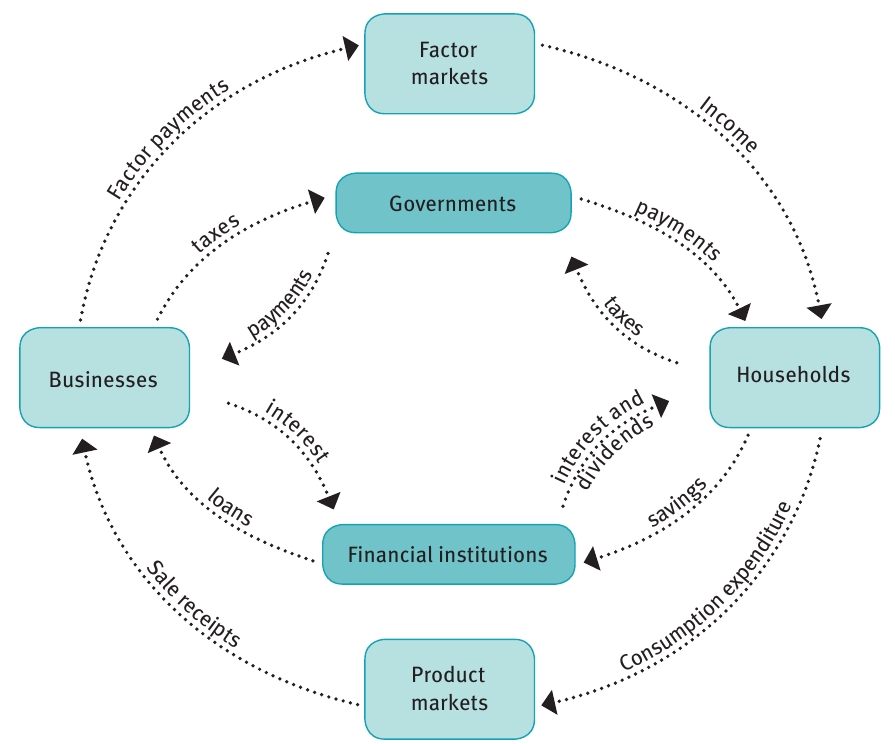
Households also participate in saving and borrowing, which means money can enter the circular flow (through loans from banks) or leave it (through savings deposits).
Business enterprises
Businesses, also called firms, are the producers in the economy. Their role includes:
- Buying factors of production(hiring workers, renting land, borrowing capital) from households
- Producing goods and services that households want to buy
- Creating employment by hiring people from households
- Generating income through sales of their products
This creates what we call a circular flow because money moves in a circle: businesses pay households for their work, and households spend that money buying products from businesses.
With just households and businesses, there are two circular flows: one of goods and services (real flow) and another of money (monetary flow). Both households and businesses can also save money (which leaves the circular flow) or borrow money (which enters the circular flow).
The government
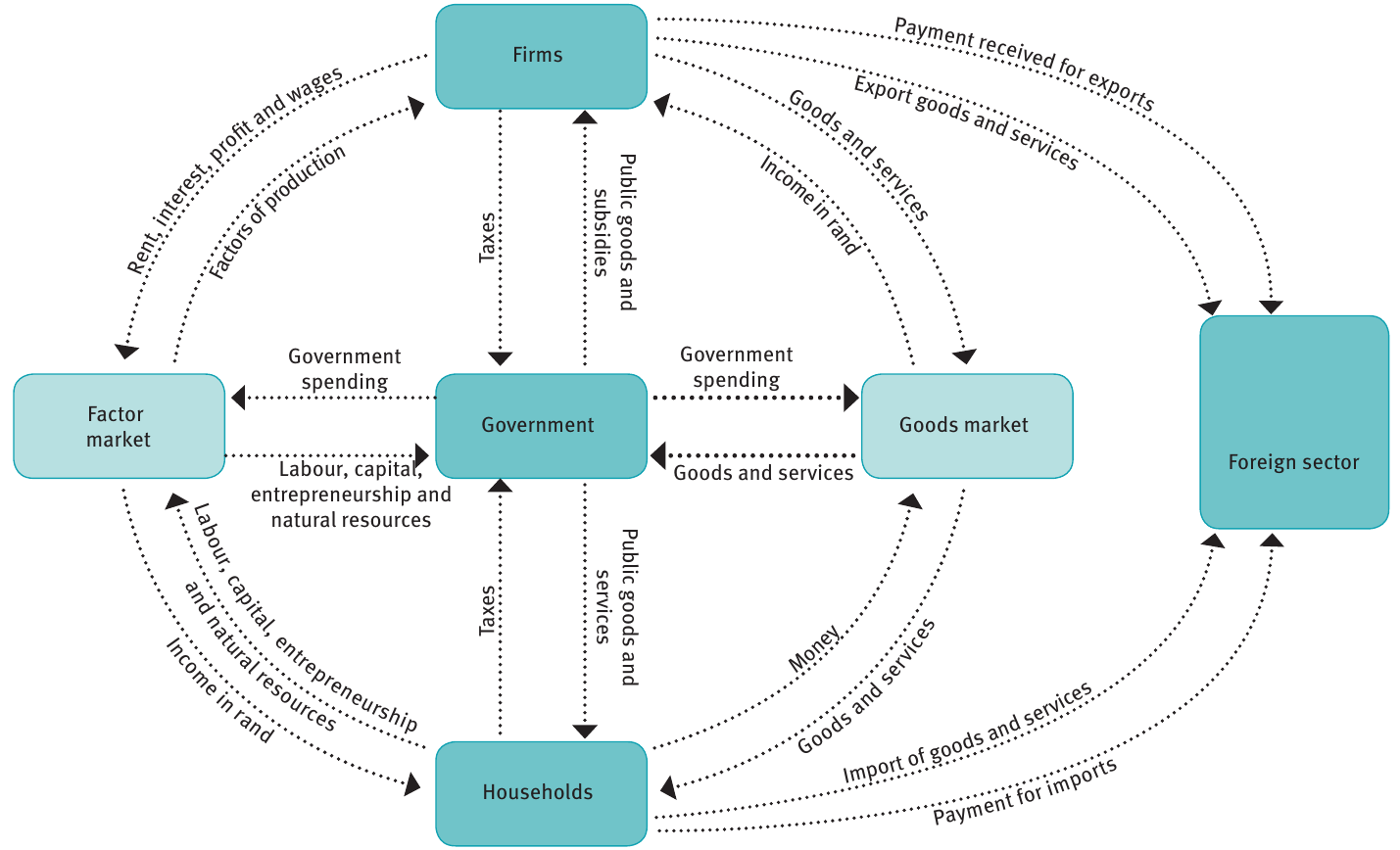
Government adds another layer of complexity to the circular flow model. The government participates in the economy by:
- Collecting taxes from both households and businesses (money leaves the circular flow)
- Providing public services like education, healthcare, and infrastructure (money enters the circular flow)
- Buying goods and services from businesses for government operations
- Paying factors of production by employing civil servants and buying resources
The government acts as both a spender (when it buys goods and services) and a collector (when it collects taxes). This means money constantly flows in and out of the government sector.
The foreign sector
South Africa has what economists call an open economy because we trade with other countries around the world. The foreign sector affects our circular flow through:
- Exports: When other countries buy South African goods and services, money flows into our economy
- Imports: When South Africans buy goods from overseas, money flows out of our economy
This is different from a closed economy, which would have no international trade at all.
Types of economies
Understanding the distinction between different types of economies helps us appreciate South Africa's position:
- Closed economy: An economy that doesn't trade with other countries (very rare in today's world)
- Open economy: An economy that engages in international trade through imports and exports (like South Africa)
Most modern economies, including South Africa's, are open economies because international trade brings benefits like access to goods we can't produce locally and markets for our exports.
Summary
Remember!
- Five economic participants: Households, businesses, financial institutions, government, and the foreign sector all play important roles in the economy
- Two types of flows: Real flow (goods and services) and monetary flow (money and payments) constantly move between participants
- Circular nature: Money flows in circles between participants - households earn from businesses and spend back to businesses
- Government impact: Government collects taxes (money out) and provides services (money in), affecting the circular flow
- South Africa is an open economy: We trade with other countries through imports (money out) and exports (money in)