Price Formation (Grade 10 NSC Matric Economics): Revision Notes
📚Revision Notes
Price Formation
Price formation is one of the most fundamental concepts in microeconomics. Understanding how prices are determined in markets will help you grasp how our economy functions on a daily basis.
What is price formation?
Price formation occurs when the market forces of supply and demand reach a balance point, known as the equilibrium point. This is where the magic happens in any market - from your local spaza shop to the Johannesburg Stock Exchange.
Note
Think of it like a see-saw that perfectly balances. On one side, you have consumers wanting to buy products (demand), and on the other side, you have businesses wanting to sell products (supply). When these two forces balance out, we get our market price.
Understanding market equilibrium
The equilibrium point gives us two crucial pieces of information:
- Equilibrium price: The exact price at which the product will be sold
- Equilibrium quantity: How many units of the product will be bought and sold
A market reaches equilibrium when the demand for a product equals the supply of that product. At this point, both buyers and sellers are satisfied with the price and quantity being traded.
The equilibrium price is determined by two key factors:
- The price that consumers are willing to pay for the product
- The price at which producers are willing to supply the product
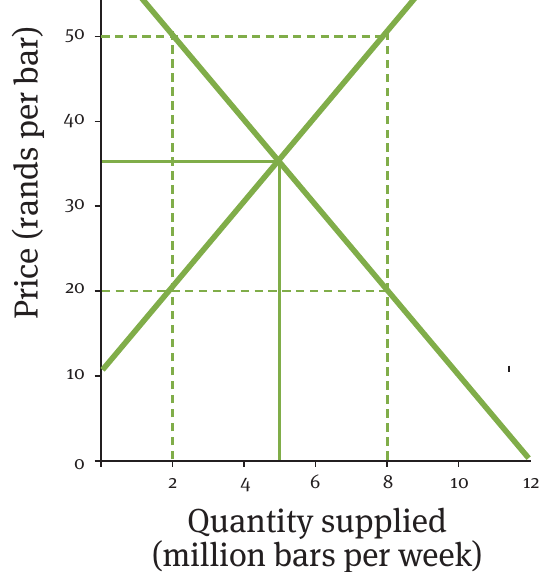
This graph perfectly illustrates how price formation works in practice. Notice how the supply curve (sloping upward) intersects with the demand curve (sloping downward) at a single point - this is our equilibrium point where price formation occurs.
The price mechanism in action
Markets have a brilliant built-in correction system called the price mechanism. This system ensures that markets constantly adjust themselves to maintain balance.
Important
Critical Concept: Market Self-Correction
Markets have a natural ability to correct imbalances through automatic price adjustments. Whether prices are too high or too low, the market forces will push them back toward equilibrium. This self-regulating nature is fundamental to how free markets operate.
Here's how this self-correction works:
When prices rise above equilibrium
If the price of a good increases above the equilibrium price, several things happen:
- Supply increases - producers want to make more because they can earn higher profits
- Demand falls - consumers buy less because the product is now more expensive
- This creates a surplus - there's more supply than demand
- Prices will then drop until supply and demand balance again
When prices fall below equilibrium
If the price drops below the equilibrium price:
- Supply decreases - producers make less because profits are lower
- Demand increases - consumers buy more because the product is cheaper
- This creates a shortage - there's more demand than supply
- Prices will rise until supply and demand balance again
The market's natural tendency
Whether there's excess supply or excess demand, these imbalances act as triggers that push the market back towards equilibrium. This is why economists often say that markets are self-regulating.
Real-world applications
Understanding price formation helps explain everyday economic situations you might observe:
Example
Practical Examples of Price Formation
-
Petrol prices: When crude oil supply is disrupted, petrol prices rise until consumers reduce their demand or alternative supplies are found
-
Concert tickets: Popular artists can charge high prices because demand exceeds the limited supply of venue seats
-
Seasonal fruits: Strawberry prices drop during harvest season when supply increases, then rise again when the season ends
Exam tips
Note
Exam Success Strategies
- Draw clear graphs: Practice drawing supply and demand curves that intersect cleanly
- Label everything: Always label your axes, curves, and equilibrium point
- Use real examples: South African examples like maize prices or taxi fares can strengthen your answers
- Explain the process: Don't just state what happens - explain why the price mechanism works
Summary
Key Points to Remember:
- Price formation occurs where supply and demand curves intersect at the equilibrium point
- The equilibrium point determines both the market price and the quantity that will be traded
- Markets naturally self-correct through the price mechanism when prices move away from equilibrium
- Surpluses occur when prices are too high, shortages occur when prices are too low
- Both surpluses and shortages trigger price adjustments that restore market balance