Temporary and Permanent Movements (Grade 10 NSC Matric Geography): Revision Notes
📚Revision Notes
Temporary and Permanent Movements
Population movement is a key feature of our globalised world. Understanding the different types of movement and their causes helps us make sense of migration patterns and their impacts on both origin and destination areas.
Understanding types of population movements
When people decide to move from one place to another, their movements can be classified into two main categories based on how long they plan to stay in their new location.
Note
Key Definitions:
Permanent movement occurs when people relocate to a new destination and plan to stay there forever. These migrants typically do not intend to return to their place of origin and often establish new lives, careers, and families in their destination country.
Temporary movement happens when people move to a destination for a specific period of time before returning home. These movements might last weeks, months, or even years, but the key characteristic is the intention to eventually return to their place of origin.
The reasons why people move can be grouped into three main categories: economic, political, and humanitarian (refugees). Each type has distinct characteristics and impacts.
Economic migrants
Economic migrants are people who choose to leave their home country because they believe they will find better employment opportunities or higher wages elsewhere. Their primary motivation is to improve their quality of life and economic circumstances.
These migrants often move from areas with high unemployment, low wages, or limited economic opportunities to regions experiencing economic growth or labour shortages. Economic migration can be either temporary or permanent, depending on the individual's circumstances and opportunities.
Case study: Irish migration to the USA
Example
Case Study: Irish Economic Migration During the Potato Famine
The Irish migration to America during the 19th century provides an excellent example of economic migration driven by desperate circumstances. In Ireland during the 1840s, most land was owned by wealthy landlords, whilst the majority of people either rented small plots or worked for very low wages. Potatoes became the main food source for the poor population.
The Crisis: The situation became catastrophic when a disease called blight destroyed the potato crop in 1845 and 1846. This disaster, known as the Irish Potato Famine, led to widespread starvation and death. Nearly a million people died, whilst many others decided to emigrate to America in search of survival and better opportunities.
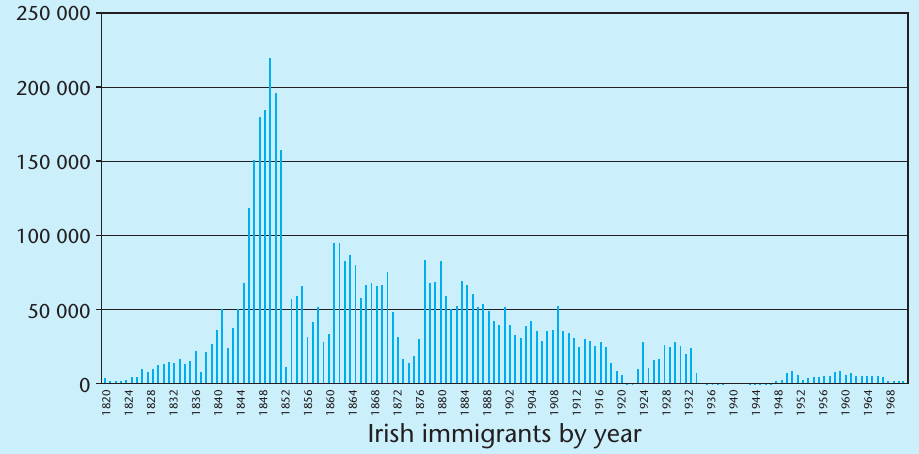
Migration Scale: By the end of 1854, nearly 2 million people - about a quarter of Ireland's population - had emigrated to the United States. The chart shows how immigration peaked dramatically during the famine years of the 1840s-1850s, with over 200,000 Irish people arriving in some years.
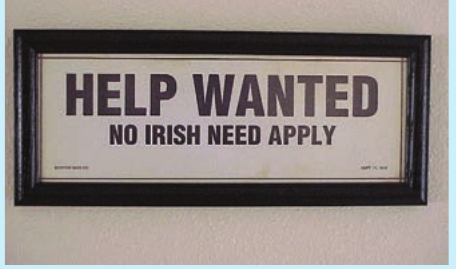
However, life in America was initially very difficult for Irish immigrants. They earned little money and worked long hours in dangerous conditions. They also faced significant discrimination because they were Catholics in a largely Protestant country.
Despite these challenges, many Irish immigrants eventually found success. They worked on building America's railroads, and some managed to save enough money to buy land and become farmers. Others became coal miners or domestic workers. Women often worked as domestic servants in wealthy American homes.
Note
Over time, people of Irish descent became successful in business and professional careers, with higher than average incomes and education levels. A remarkable example is John F. Kennedy, who became President of the United States in 1961 - he was the great-grandson of a farmer who had left Ireland in 1849.
Migrant labour
Migrant labour refers to people who move to a different area temporarily for work. These workers typically do not wish to settle permanently in their destination, or they may not be given permission to do so. They often work in specific industries where there are labour shortages, filling gaps in the workforce for a limited period.
Migrant labourers are sometimes called by different names, such as migrant workers, contract workers, or guest workers. While they are generally temporary migrants, some may eventually settle permanently in their host country or region if circumstances allow.
Case study: Turkish guest workers in Germany
Example
Case Study: Turkish Guest Workers in Germany
Background: During the 1950s, West Germany experienced rapid economic growth but faced a severe shortage of workers willing to take on unskilled and heavy manual labour in factories and construction sites. The shortage became more critical when East Germany built the Berlin Wall, cutting off the flow of workers from the east.
The Agreement: In 1961, the German and Turkish governments signed an agreement allowing Turkish workers to come and work in Germany for a limited time. This arrangement was designed to benefit both countries: Germany would receive the labour it needed to build its economy, whilst Turkish workers would learn valuable skills to use when they returned home.
Initial System: Most Turkish migrants were young men from rural areas who had to return home after two years to make space for new workers. They typically lived in hostels and sent money back to their families in Turkey.
Many returned home at the end of their contracts, but some had their work permits renewed because they were performing well and their employers wanted to keep them.
In 1973, Germany stopped recruiting guest workers, expecting the numbers to decline. Instead, many Turkish immigrants brought their wives and families to join them. By 1980, there were about three million Turks in Germany, and many had established successful businesses.
Important
However, integration has remained challenging. Many Turkish families have not fully integrated into German society, partly due to language and religious differences - many Turks are Muslim whilst most Germans are Christian. Nevertheless, with each generation, living conditions continue to improve.
Case study: Migrant labour from the Philippines
The Philippines, with nearly 100 million people, is the world's 12th most populous country. About 11 million Filipinos live in other countries, with many having migrated permanently since the 1970s, though most have become temporary migrants seeking work abroad due to high unemployment and low wages at home.
Example
Case Study: Filipino Migrant Workers
Changing Demographics: Initially, most Filipino migrants were men who found work as farm and construction labourers or in the shipping industry. Today, however, about 70% of all Filipino migrants are women, with many working as domestic workers and caregivers in the United States, Europe, the Middle East, and other parts of Southeast Asia, particularly Hong Kong and Singapore.
Professional Migration: Many Filipino professionals, including IT specialists and medical professionals, also migrate temporarily. About 70% of all Filipino migrants are between 24 and 44 years old, and 50% have some form of higher education.
Economic Impact: Filipino migrants send billions of dollars home each year, which significantly helps the Philippine economy. This money supports families by covering food, education, and medical costs.
Much of the temporary migration is organised through recruitment agencies monitored by the government. These agencies match job seekers with employers and charge fees for their services. Even with official support, migrants remain vulnerable to exploitation, working long hours with limited job security.
Important
Social Costs of Migration: Leaving families behind creates emotional challenges for parents who may not see their children for years. Approximately six million Filipino children are growing up with at least one parent abroad due to migration, and couples are often separated as they work in different countries.
Political migrants
Political migrants are people who leave their home country because they cannot express their political opinions freely or safely. They move to find greater freedom elsewhere and often work to bring about positive change in their home countries from abroad.
Some political migrants choose to leave voluntarily when they feel unsafe, but others are denied permission to return home or face imprisonment or death if they do return. These political migrants who cannot return home are known as exiles.
Note
As one writer described the experience: "Exile is strangely compelling to think about but terrible to experience. It is the unhealable rift forced between a human being and a native place, between the self and its true home: its essential sadness can never be surmounted." This quote captures the deep emotional impact of being unable to return to one's homeland.
Many exiles dream of returning to their home country and will do so if the political situation changes and it becomes safe. However, returning home can also be challenging after years of living elsewhere.
Case study: South African political migrants
Example
Case Study: South African Political Migrants During Apartheid
Government Restrictions: From 1950, the South African government banned many political organisations that opposed apartheid policies. When an organisation was banned, belonging to it became a criminal offence, and members could face house arrest, imprisonment, or even death for continuing their political activities.
Exile Numbers: In response to these restrictions, many people chose to go into exile. Initially, the numbers were relatively small, but following the Soweto uprising of 1976, thousands of young people left South Africa. By 1990, there were approximately 40,000 South African exiles living in various parts of the world.
Return Challenges: As political changes came to South Africa, many exiles wished to return. Some had left with valuable skills, and others had gained educational opportunities whilst living abroad. However, many returning exiles found it difficult to adjust to life in post-apartheid South Africa, highlighting the challenges faced by political migrants even when they can finally return home.
Refugees
Some people are forced to move from their home country to another and are considered refugees. The United Nations Refugee Agency (UNHCR) defines a refugee as someone who "cannot return to their own country because of a well-founded fear of persecution for reasons of race, religion, nationality, political association or political opinion."
Note
Legal Process for Refugees:
When people flee to another country seeking safety, they must register with immigration officials and apply for asylum (protection against the dangers they face at home). If immigration officials determine they need protection, they receive refugee status, which usually provides them with the same rights as citizens of the host country, except voting rights. The host country cannot force refugees to return home.
Important
Important Distinctions:
It's crucial to distinguish between different types of displaced people:
- Sometimes people use the term 'refugee' to describe those fleeing natural disasters like earthquakes, but these people don't qualify as refugees under the strict legal definition and won't receive the same protection
- People forced to move within their own country are called internally displaced persons (IDPs) - these individuals have been forced to leave their homes but remain within their country's borders
The UNHCR estimates that approximately 15 million refugees live around the world, with more than half located in Asia and about one-fifth in Africa.
Case study: Somali refugees in Kenya
Example
Case Study: Somali Refugees in Kenya
Background: Somalia has experienced civil war since President Siad Barre's government was overthrown by rebels in 1991. By 2011, the UNHCR estimated that there were at least 1.5 million internally displaced people in Somalia and 680,000 refugees in neighbouring countries.
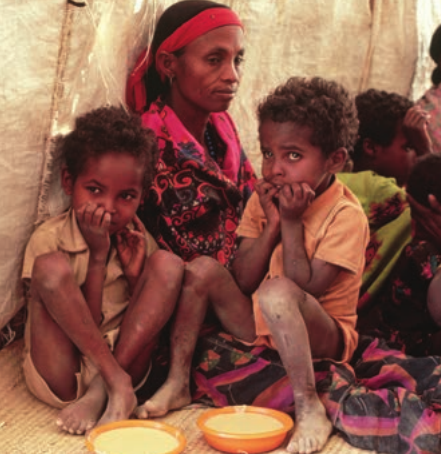
Living Conditions: Hundreds of thousands of Somalis live in refugee camps in Kenya, with little hope of returning home soon. Some have lived in these camps for 20 years, knowing no other life. The Dadaab camps in northeastern Kenya house the world's largest concentration of refugees.
Camp Challenges: Conditions in the camps are extremely challenging. They are overcrowded, with insufficient food, water, and sanitation. International donors have provided millions of dollars to humanitarian organisations, but even these large contributions are not enough to meet everyone's needs.
In 2010, Michelle Kagari of Amnesty International reported that "Kenya disproportionately shoulders the responsibility for massive refugee flows from Somalia." However, there have been concerns about the treatment of Somali refugees in Kenya. Human Rights Watch noted that many new arrivals are harassed by police and unlawfully returned to Somalia.
Important
Protection Concerns: The situation highlights the complex challenges facing refugees. As one refugee advocate noted: "Continued fighting and horrendous abuses in Somalia pose a very real threat to the lives of tens of thousands of children, women and men. No Somali should be forcibly returned to Somalia."
Amnesty International has called on the Kenyan government to ensure that Somalis receive proper refuge and adequate protection. The Kenyan government has stated that police abuse does not reflect official policy towards refugees and has made more land available to help relieve overcrowding in existing camps.
Global refugee patterns
Understanding where refugees come from and where they go helps us see global patterns of conflict and displacement.
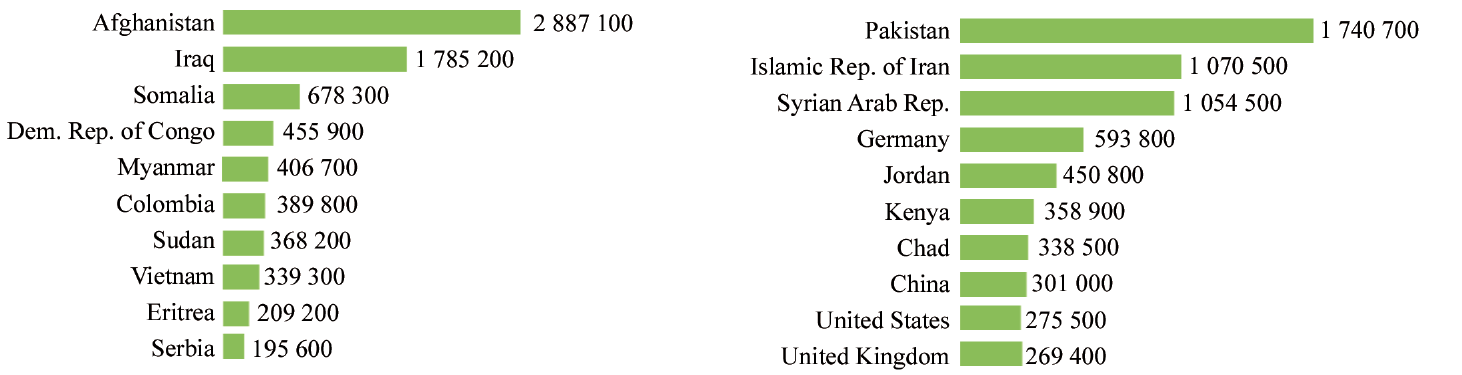
The data shows that Afghanistan was the largest source of refugees by the end of 2009, with nearly 3 million people forced to flee their country. Other major source countries include Iraq, Somalia, Democratic Republic of Congo, Myanmar, and Colombia - all nations experiencing significant conflict or persecution.
Pakistan hosted the most refugees globally, primarily Afghans fleeing conflict in their neighbouring country. Iran, Syria, Germany, and Jordan also serve as major host countries. This pattern shows that most refugees actually stay in countries close to their homeland, rather than travelling to distant, wealthy nations.
Refugees in South Africa
Note
South Africa's relationship with refugees changed dramatically after 1994. Before 1993, South Africa did not recognise refugees, but following the transition to democracy, the country became a signatory to United Nations and Organisation of African Unity conventions on refugees.
Since then, South Africa has become an important destination for refugees from across Africa, reflecting both its relative stability and economic opportunities compared to many other African nations.
Summary
Key Points to Remember:
-
Temporary movements involve people who plan to return home, whilst permanent movements involve people who intend to stay forever in their new location
-
Economic migrants move voluntarily to find better job opportunities and improve their living standards - they can move either temporarily or permanently
-
Migrant labour refers specifically to temporary workers who fill labour shortages in destination countries, often sending money back to families at home
-
Political migrants and exiles leave their countries due to political persecution or inability to express their views freely - exiles cannot return home safely
-
Refugees are people forced to flee their countries due to persecution, war, or violence and have legal protection under international law, whilst internally displaced persons are forced to move within their own countries