Representations of Life’s History (Grade 10 NSC Matric Life Sciences): Revision Notes
📚Revision Notes
Representations of Life's History
Scientists have developed several ways to understand and represent the vast history of life on Earth. These representations help us visualise how life has changed over billions of years and understand the processes that shaped our planet's biodiversity.
Geological timescale
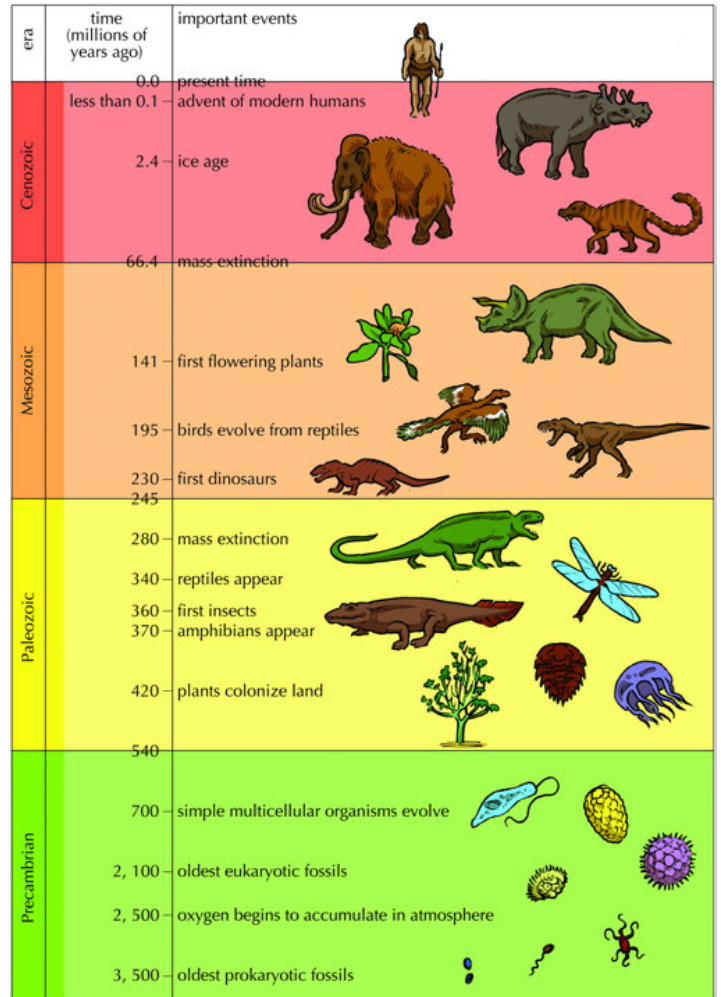
The geological timescale acts like a giant calendar showing Earth's history. It organises major geological and biological events into manageable time units, helping us understand when different life forms appeared and disappeared.
Key time divisions
Scientists divide Earth's history into three main types of time periods:
Eon: The largest unit of geological time, lasting about one billion years. Earth's history spans several aeons.
Era: A division within an aeon that doesn't have a fixed length. For example, the Mesozoic era lasted from 252 million to 66 million years ago - about 186 million years total.
Period: The smallest division, which is a subdivision of an era. The length of each period is determined by studying fossil evidence from that particular time.
Note
The geological timescale provides a framework for understanding the timing of major evolutionary events and helps scientists communicate about Earth's history in an organised way.
The geological timescale shows four major eras in Earth's history:
- Precambrian: The earliest and longest era (from Earth's formation to about 540 million years ago)
- Palaeozoic: Known for early complex life forms and plants colonising land
- Mesozoic: Often called the "Age of Reptiles" - when dinosaurs dominated
- Cenozoic: The current era, sometimes called the "Age of Mammals"
The geological clock
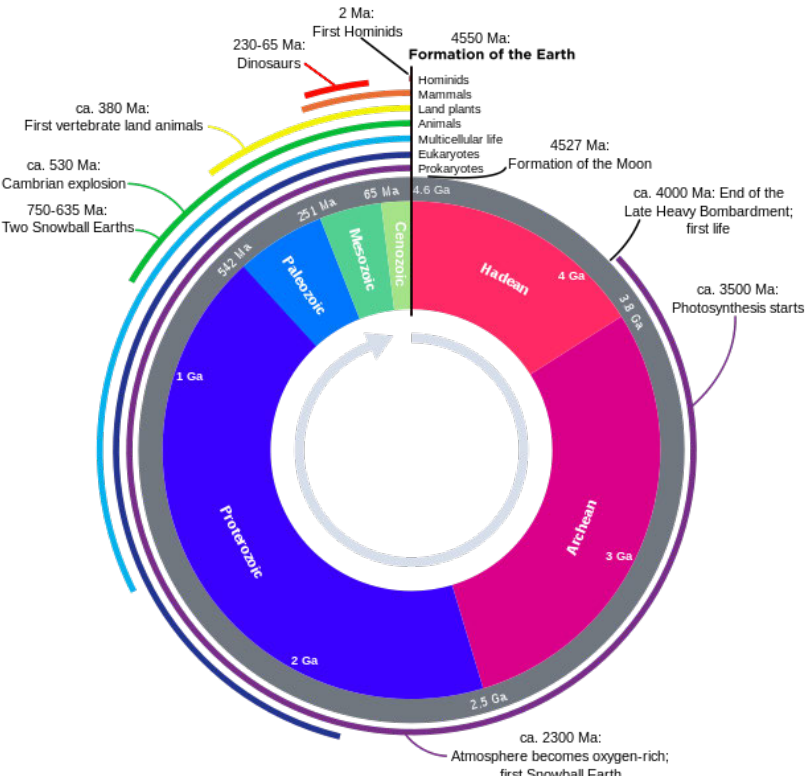
Another helpful way to visualise Earth's history is through a geological clock. This representation shows the entire 4.5 billion year history of Earth compressed into a 24-hour day.
Important
On this clock, human history represents less than a minute! This helps us understand just how recent human existence is compared to the vast history of life on Earth. Most of Earth's history occurred before complex life forms appeared.
Continental drift
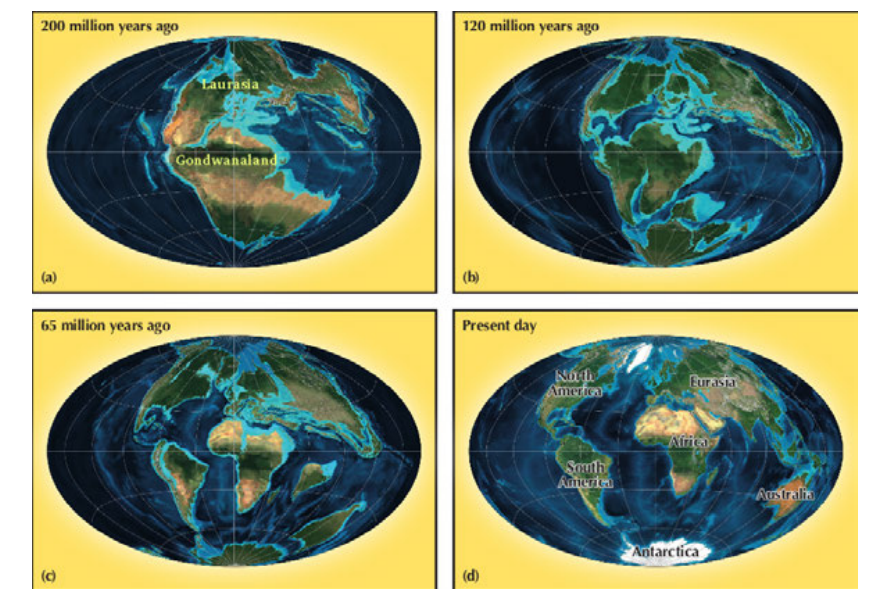
Continental drift describes how Earth's continents have moved and changed position over geological time. This movement has profoundly affected the distribution of life on our planet.
Understanding plate tectonics
Plate tectonics studies how Earth's crust (the lithosphere) folds and moves. The continents sit on large plates that slowly drift across the ocean floor.
Biogeography examines where different plants and animals live across the globe. This field has provided crucial evidence supporting continental drift theory.
Evidence for continental drift
Scientists have gathered compelling evidence showing that continents were once joined together:
Note
Fossil evidence: Identical plant and animal fossils found on different continents suggest these landmasses were once connected. For example, Mesosaurus fossils appear in both Brazil and South Africa.
- Geological evidence: Rock formations and mountain ranges on different continents match up, indicating they were once part of the same landmass.
- Glacial evidence: Ancient glacier deposits found in currently warm regions show these areas were once positioned differently on Earth.
Phases of continental breakup
Example
Worked Example: Continental Breakup Timeline
Continental drift occurred in three main phases:
Step 1 - First phase (175 million years ago): The supercontinent Pangaea began splitting, forming Laurasia in the north and Gondwana in the south.
Step 2 - Second phase (150-140 million years ago): Gondwana broke apart, separating into Africa, South America, India, Antarctica, and Australia.
Step 3 - Third phase (Cenozoic era): Laurasia split further, with North America separating from Europe, creating the Atlantic and Indian Oceans.
Natural selection and evolution
Natural selection explains how life forms change over time to become better adapted to their environments. This process has driven the evolution of all life on Earth.
Key features of natural selection
Natural selection works through several important principles:
Note
Key Principles of Natural Selection:
- Variation exists: Individuals within a species show differences in their characteristics
- Inheritance: Genetic traits pass from parents to offspring
- Survival advantage: Some variations help organisms survive better in their environment
- Reproductive success: Better-adapted individuals produce more offspring
- Population change: Over many generations, favourable traits become more common in the population
This process, repeated over millions of generations, leads to the evolution of new species and the incredible diversity of life we see today.
Fossil formation
Fossils provide direct evidence of ancient life forms. However, fossilisation is extremely rare and requires very specific conditions.
What are fossils?
Fossils are preserved remains of ancient organisms, typically over 10,000 years old. They can include bones, shells, leaf imprints, or even entire organisms preserved in special conditions.
Palaeontology is the scientific study of fossils and how they relate to the history of life on Earth.
How fossils form
Example
Worked Example: The Fossilisation Process
Fossilisation follows a specific process that takes millions of years:
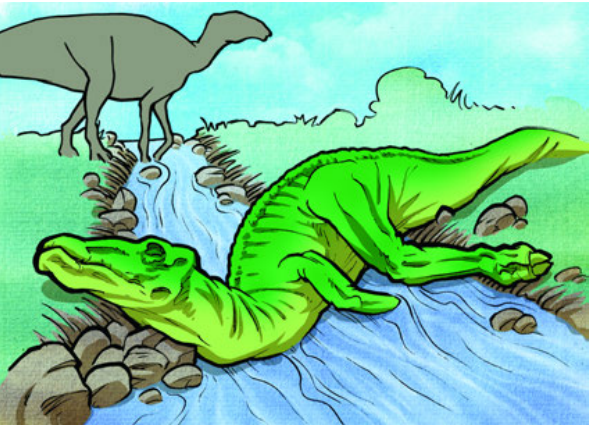
Step 1 - Death and burial: An organism dies and must be quickly buried under mud or sediment. This prevents decay and scavenging.
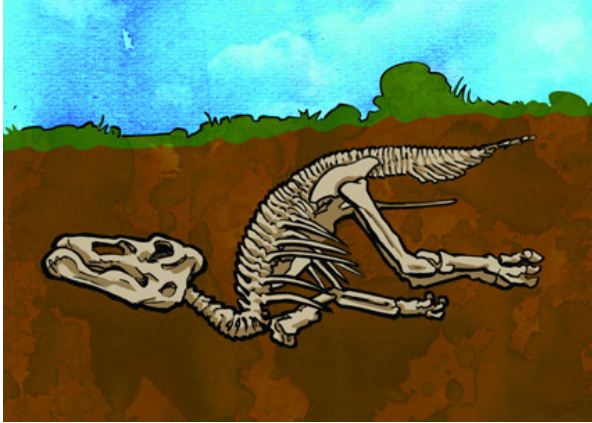
Step 2 - Compression: Over time, more layers of sediment build up, compressing the buried organism and surrounding material.
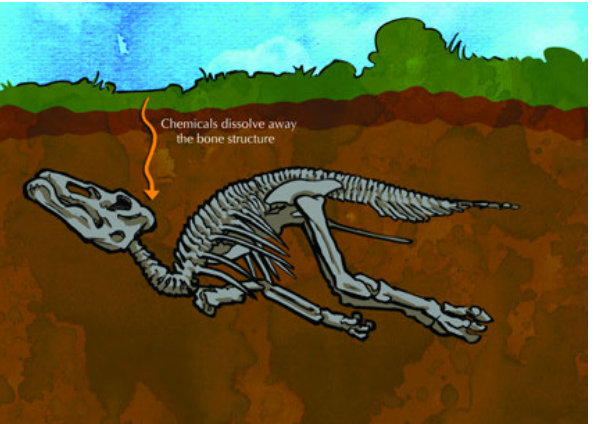
Step 3 - Mineralisation: Mineral-rich water seeps through the sediment layers. Chemicals gradually dissolve the original bone or shell structure and replace it with minerals.
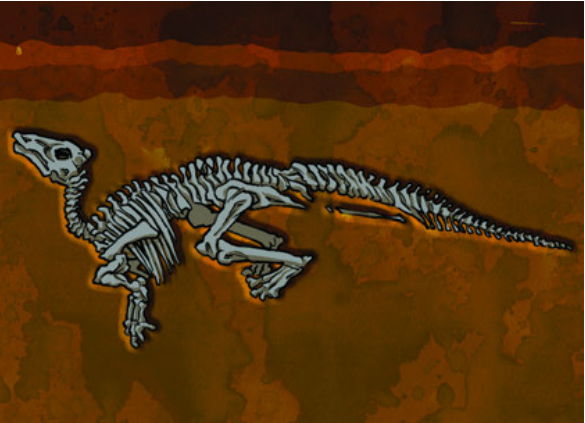
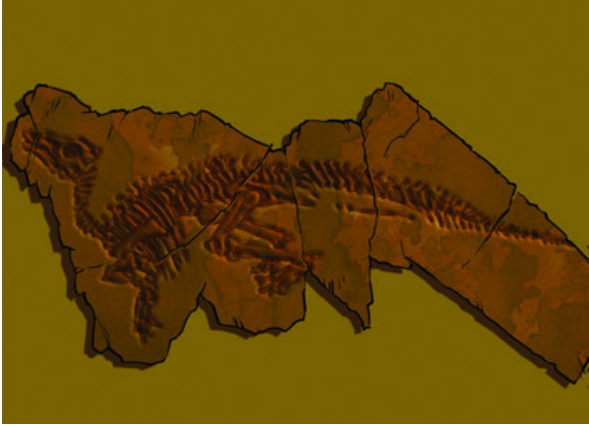
Step 4 - Rock formation: The compressed sediments turn into rock, preserving the shape of the original organism as a fossil.
Step 5 - Exposure: After millions of years, geological processes bring the fossil-containing rock back to the surface where scientists can discover it.
Important
Remember that fossilisation is incredibly rare. Most organisms decay completely before they can be preserved. Only organisms buried in exactly the right conditions become fossils.
Methods of dating fossils
Scientists use two main methods to determine the age of fossils: radiometric dating and relative dating.
Radiometric dating
Radiometric dating measures the amount of radioactive carbon (Carbon-14) remaining in organic material. This method works because:
- Living organisms constantly absorb Carbon-14 from the atmosphere
- When an organism dies, it stops absorbing Carbon-14
- The existing Carbon-14 begins to decay at a predictable rate
- By measuring how much Carbon-14 remains, scientists can calculate how long ago the organism died
Half-life: The time required for half of a radioactive substance to decay. Carbon-14 has a half-life of 5,730 years.

Example
Worked Example: Carbon-14 Decay
This graph shows how Carbon-14 decreases over time:
- After 5,730 years: Only 50% remains
- After another 5,730 years (11,460 years total): Only 25% remains
- After another 5,730 years (17,190 years total): Only 12.5% remains
The mathematical relationship can be expressed as:
Where is the amount remaining after time , is the initial amount, and is the half-life.
Relative dating
Relative dating determines the order of events without giving exact ages. This method relies on studying rock layers:
Note
Key Principles of Relative Dating:
- Rock layer principle: Deeper rock layers are older than layers above them
- Fossil succession: The order of fossils in different layers shows the sequence of life forms over time
- Comparative analysis: Scientists can compare the relative ages of fossils found in different locations
Relative dating was crucial in developing our understanding of geological time before radiometric methods were available.
Deductive reasoning and evolutionary evidence
Scientists use deductive reasoning to piece together Earth's history. This involves combining evidence from fossils, continental drift, climate data, and natural selection theory to understand how life evolved.
Transitional fossils
Transitional fossils show intermediate characteristics between ancestral species and their descendants. These provide direct evidence of evolutionary change over time.
Example
Worked Example: Archaeopteryx as a Transitional Fossil
The most famous transitional fossil is Archaeopteryx, which shows features of both dinosaurs and modern birds:
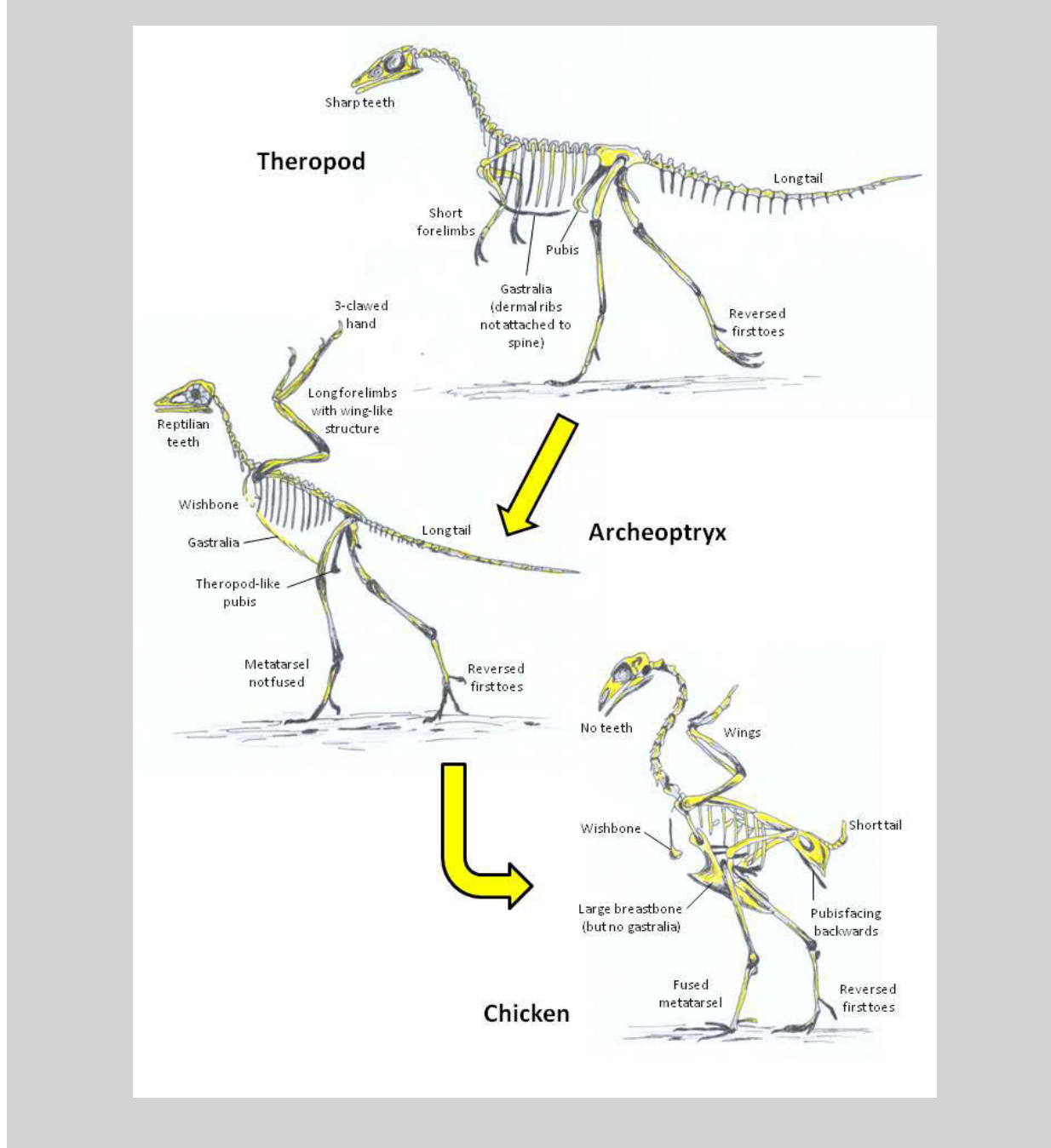
Dinosaur features:
- Teeth
- Long tail
- Clawed hands
Bird features:
- Feathers
- Wishbone
- Wing-like forelimbs
Intermediate features:
- Mix of reptilian and avian skeletal structures
Archaeopteryx helps us understand how birds evolved from theropod dinosaurs during the Mesozoic era.
Using evidence to understand the past
Scientists combine multiple lines of evidence:
- Fossil records showing changes in life forms over time
- Continental drift explaining why similar fossils appear on different continents
- Climate data revealing how environmental changes affected evolution
- Comparative anatomy showing relationships between different species
This comprehensive approach allows scientists to build detailed pictures of how life on Earth has changed throughout geological time.
Summary
Key Points to Remember:
-
Geological timescale: Earth's history is divided into aeons, eras, and periods, with each representing different stages of life's development
-
Continental drift: Continents have moved over geological time, affecting the distribution and evolution of life forms through plate tectonics
-
Fossil formation: Fossils form through a rare process requiring quick burial, compression, mineralisation, and eventual exposure over millions of years
-
Dating methods: Radiometric dating uses radioactive decay (like Carbon-14's 5,730-year half-life) while relative dating uses rock layer positions to determine fossil ages
-
Evolutionary evidence: Transitional fossils like Archaeopteryx provide direct evidence of how species evolved, while deductive reasoning helps scientists piece together Earth's complex history