Energy Flow (Grade 10 NSC Matric Life Sciences): Revision Notes
📚Revision Notes
Energy Flow
Introduction to energy flow
Energy flow describes how energy moves through feeding relationships in an ecosystem. Understanding this concept is crucial because it explains how all living organisms obtain the energy they need to survive, grow, and reproduce.
In any ecosystem, energy moves in one direction - from the sun through producers to various levels of consumers. This movement follows specific patterns and rules that determine how much energy is available at each level of the food chain.
Note
Energy flow is unidirectional, meaning it cannot flow backwards through the ecosystem. This is a fundamental principle that distinguishes energy flow from nutrient cycling, where nutrients can be recycled and reused.
The energy transfer process
Energy enters ecosystems when producers (such as green plants) capture solar energy through photosynthesis. This solar energy is converted into chemical energy stored in carbohydrates. From here, energy flows through the ecosystem as organisms feed on one another.
However, this energy transfer is highly inefficient. At each step in the food chain, approximately 90% of the available energy is lost. This energy loss occurs in several ways:
- Heat production during metabolic processes
- Energy used for movement, growth, and reproduction
- Incomplete digestion of food
- Energy lost through excretion
Important
The 10% Rule: This means that only about 10% of the energy from one trophic level is passed on to the next level. This principle is known as the 10% rule and explains why there are fewer organisms at higher trophic levels.
This can be expressed mathematically as:
Trophic levels
Trophic levels represent the different feeding positions in a food chain. Each level has a specific role in energy transfer:
Producers (autotrophs)
- Green plants and other photosynthetic organisms
- Convert solar energy into chemical energy through photosynthesis
- Form the foundation of all food chains
- Store energy in the form of carbohydrates
Primary consumers (herbivores)
- Animals that feed directly on plants
- Examples include zebras, impala, and grasshoppers
- Convert plant material into animal tissue
- Only receive about 10% of the energy stored in plants
Secondary consumers (carnivores)
- Animals that feed on primary consumers
- Include predators like leopards and small carnivorous fish
- Obtain energy indirectly from plants through herbivores
- Receive only about 1% of the original plant energy
Tertiary consumers
- Top predators that may feed on secondary consumers
- Often the largest predators in an ecosystem
- May also feed on primary consumers and producers
- Receive only about 0.1% of the original plant energy
Note
Notice how the percentage of available energy decreases dramatically at each trophic level. This exponential decrease explains the pyramid structure of ecosystems and why there are so few top predators.
Decomposers
- Bacteria and fungi that break down dead organic matter
- Release nutrients back into the soil for plants to use
- Play a crucial role in recycling nutrients through the ecosystem
- Include organisms that decompose plants, animals, and waste products
Food chains
A food chain represents a simple linear sequence showing how energy and nutrients move from one organism to another. Food chains always begin with a producer and end with decomposers.
Example
Example: Grassland Food Chain
Here's an example of a grassland food chain: Green plant → Impala → Leopard → Bacteria
This can also be written showing the trophic levels: Producer → Primary consumer → Secondary consumer → Decomposer
The arrows in food chains show the direction of energy flow, pointing from the organism being eaten to the organism that eats it.
Food pyramids
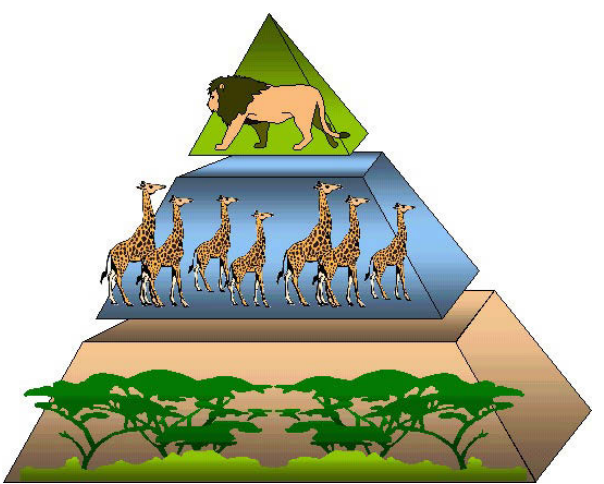
A food pyramid is a triangular diagram that shows the relationships between organisms at different trophic levels. The pyramid shape reflects the decreasing amount of energy, biomass, or number of organisms at each successive level.
Structure of food pyramids
Producers form the base of the pyramid because:
- They capture energy directly from the sun
- They have the most energy to pass on
- They support all other levels
Primary consumers form the second level because:
- They feed directly on plants
- There are fewer of them than producers
- They have less energy than producers
Secondary consumers occupy the third level because:
- They obtain energy indirectly from plants
- They are fewer in number than primary consumers
- They have even less available energy
Types of food pyramids
There are three main types of ecological pyramids:
Note
Understanding Different Pyramid Types
Each type of pyramid provides different information about ecosystem structure:
-
Pyramid of numbers: Shows the total number of organisms at each trophic level. These pyramids are not always triangular because some producers (like trees) may be large but few in number.
-
Pyramid of biomass: Shows the total mass of living matter at each trophic level. This usually forms a triangular shape because biomass decreases at higher levels.
-
Pyramid of energy: Shows the total amount of energy content at each trophic level. Energy pyramids are always triangular and are the most accurate representation of ecosystem relationships.
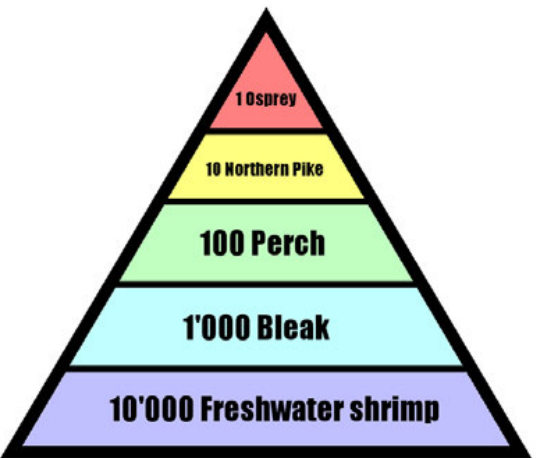
The diagram above shows a pyramid of numbers from a freshwater ecosystem, demonstrating how population sizes decrease as you move up trophic levels.
Food webs

A food web is a more complex and realistic representation of feeding relationships in an ecosystem. Unlike food chains, which show single linear pathways, food webs show multiple interconnected food chains.
Characteristics of food webs
Food webs are more complex than food chains because:
- Most organisms obtain food from multiple sources
- Many organisms feed at different trophic levels
- The removal of one species affects multiple other species
- They show the interconnected nature of ecosystem relationships
Stability of food webs
Important
Why Food Webs Are More Stable
Food webs are generally more stable than individual food chains because:
- If one food source disappears, organisms can switch to alternatives
- Multiple pathways exist for energy flow
- The system can maintain function even if some species are removed
- They better represent the complexity of natural ecosystems
Food webs help us understand that ecosystems are interconnected systems where changes to one component can affect many others.
Practical applications
Understanding energy flow helps explain several important ecological concepts:
- Why there are fewer large predators: The 10% rule means insufficient energy reaches top trophic levels to support large populations
- Ecosystem stability: Multiple food sources in webs provide backup options if one source fails
- Conservation importance: Removing key species can disrupt entire food webs
- Agricultural efficiency: Growing plants for human consumption is more energy-efficient than raising livestock
Summary
Key Points to Remember:
- Energy flows in one direction through ecosystems, from producers to consumers, with significant losses at each transfer
- The 10% rule explains why only about 10% of energy passes from one trophic level to the next
- Food chains show simple linear energy pathways, while food webs represent the complex interconnected feeding relationships in real ecosystems
- Food pyramids demonstrate decreasing energy, biomass, or numbers at higher trophic levels
- Decomposers play a vital role by recycling nutrients back into the ecosystem for producers to use again