Nutrient Cycles (Grade 10 NSC Matric Life Sciences): Revision Notes
📚Revision Notes
Nutrient Cycles
Nutrient cycles are essential processes that keep ecosystems functioning by moving materials through the environment. These cycles ensure that important elements like water, oxygen, carbon, and nitrogen are constantly recycled and made available to living organisms.
What are nutrient cycles?
A nutrient cycle describes how organic and inorganic materials move through the environment and return to support the production of living matter. These cycles are controlled by the food web pathways we've studied, where organisms break down organic matter into inorganic nutrients that can be used again.
Note
The interconnected nature of nutrient cycles means that disruption in one cycle can affect all others, highlighting the delicate balance that maintains life on Earth.
The main nutrient cycles we need to understand include the water cycle, oxygen cycle, carbon cycle, and nitrogen cycle. Each plays a vital role in supporting life on Earth.
Water cycle
The water cycle, also called the hydrological cycle, is the continuous movement of water through Earth's atmosphere, oceans, land, and living organisms. Over two-thirds of Earth's surface is covered by water, and up to 70% of plants and animals are made of water.
This cycle is crucial because it determines our weather and climate, supports plant growth, and makes life possible.
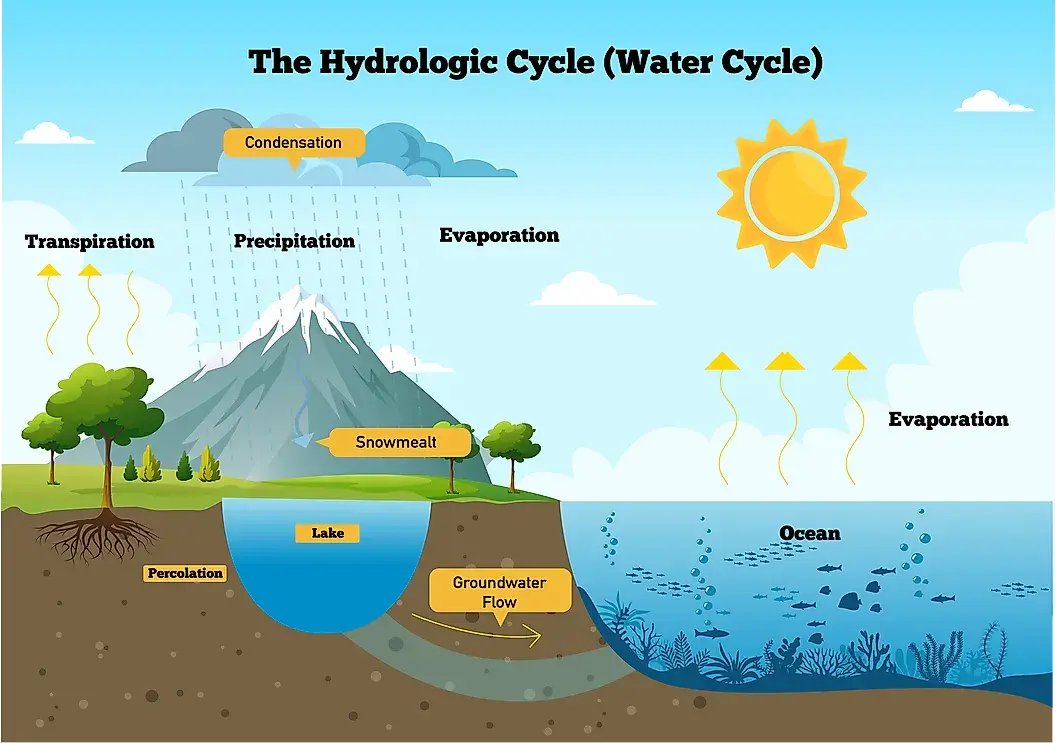
Key processes in the water cycle
Evaporation occurs when water changes from liquid to gas, mostly from oceans where water is most abundant. However, evaporation also happens from lakes, rivers, streams, and after rainfall.
Transpiration is the loss of water from plant surfaces, particularly through tiny pores called stomata. This process accounts for about 50% of water returning to the atmosphere from land areas.
Note
Evapotranspiration combines evaporation and transpiration processes, and scientists often refer to both together using this term because they work simultaneously in natural systems.
Condensation happens when water vapour in the atmosphere converts back to liquid form. You can observe this when dew drops form on grass or cold glass surfaces. In the atmosphere, water condenses to form clouds.
Precipitation returns water to Earth as rain, sleet, snow, or ice (hail). When rain falls, most runs off into lakes and rivers, while some soaks into the ground.
Infiltration describes how water sinks into the ground. The soil or rock type determines how easily water moves through the surface. As water travels deeper underground, it becomes filtered and purified - the deeper it goes, the cleaner it becomes.
Melting and freezing processes store water temporarily in ice form (such as glaciers and ice sheets) and release it back to oceans and seas when temperatures rise.
Oxygen cycle
Oxygen is one of the main gases in our atmosphere, alongside nitrogen. The oxygen cycle shows how this essential gas moves between the air and living organisms.
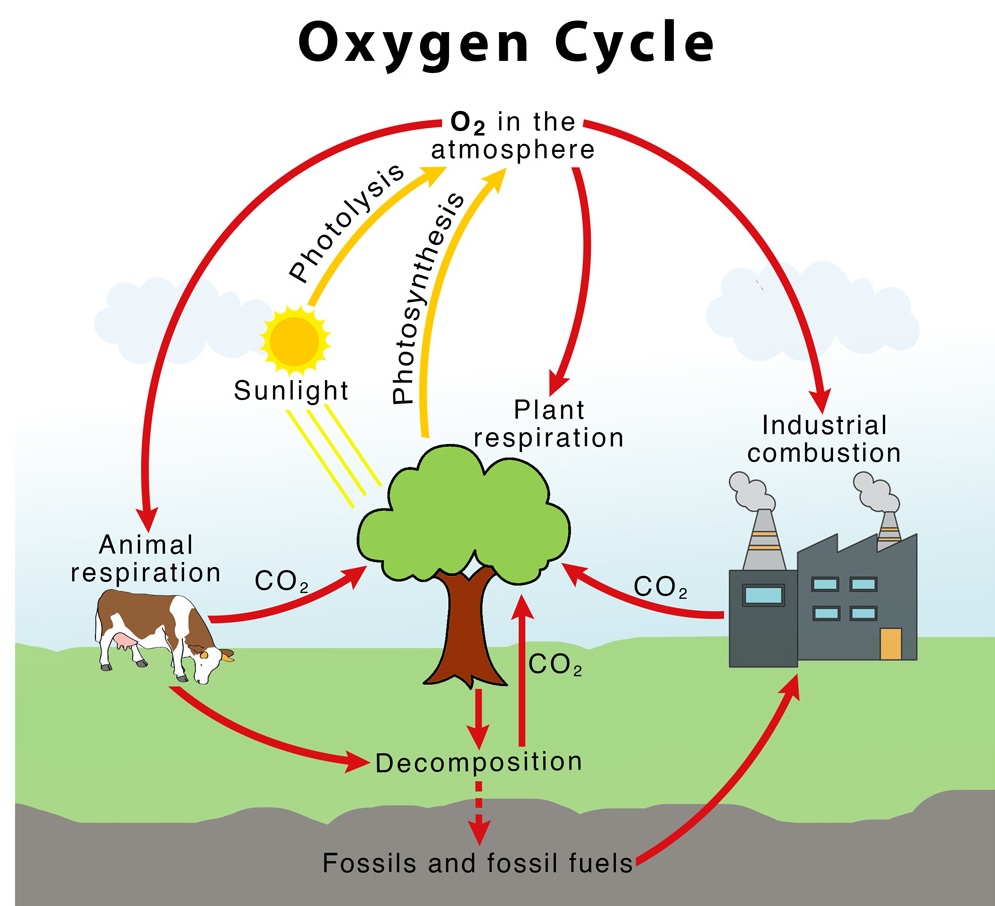
How oxygen cycles through the environment
Breathing and respiration involve organisms like animals and plants taking oxygen from the air. They use this oxygen during cellular respiration to release energy from organic nutrients such as glucose.
Photosynthesis occurs when plants absorb carbon dioxide from the air to make sugars and release oxygen as a byproduct.
Important
There is a complementary relationship between photosynthesis and respiration - photosynthesis produces oxygen whilst respiration uses oxygen. This creates a balanced cycle that maintains oxygen levels in our atmosphere.
The oxygen cycle demonstrates how the atmosphere (0.5%), biosphere (0.01%), and lithosphere (99.5%) all serve as reservoirs for oxygen, with various processes moving oxygen between these compartments.
Carbon cycle
Carbon serves as the basic building block of all organic materials and therefore all living organisms. Most carbon on Earth exists in the crust, with other important reservoirs including oceans and the atmosphere.
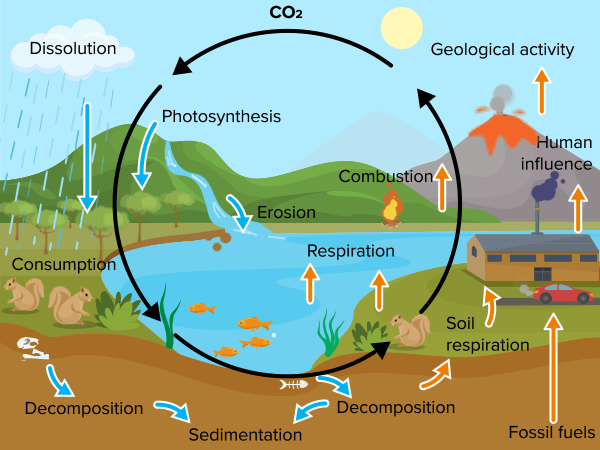
Processes that move carbon between reservoirs
Combustion transfers carbon to the atmosphere as carbon dioxide () when wood and fossil fuels burn, including emissions from factories and vehicles.
Photosynthesis removes carbon dioxide from the atmosphere when plants convert it into energy-rich compounds like glucose, which contains carbon.
Example
Carbon Movement Example: Plant-Animal Interaction
Step 1: Plant absorbs from atmosphere during photosynthesis
Step 2: Plant converts into glucose () for energy storage
Step 3: Animal eats plant, taking up carbon-containing compounds
Step 4: Animal releases back to atmosphere through respiration
Cellular respiration happens when animals eat plants for food, taking up carbon. Both plants and animals release carbon back to the atmosphere as carbon dioxide during gas exchange.
Metabolism occurs when organisms convert carbon into organic molecules like fats, carbohydrates, and proteins after eating plants or animals.
Precipitation allows carbon dioxide in the atmosphere to form carbonate compounds in ocean sediments.
Decay releases carbon dioxide gas back to the atmosphere when all organisms decompose after death.
Photosynthesis and gas exchange represent the main carbon cycling processes involving living organisms, creating a continuous flow of carbon through ecosystems.
Nitrogen cycle
Nitrogen gas () makes up about 78% of our atmosphere. This element is essential for living organisms because it's used to produce amino acids, proteins, and nucleic acids (DNA and RNA).
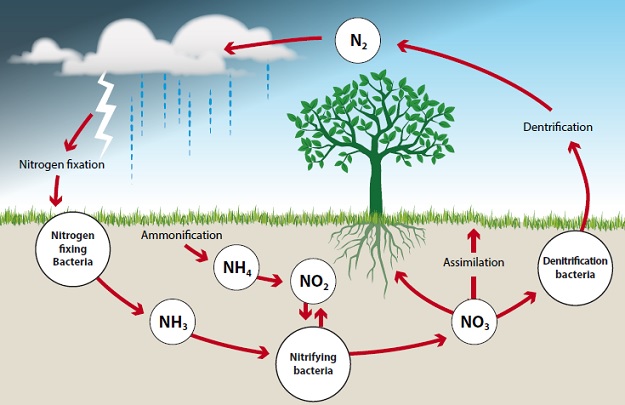
Why nitrogen fixation is necessary
Although nitrogen gas surrounds us in the atmosphere, it's not available to most organisms in this form. It must be converted into compounds that plants and animals can absorb and use.
Important
Only certain single-celled organisms like bacteria can use atmospheric nitrogen directly. For multicellular organisms like plants and animals, nitrogen must be changed into other forms such as nitrates or ammonia through a process called nitrogen fixation.
Steps in the nitrogen cycle
Lightning can convert nitrogen directly to nitrates. The rapid growth of fungi and algae after thunderstorms happens because lightning increases nitrate levels in rainwater, acting as natural fertiliser.
Decomposition occurs when bacteria and fungi break down proteins and amino acids from dead plants and animals.
Ammonification converts the nitrogen-containing breakdown products from amino acids into ammonia () through the action of decomposing bacteria.
Nitrification happens when specialised bacteria convert ammonia to nitrate () compounds.
Absorption allows plants to take up ammonia and nitrates through their root systems.
Ingestion provides nitrogen supplies to humans and animals when they eat plants or plant-eating animals.
Denitrification completes the cycle when bacteria convert ammonia and nitrate back into nitrogen gas and nitrous oxide (), returning nitrogen to the atmosphere to start the cycle again.
Summary
Key Points to Remember:
-
Nutrient cycles move essential materials like water, oxygen, carbon, and nitrogen through ecosystems, ensuring continuous availability for living organisms.
-
The water cycle involves evaporation, transpiration, condensation, precipitation, and infiltration processes that move water between atmosphere, land, and oceans.
-
Oxygen and carbon cycles are interconnected through photosynthesis and respiration - photosynthesis produces oxygen and uses carbon dioxide, while respiration does the opposite.
-
The nitrogen cycle requires bacterial processes to convert atmospheric nitrogen gas into forms that plants and animals can use, such as ammonia and nitrates.
-
All nutrient cycles work together to maintain the balance of materials needed for life, demonstrating the interconnected nature of Earth's systems.