How Science Works (Grade 10 NSC Matric Life Sciences): Revision Notes
📚Revision Notes
How Science Works
Science is a systematic way of understanding the world around us. To be accepted as legitimate science, investigations must follow specific methods that can be repeated and tested by other scientists. This ensures that scientific knowledge is reliable and builds upon previous discoveries.
What makes science work
Scientific investigation requires many important skills and processes working together. Scientists must use methods that can be repeated and follow a logical approach. The process involves formulating hypotheses (educated guesses) and carrying out careful experiments to test these hypotheses.
Key skills that scientists need include:
- Making objective observations without personal bias
- Taking accurate measurements using appropriate tools
- Collecting and recording data systematically
- Presenting results through drawings, tables, and graphs
- Identifying patterns and relationships in data
- Communicating findings to other scientists and the public
Note
Scientists also need to acknowledge the work of others who came before them. This is called referencing, and it helps ensure that scientific knowledge continuously improves and builds upon existing understanding.
The scientific method
The scientific method has been the foundation of scientific discovery throughout history. Humans have always been curious about why and how things happen in the world around us. The scientific method gives scientists a well-structured approach to find answers to their questions.
Important
An essential part of any scientific investigation is recording and documenting everything carefully so that other scientists can repeat the work. Using the scientific method, there are very few things that cannot be investigated.
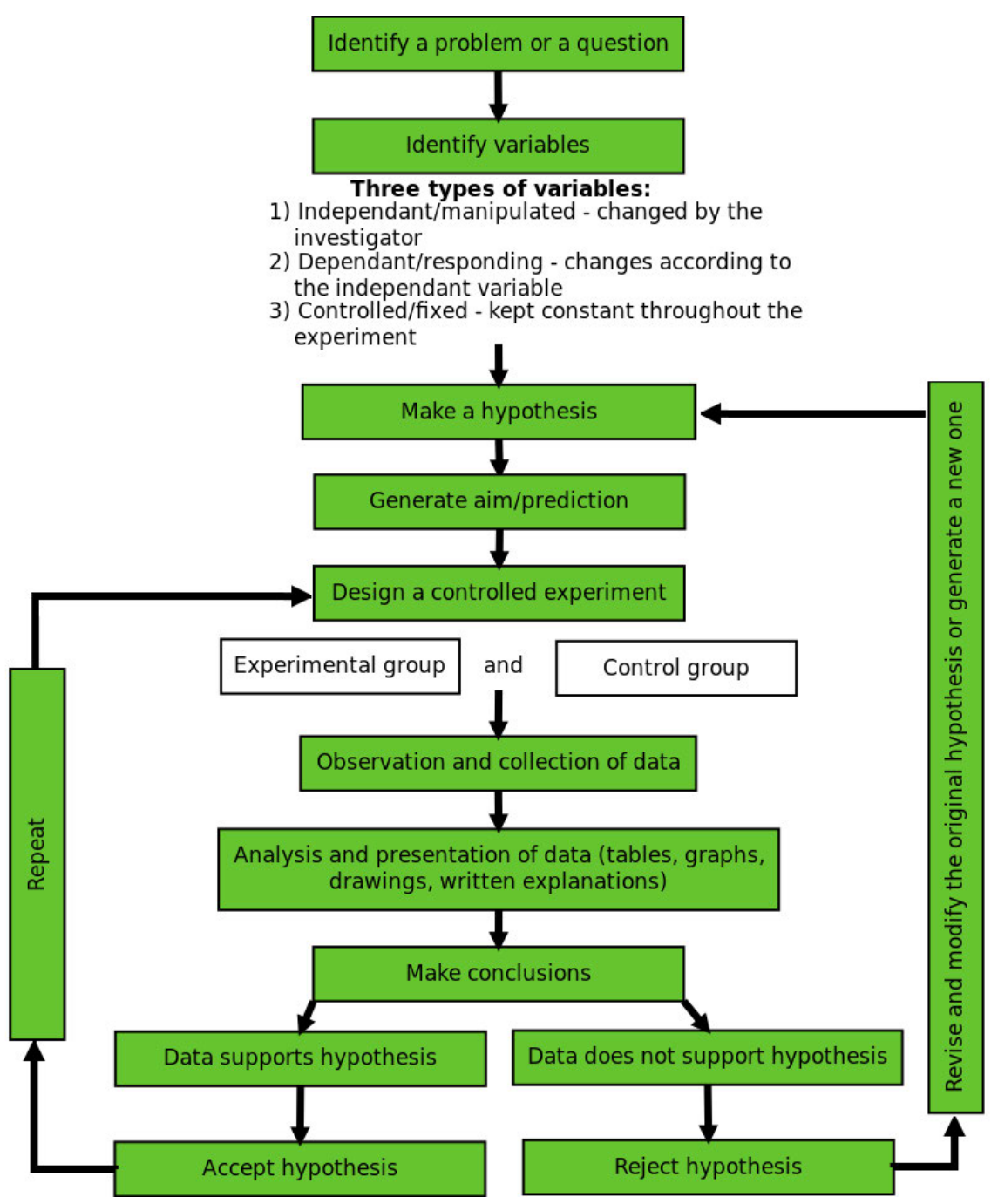
The scientific method follows a logical sequence that can be repeated and modified as needed. If data does not support a hypothesis, scientists must reject it and either revise their original hypothesis or create a completely new one.
Step-by-step guide to the scientific method
1. The question
All scientific investigations begin with curiosity. Scientists are naturally curious people, and most investigations start when a scientist notices something they do not understand. The first step is always to ask a clear question that you want to find an answer to.
Good scientific questions often ask:
- What is happening?
- How is it happening?
- When is it occurring?
- Why is it happening?
Example
Example: Identifying a Scientific Question
A farmer notices that his tomato plants growing in shaded areas have smaller tomatoes than plants growing in sunny spots. This observation leads him to wonder: "Does the amount of sunlight a tomato plant receives affect the size of tomatoes?"
2. Introduction and background research
Once you have identified your question, you need to conduct background research. This research helps ensure you are not investigating something that has already been thoroughly studied. Background research also reveals interesting connections, theories, and methods that other people have used to answer similar questions.
Science always builds on the work of others, ensuring that our understanding constantly improves. It is essential to acknowledge the work of previous scientists through proper referencing. You must also communicate your findings clearly so that future scientists can use your work as a foundation for their research.
3. Identify variables
Your background research will help you identify the factors that might influence your question. Factors that might change during an experiment are called variables.
When identifying variables, think about:
- All the relevant variables you can change
- All the variables you can measure or observe
Important
There are three important types of variables that you must understand:
Dependent variable: This is what you want to measure or investigate. It is the outcome that may change based on what you do in your experiment.
Independent variable: This is the factor you deliberately change to see how it affects the dependent variable. In a good experiment, you should only test one independent variable at a time.
Fixed/controlled variables: These are all the factors you keep exactly the same throughout your experiment. Controlling these variables ensures that only your independent variable is causing any changes you observe.
Example
Example: Identifying Variables in Tomato Investigation
- Dependent variable: The mass or size of tomatoes (what you measure)
- Independent variable: Amount of sunlight exposure (what you change)
- Fixed/controlled variables: Same tomato species, same fertiliser, same soil type, same container type, same amount of water
4. Hypothesis
A hypothesis is a statement or prediction about what you think will happen in your investigation. It is not just a guess - it should be based on your background research and scientific understanding.
A good hypothesis must:
- Be specific and clear
- Relate directly to your question
- Include both the cause and effect variables
- Be testable through experimentation
- Be written as a statement, not a question
- Use future tense language
- Be expressed as a prediction that can be proven right or wrong
Example
Example: Writing a Hypothesis
"I think that the more sunlight a tomato plant receives, the larger the tomatoes will grow."
Note
Scientific investigations do not aim to prove that something is definitely true. Instead, they test whether the evidence supports or contradicts a prediction. Even if your hypothesis turns out to be wrong, this is still valuable scientific information that teaches us something new.
5. Aim
The aim clearly states what you are going to investigate. It should be a concise statement that directly relates to your question and hypothesis.
Useful words for writing aims include:
- To determine...
- To show that...
- To investigate...
- To find out...
- To observe...
- To measure...
Example
Example: Writing an Aim
"To investigate the effect of different amounts of sunlight on tomato growth."
6. Apparatus
List all the equipment and materials you will need for your investigation. This should include:
- Specific sizes of beakers, test tubes, and measuring equipment
- Any specialised equipment required
- All chemicals and substances needed with exact quantities
Make sure all equipment is available before beginning your investigation.
7. Method
Your method is a step-by-step description of exactly how you will test your hypothesis. This is the most important part of the scientific method because it ensures your experiment tests your hypothesis accurately.
A good method should:
- Be written so clearly that a complete stranger could follow it exactly
- Use past tense and passive voice
- Include precise instructions about apparatus and measurements
- List each step in the correct sequence with numbers
- Explain how you will measure and record results
- Include safety precautions where necessary
- Specify how many times you will repeat the experiment
Important
The method must be detailed enough that other scientists can replicate your experiment and get similar results.
8. Results
Results are simply your observations from conducting the investigation. When recording results:
- Write down exactly what you observed
- Do not include explanations - just record the facts
- Present information in suitable formats like tables and graphs
- Record all results, even if they are not what you expected
- Remember that "no change" is still a valid result that should be recorded
9. Analysis of results and discussion
Analysis means explaining what your results show. This involves:
- Describing in words what your tables and graphs demonstrate
- Discussing relationships between your independent and dependent variables
- Looking for patterns or trends in your data
- Identifying any unusual results and suggesting possible reasons
This section helps readers understand what your results actually mean.
10. Evaluation of results
Evaluation answers the question "What do the results mean?" You need to carefully consider:
Validity: Was it a fair test? Did the experiment actually test what it was supposed to test?
Reliability: If you repeated the experiment, would you get similar results? The best way to ensure reliability is to repeat experiments several times and calculate averages.
Experimental errors: What might have gone wrong during the experiment? Consider errors in methods, apparatus, or measurements, and suggest improvements for next time.
Unusual results: If any results seem strange, discuss possible reasons and whether they should be included in your conclusions.
11. Conclusion
The conclusion links your results back to your original aim and hypothesis. In a short paragraph, state whether your observations supported or contradicted your hypothesis. Be sure to mention the specific variables you tested.
Important
If your hypothesis was not supported, do not change it! Instead, try to explain what might have been different about your understanding or what new information the experiment revealed.
Example
Example: Writing a Conclusion
"It was clear that tomato plants produce larger tomatoes when exposed to bright sunlight. The original hypothesis was supported."
Important scientific principles
Understanding how science works also involves recognising key principles that apply across different areas of life sciences.
Structure and function
In living organisms, the structure of any biological feature is closely related to its function. For all structures you study in life sciences, ask yourself:
- What makes this structure suited to its function?
- How has this structure adapted to perform its function efficiently?
- Why is this structure so effective for its particular role?
Note
This principle helps us understand why organisms are built the way they are and how they survive in their environments.
Summary
Key Points to Remember:
- The scientific method provides a structured, repeatable approach to answering questions about the natural world
- Variables must be carefully identified and controlled - only change one independent variable at a time
- A hypothesis is a testable prediction based on background research, not just a random guess
- Good experimental design ensures results are both valid (testing what they claim to test) and reliable (consistent when repeated)
- Scientific investigations aim to support or reject hypotheses, not to prove them absolutely correct