Plant and Animal Tissues (Grade 10 NSC Matric Life Sciences): Revision Notes
📚Revision Notes
Plant Tissues
Plants are made up of different types of specialised tissues that work together to help the plant survive and grow. Understanding these tissues is essential for learning how plants function at the cellular level.
Plant tissues can be broadly organised into two main categories:
- Meristematic tissues - these contain cells that are actively dividing to produce new growth
- Permanent tissues - these are mature, specialised cells that have stopped dividing
Note
Permanent tissues are further divided into simple tissues (made of one cell type) and complex tissues (made of multiple cell types working together). This classification system helps us understand how different plant parts are organised and function.
Meristematic tissue
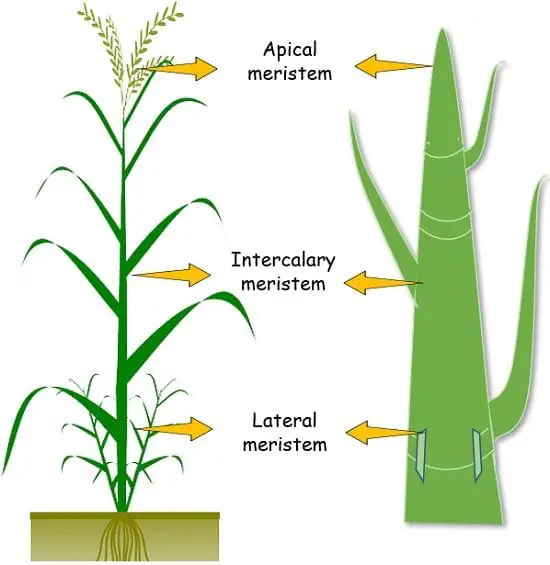
Meristematic tissue contains undifferentiated cells that have the ability to divide continuously. These tissues are responsible for plant growth and the formation of all other tissue types through a process called cellular differentiation.
Note
Cellular differentiation is the process of developing a particular structure suited to a specific function. This allows plants to create specialised tissues from basic meristematic cells.
Location and types
You can find meristematic tissue in specific growth areas of plants:
- Apical meristems are located in buds and growing tips of roots and shoots, allowing plants to grow longer
- Lateral meristems such as the cambium (or 'bark') in trees, help plants grow thicker
Structural adaptations
Meristematic cells have several key features that allow them to divide rapidly and differentiate:
- Small, round or many-sided shape - Allows many cells to pack closely together
- Very small or no vacuoles - Prevents cells from becoming rigid, enabling quick division
- Large amounts of cytoplasm and big nuclei - Provides the DNA and cellular machinery needed for division and specialisation
Simple permanent tissues
Simple permanent tissues are made up of only one type of cell. Once meristematic cells develop into these tissues, they lose their ability to divide and become specialised for specific functions.
Epidermis tissue
The epidermis forms a protective single layer covering all plant surfaces including leaves, flowers, roots and stems. This tissue acts as the plant's first line of defence against the environment.
Key structural features and functions:
Protective barrier: The epidermis prevents harmful microorganisms and pathogens from entering the plant whilst allowing light to pass through for photosynthesis in underlying tissues.
Trichomes: These are tiny hair-like structures projecting from the epidermis surface. Leaf trichomes help trap water above the stomata and reduce water loss, whilst some can produce chemicals that deter browsing animals.
Root hairs: These are extensions of epidermal cells in roots that dramatically increase the surface area available for water and mineral absorption from soil.
Waxy cuticle: Leaves have a waxy outer coating on their epidermis that prevents water loss.
Guard cells: These specialised bean-shaped cells contain chloroplasts and control the opening and closing of stomata.
Guard cells and stomata
A stoma is a pore in the leaf epidermis that allows gaseous exchange. Each stoma is surrounded by a pair of guard cells that can change shape to open or close the pore.
Example
How Guard Cells Control Stomata:
Step 1: Guard cells absorb water and ions from surrounding cells
Step 2: The cells swell due to increased turgor pressure
Step 3: This swelling causes the stomatal pores to open
Step 4: When water is lost, guard cells shrink and stomata close
This mechanism helps plants balance their need for gas exchange with water conservation.
The stomata allow oxygen, carbon dioxide and water vapour to enter and exit the leaf. Guard cells contain chloroplasts for photosynthesis and control the stoma opening through changes in turgor pressure.
Parenchyma tissue
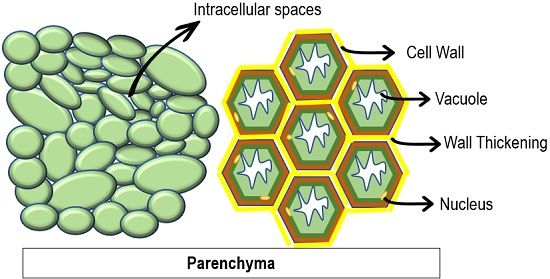
Parenchyma is the most common type of plant tissue and forms the majority of stems, roots and soft fruits like tomatoes and grapes. This versatile tissue performs many essential functions.
Structure and function
- Thin cell walls - Enable close packing and rapid diffusion between cells
- Intercellular air spaces - Allow gases to move freely throughout the tissue
- Large central vacuoles - Store ions, waste products and water whilst providing structural support
- Some cells contain chloroplasts (chlorenchyma) - Enables photosynthesis and starch storage
- Some cells retain ability to divide - Allows replacement of damaged tissue
Note
Parenchyma tissue serves multiple roles including gas diffusion, water and nutrient storage, photosynthesis (in chlorenchyma), and can even help heal wounds by producing new cells when needed.
Collenchyma tissue
Collenchyma is a supporting tissue typically found in young shoots and leaves. This tissue provides flexible strength that allows plants to bend without breaking in wind.
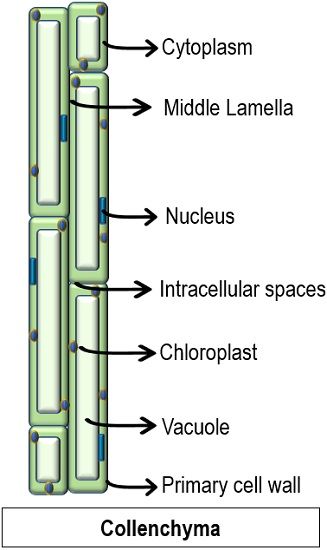
The cells are closely packed together with no air spaces between them. What makes collenchyma unique is that the corners of each cell wall are thickened with deposits of cellulose and pectin, whilst the rest of the cell wall remains thin.
- Round, oval or many-sided cells with no gaps - Close packing provides structural support
- Thickened corners with cellulose and pectin - Gives mechanical strength to the tissue
- Thin walls on most sides - Provides flexibility, allowing the plant to bend
Note
This combination of strength and flexibility makes collenchyma perfect for supporting growing parts of plants that need to move with environmental forces.
Sclerenchyma tissue
Sclerenchyma is the main supporting tissue that makes plants hard and rigid. Unlike other tissues, sclerenchyma cells are dead at maturity and have thick, lignified cell walls.
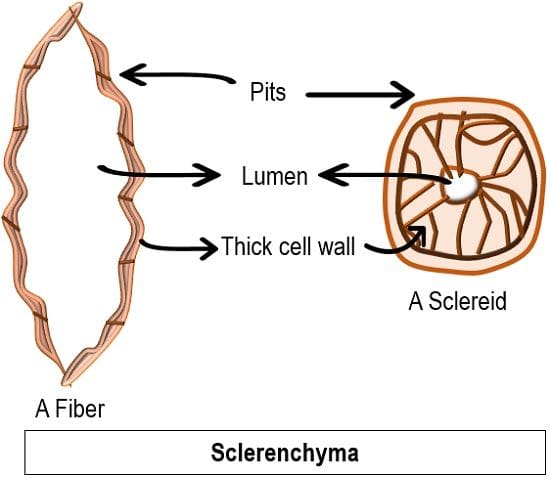
There are two types of sclerenchyma cells:
Fibres are long, narrow cells with thick lignified walls that provide mechanical strength and can conduct water. You find these in fabrics like flax, jute and hemp, and in ropes because of their strength.
Sclereids are specialised cells with extremely thick walls that nearly fill the entire cell. These "stone cells" give fruits like pears their gritty texture and provide protection to other cells.
Important
The lignin in sclerenchyma walls acts like wire reinforcement in concrete, giving plants incredible strength to resist bending and breaking forces. Dead cells with lignified secondary walls provide maximum mechanical strength without living cell contents interfering.
Complex permanent tissues
Complex tissues contain multiple types of cells working together to perform specific functions. The two main complex tissues are xylem and phloem, which form the plant's vascular system.
Xylem tissue
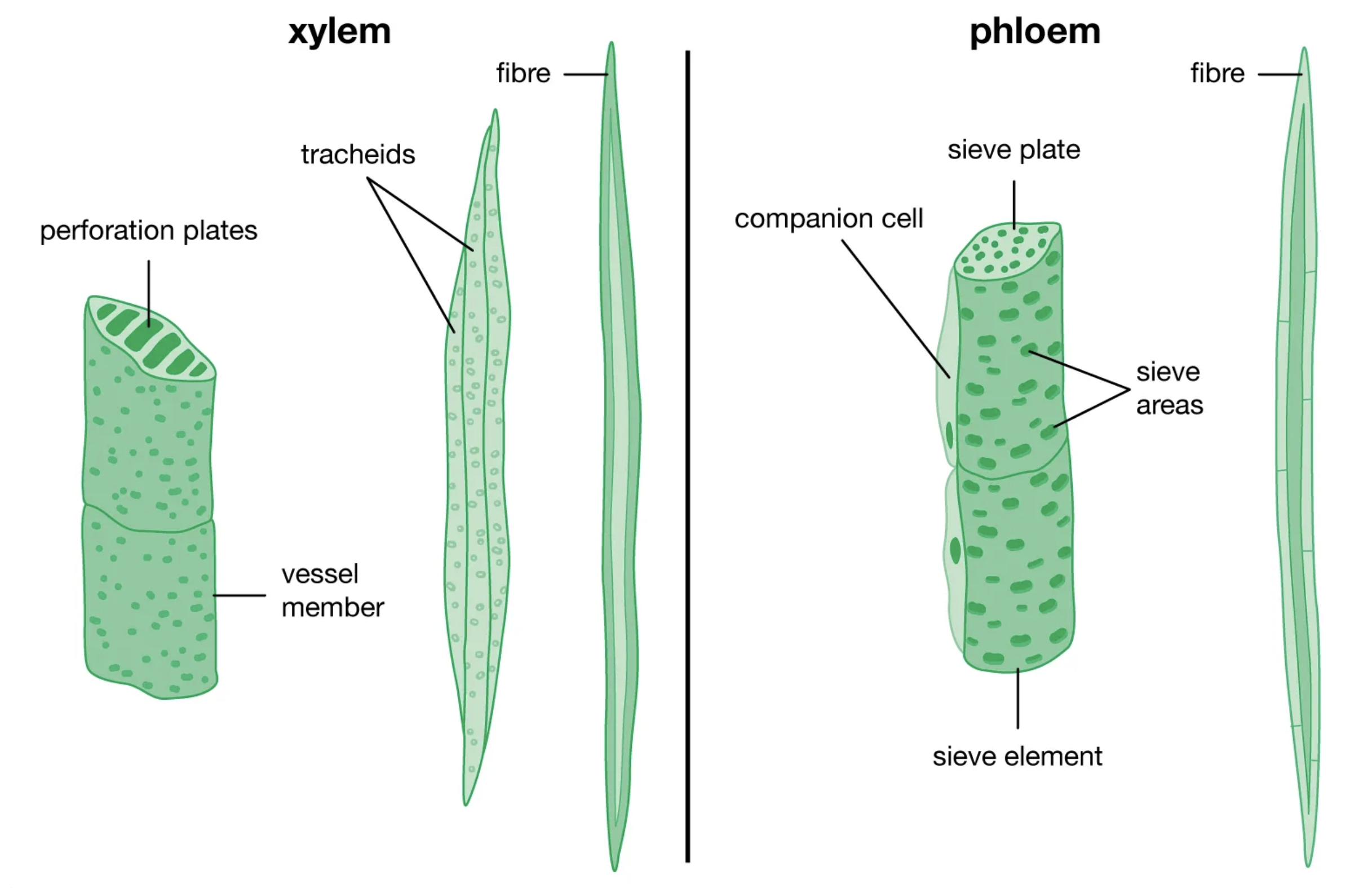
Xylem has two main jobs: supporting the plant structurally and transporting water with dissolved minerals from roots to stems and leaves. This tissue contains vessels, tracheids, fibres and parenchyma cells working together.
Xylem vessels are long chains of dead cells arranged end-to-end with their connecting walls dissolved away. This creates continuous tubes perfect for water transport. The cells have thick, lignified secondary walls with various thickening patterns (spirals, rings, or pits) that provide strength whilst maintaining flexibility.
Tracheids have thick secondary walls and tapered ends. Unlike vessels, they don't have completely open ends but have pits in their walls that allow water to pass horizontally between cells.
- Long, hollow tubes - Create efficient water transport pathways
- Dead cells with no cytoplasm - Prevents obstruction of water flow
- Thick, lignified walls - Support the plant and resist the suction force created by transpiration
- Pits in cell walls - Allow water to move sideways to neighbouring cells
- Different wall thickening patterns - Provide flexibility so stems can bend without breaking
Phloem tissue
Phloem is the living tissue that transports organic nutrients (mainly sucrose) produced during photosynthesis from leaves to all parts of the plant. This complex tissue includes several specialised cell types.
The main components are:
- Sieve tube elements - conducting cells that transport sugars
- Companion cells - support cells that maintain sieve tube function
- Parenchyma cells - storage cells
- Fibres - support cells
Sieve tube elements are living cells arranged end-to-end to form long transport tubes. They have cellulose cell walls but lack nuclei and most organelles, creating more space for nutrient flow.
Companion cells are densely packed with ribosomes and mitochondria. They connect to sieve tube elements through plasmodesmata and perform all the cellular functions that sieve tubes cannot do themselves, including loading them with sucrose.
Important
The Essential Partnership:
The partnership between sieve tubes and companion cells is essential - sieve tubes provide the transport pathway whilst companion cells provide the energy and control needed for efficient nutrient movement throughout the plant. This cooperation allows plants to move nutrients efficiently from where they're made to where they're needed.
Summary
Key Points to Remember:
- Meristematic tissues contain actively dividing cells that produce all other plant tissues through cellular differentiation
- Simple permanent tissues (epidermis, parenchyma, collenchyma, sclerenchyma) are made of one cell type and perform specific functions like protection, storage, and support
- Complex permanent tissues (xylem and phloem) contain multiple cell types working together to transport water, minerals, and organic nutrients throughout the plant
- Structure always relates to function - each tissue's cellular features are perfectly adapted for their specific roles in plant survival
- Xylem transports water upward from roots whilst phloem transports sugars to wherever the plant needs energy