Tariff Systems (Grade 10 NSC Matric Mathematical Literacy): Revision Notes
📚Revision Notes
Tariff Systems
What is a tariff system?
A tariff is a pricing schedule that shows the pre-determined costs for various services. These fixed pricing structures are used to calculate how much you will pay for services like water, electricity, telephone calls, and public transport.
Note
Tariff systems are designed to provide transparency and predictability in service pricing, allowing consumers to estimate costs before using services.
Tariff systems work by combining different elements:
- A unit of measurement (such as kilolitres for water or kilowatt-hours for electricity)
- Rate per unit (the cost for each unit consumed)
- Sometimes a basic charge (a fixed cost regardless of usage)
Understanding tariff systems is essential for calculating service costs and making informed decisions about usage and spending.
Municipal tariffs
Municipal tariffs cover essential services provided by local government, including water, electricity, and refuse removal. These tariffs typically use a stepped pricing structure where the cost per unit increases as your usage increases.
Note
The stepped pricing system serves two purposes: it generates revenue for municipalities while encouraging conservation of precious resources like water and electricity.
Water tariffs
Water is measured in kilolitres (kl) and charged using a tiered system. Here's how it works. The pricing structure shows that water becomes more expensive per unit as you use more:
- First 9 kilolitres: R9.50 per kl
- Next 16 kilolitres (9-25 kl): R11.22 per kl
- Next 5 kilolitres (25-30 kl): R14.95 per kl
- And so on...
This stepped structure encourages water conservation by making excessive usage more costly.
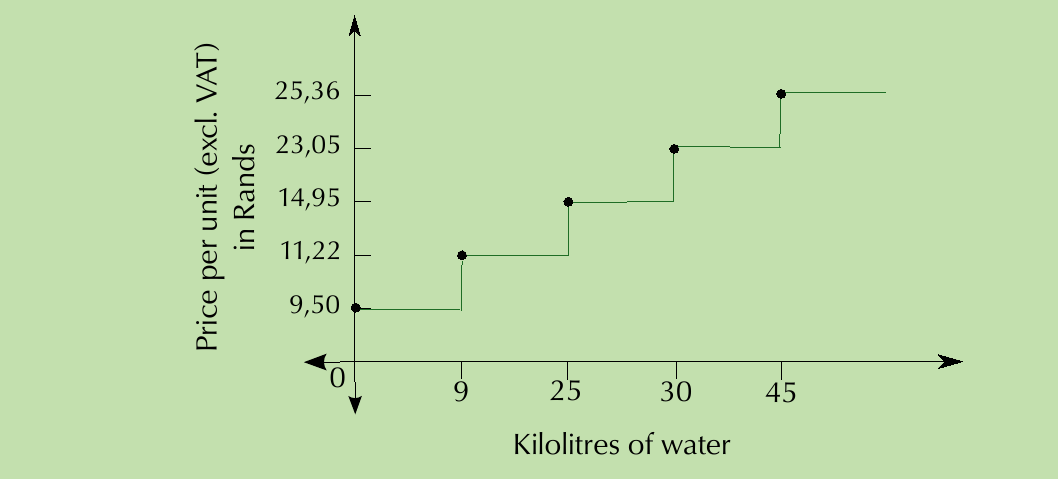
The graph shows how water pricing jumps at each usage threshold, creating the characteristic stepped pattern of municipal tariffs.
Calculating water costs
The calculation process follows a systematic approach that ensures accurate cost determination:
Example
Worked Example: Calculating Water Costs
If someone uses 32 kilolitres of water:
Step 1: Break your total usage into the different price brackets Step 2: Calculate the cost for each bracket separately Step 3: Add all the bracket costs together
- First 9 kl: 9 × R9.50 = R85.50
- Next 16 kl (from 9 to 25): 16 × R11.22 = R179.52
- Next 5 kl (from 25 to 30): 5 × R14.95 = R74.75
- Final 2 kl (from 30 to 32): 2 × R23.05 = R46.10
- Total excluding VAT: R85.50 + R179.52 + R74.75 + R46.10 = R385.87
Remember to add 14% VAT to get the final amount: R385.87 × 1.14 = R439.89
Electricity tariffs
Electricity follows a similar block system but uses kilowatt-hours (kWh) as the unit of measurement.
The electricity tariff structure typically includes:
- Block 1 (0-150 kWh): 129.05 cents per kWh
- Block 2 (150-350 kWh): 134.65 cents per kWh
- Block 3 (350-600 kWh): 134.65 cents per kWh
- Block 4 (over 600 kWh): 159.81 cents per kWh
Important
Notice how the highest usage block (Block 4) has a significantly higher rate to discourage excessive electricity consumption. This dramatic price increase is designed to promote energy efficiency.
Telephone tariffs
Telephone services use tariffs based on distance and time of day. These tariffs typically include both a basic connection charge and a rate per second of talk time.

Key components of telephone tariffs include:
- Basic charge: Fixed cost for connecting the call (R0.57 in the example)
- Distance categories: Local calls (0-50 km) vs long-distance calls (over 50 km)
- Time periods: Standard time (weekday business hours) vs off-peak times
- Rate per second: Variable cost based on distance and time
Calculating telephone costs
The formula for telephone cost calculation combines fixed and variable elements:
Note
Formula: Total cost = Basic charge + (Rate per second × Number of seconds)
Example
Worked Example: Telephone Cost Calculation
A 1000-second local call during standard time:
- Basic charge: R0.57
- Call cost: 1000 seconds × R0.00700 = R7.00
- Total cost: R0.57 + R7.00 = R7.57
The same call during off-peak time would cost less:
- Basic charge: R0.57
- Call cost: 1000 seconds × R0.00344 = R3.44
- Total cost: R0.57 + R3.44 = R4.01
Mobile telephone tariffs
Mobile tariffs are often contract-based and include various services with different pricing structures.
Mobile tariffs typically include:
- Monthly subscription: Fixed monthly fee
- Call rates: Different rates for first few minutes vs subsequent minutes
- SMS charges: Cost per text message
- MMS charges: Cost per multimedia message
- Same-network rates: Often cheaper rates for calls within the same provider
Key pricing elements
Understanding mobile pricing structures helps you choose the most cost-effective plan:
- First 5 minutes of the day: Often higher rate (e.g., R1.95 per minute)
- Subsequent calls: Lower rate (e.g., R1.55 per minute)
- Same network calls: Usually discounted (e.g., R0.99 per 60 seconds)
- Text messages: Fixed rate per SMS (e.g., R0.60)
Transport tariffs
Transport systems use tariffs based on distance zones or specific routes. Many systems also offer different ticket types for various journey patterns.
Types of transport tariffs
Transport pricing can follow different models depending on the service provider and route complexity:
Route-based pricing: Fixed cost for specific routes regardless of distance
- Example: R5.30 for routes F1, F14, F15, F16
Distance zones: Different prices for different distance ranges
- Zone 1 (1-19 km): R4.00 single ticket
- Zone 2 (20-29 km): R5.00 single ticket
- And so on...
Ticket types:
- Single: One-way journey
- Return: Round trip (usually less than double single fare)
- Weekly/Monthly: Better value for regular users
Note
When choosing between ticket types, calculate the cost per journey by dividing monthly pass costs by the number of trips per month, then compare this with single ticket prices to find the best value.
Key calculation principles
Mastering tariff calculations requires understanding the systematic approach that applies across all tariff types.
The step-by-step method
Follow this methodical approach for accurate tariff calculations:
- Identify the tariff structure (stepped, flat rate, or combination)
- Break down usage into the appropriate brackets or categories
- Calculate each portion separately using the relevant rate
- Add fixed charges (basic charges, monthly fees, etc.)
- Sum all components for the total cost
- Add VAT if required (usually 14% in South Africa)
Important
Common exam traps to avoid:
- Forgetting to add VAT when the question asks for the total including VAT
- Using the wrong time period for telephone tariffs
- Not breaking usage into correct brackets for stepped tariffs
- Mixing up units (kl vs kWh, minutes vs seconds)
Summary
Key Points to Remember:
- Tariffs are pre-set pricing schedules that help you calculate service costs before using them
- Municipal tariffs use stepped pricing - the more you use, the higher the rate per unit becomes
- Telephone tariffs depend on distance and time - local calls and off-peak times are usually cheaper
- Mobile contracts combine fixed monthly fees with variable usage charges for different services
- Transport tariffs offer different ticket types - monthly passes often provide better value for regular users
- Always break stepped tariffs into brackets and calculate each portion separately before adding them together