Packaging and Models (Grade 10 NSC Matric Mathematical Literacy): Revision Notes
📚Revision Notes
Packaging and Models
What is packaging?
Packaging refers to fitting items into a limited space such as a box, cupboard, suitcase, or container. The way items are packed often determines how many items can fit into the available space. A common example is packing everything you need for your school day (books, sports equipment, and food) into your school bag or backpack.
The same principles apply when posting a package to a friend or family member, where you need to consider multiple factors to ensure efficient and cost-effective packaging.
Note
In everyday life, we encounter packaging problems constantly - from organizing your school locker to packing groceries in shopping bags. Understanding these principles helps you make better decisions about space utilization and cost management.
Key considerations in packaging problems
When solving packaging problems, you must consider several important factors that work together to determine the best packaging solution:
Note
Space constraints
- Available space: The dimensions of the container (length, width, height)
- Item dimensions: The size and shape of items being packed
- Packing efficiency: How items fit together without wasting space
Note
Weight limitations
- Maximum weight capacity: Each container has a weight limit that cannot be exceeded
- Item weights: Individual weight of each item being packed
- Weight distribution: Ensuring balanced packing
Important
Cost factors
- Container costs: Price of boxes, packaging materials, or shipping containers
- Quantity needed: Number of containers required affects total cost
- Shipping costs: Often determined by weight for postal packages
Note
Protection requirements
- Damage prevention: Items must not be damaged during transport
- Protective materials: Extra padding may be needed for fragile items
- Secure packing: Items must be able to be carried safely
Mathematical approaches to packaging
Understanding the mathematical relationships in packaging helps you make informed decisions and solve problems systematically.
Basic calculations
Number of containers needed:
Total cost calculation:
Weight capacity check:
Example
Worked Example: Understanding packaging arrangements
Let's examine a practical packaging problem involving a biscuit business.
Vuyo and Sipho's father owns a biscuit business called "Biscuits for Africa". During school holidays, he employs the boys to help package biscuits into boxes for transport to stores.
Question 1: Basic division calculations
- Vuyo's task: Pack 600 small boxes of ginger biscuits into large shipping boxes
- Each large box can hold 15 small boxes
- Solution: large boxes needed
- Sipho's task: Pack 500 tin cans of chocolate biscuits into large shipping boxes
- Each large box can hold 20 cans
- Solution: large boxes needed
Question 2: Cost comparison Each large shipping box costs R5,50. Which option is cheaper?
- Ginger biscuits:
- Chocolate biscuits:
Answer: Chocolate biscuits are cheaper to pack because they require fewer large boxes.
Question 3: Weight limitations Maximum weight per large box: 3,5 kg
For ginger biscuits (200g per small box): Since you cannot pack half a box, Vuyo can pack 17 small boxes per large box.
For chocolate biscuits (300g per can): Since you cannot pack a partial can, Sipho can pack 11 cans per large box.
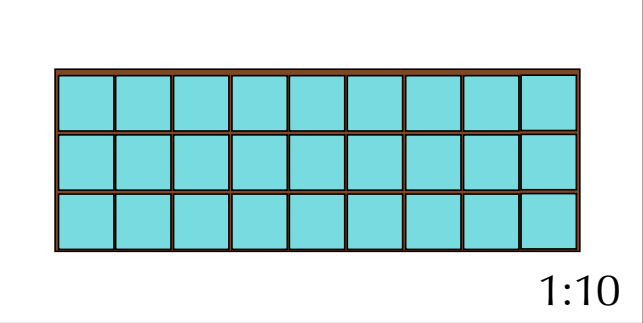
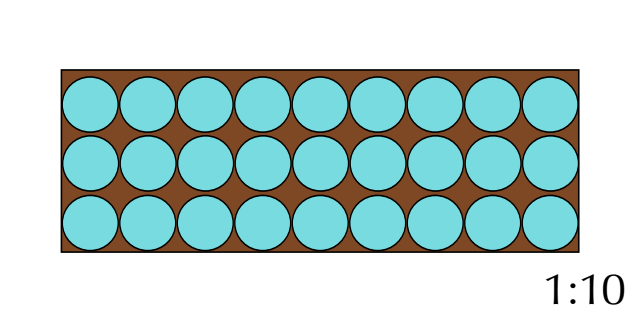
Question 4: Dimensional packing arrangements New large boxes: 45 cm long × 16 cm wide
Small ginger biscuit boxes: 5 cm × 5 cm base area
-
Length: boxes fit along length
-
Width: , so only 3 boxes fit along width
-
Total arrangement: boxes per large box
Round chocolate cans: 5 cm diameter
-
Length: cans fit along length
-
Width: , so only 3 cans fit along width
-
Total arrangement: cans per large box
Important considerations about shape and packing
Understanding why mathematical calculations don't always match practical packing arrangements is crucial for solving real-world packaging problems.
Why area calculations can be misleading
When Vuyo calculated using area alone:
- Large box bottom area:
- Small box area:
- Simple division: boxes
However, the actual packing arrangement only allows for 27 boxes due to the specific dimensions and shapes involved.
Important
Key insight about shape and packing
Area calculations alone do not account for the shape of boxes. The scale diagrams show that there are small spaces left that cannot be filled with whole boxes due to their shape. When dealing with packaging problems, it is essential to consider actual shapes and dimensions rather than just calculating areas.
Scale diagrams in packaging
Scale diagrams are powerful visual tools that help you understand and verify your packaging calculations.
Note
The 1:10 scale shown in the examples means that 1 unit on the diagram represents 10 units in real life. These diagrams help you:
- Visualise how items fit together
- Identify wasted space
- Plan efficient packing arrangements
- Check your mathematical calculations against reality
Exam tips for packaging problems
Developing a systematic approach to packaging problems will improve your accuracy and confidence in examinations.
Important
Common mistake to avoid
Don't rely solely on area calculations when determining how many items fit in a container. Always consider:
- Actual dimensions of items
- How items align with container dimensions
- Shape compatibility
- Practical packing constraints
Summary
Problem-solving approach
- Identify what items need to be packed and container dimensions
- Calculate basic division for initial estimate
- Check weight limitations if given
- Consider actual dimensional arrangements
- Compare costs if multiple options are provided
- Verify your answer makes practical sense
Summary
Key Points to Remember:
- Packaging involves fitting items efficiently into limited spaces while considering multiple constraints
- Always check weight limits, space dimensions, and cost factors when solving packaging problems
- Area calculations alone are insufficient - you must consider actual shapes and dimensions
- Division calculations give you the basic number of containers needed, but practical arrangements may differ
- Scale diagrams help visualise packing arrangements and identify potential issues with your calculations