Measuring Perimeter (Grade 10 NSC Matric Mathematical Literacy): Revision Notes
📚Revision Notes
Measuring Perimeter
What is perimeter and why is it important?
Perimeter refers to the total length of the outside boundary of a shape. Understanding how to calculate perimeter is essential for many practical situations, such as determining how much fencing is needed around a garden, calculating paint requirements for walls, or working out material costs for construction projects.
Note
DEFINITION: Perimeter
The total length of the outside of a shape or the continuous line forming the boundary of a closed geometric figure. Perimeter is measured in mm, cm, m or km.
Key shapes and their properties
Before measuring perimeter, you need to understand the basic properties of common shapes. Each shape has specific characteristics that affect how we calculate its perimeter.
Note
DEFINITION: Rectangle
A flat two-dimensional shape, with both pairs of opposite sides equal in length and all adjacent sides at right-angles (90°) to each other.
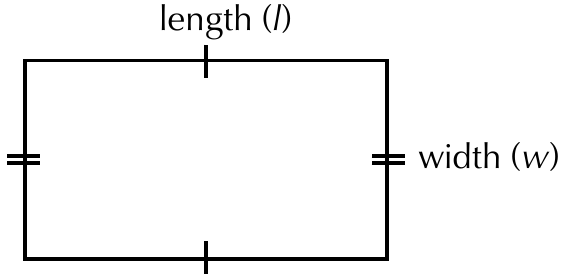
Note
DEFINITION: Square
A flat, two dimensional shape with all four sides equal in length, and all adjacent sides at right-angles (90°) to each other.
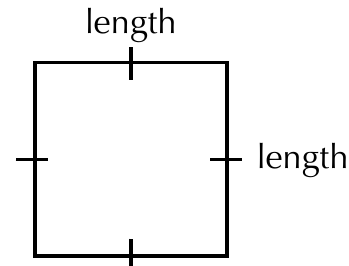
Direct measurement methods
The most straightforward way to find perimeter is through direct measurement. This involves measuring each side of the shape individually and adding all the measurements together.
For rectangles, squares and triangles
To measure the perimeter of these shapes, simply use a ruler to measure the length of each side, then add up all the sides to get the total perimeter. This method works well for shapes with straight edges where each side can be measured individually.
For circles
Measuring the perimeter of a circle requires a different approach. You need to use a piece of string by placing it along the outline of the circle, marking how much string it takes to go around the circle once. Then measure that length of string with a ruler to estimate the perimeter.
Note
DEFINITION: Circumference
The perimeter of a circle or the distance around the curved edge of a circle. Circumference is measured in mm, cm, m or km.
The perimeter of a circle is the same as the circumference of the circle.
Using formulae for accurate calculations
While direct measurement works well, using mathematical formulae provides more accurate results, especially when exact measurements are needed. Formula-based calculations eliminate measurement errors and provide precise answers.
Key formulae to remember
The following formulas are essential for calculating perimeter accurately:
- Rectangle:
- Square: (since all sides are equal)
- Triangle:
- Circle: or
Important circle terms
Understanding these key terms is essential for working with circles:
Note
DEFINITION: Radius
The radius () of a circle is a straight line drawn from the centre to the extreme edge of the circle, or the length of the line from the centre of the circle to any point on its edge.
Note
DEFINITION: Diameter
The diameter () of a circle is a straight line drawn from one edge of the circle to the other, that passes through the centre of the circle. .
Important
DEFINITION: Pi
Pi () is a special symbol we use when calculating perimeter and area of circles. The value of is 3.141592645... continuing to infinity. For all of our calculations however, we will use the approximate value of .
Worked examples
Example
Worked Example 1: Measuring a rectangular backyard
Question: Mr and Mrs Dlamini have a rectangular backyard. Using a ruler, the length is measured as 12 cm and the width as 10 cm. If the diagram uses a scale of 1:100, what is the actual perimeter in metres?
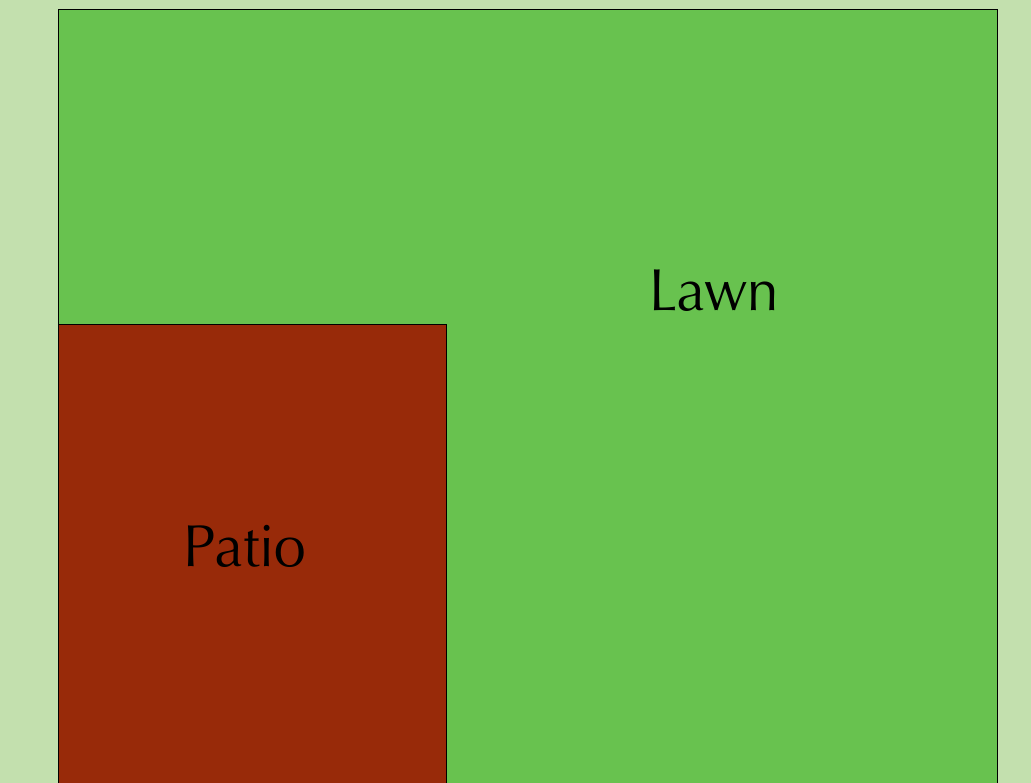
Solution:
- Since it's a rectangle, opposite sides are equal in length
- Perimeter = 12 cm + 12 cm + 10 cm + 10 cm = 44 cm
- Using the scale 1:100: Actual perimeter = 44 cm × 100 = 4400 cm = 44 m
Example
Worked Example 2: Measuring a triangular garden
Question: Mrs Dlamini wants to create a triangular vegetable garden. Using a ruler to measure the triangle in the diagram, calculate the actual perimeter if the scale is 1:100.
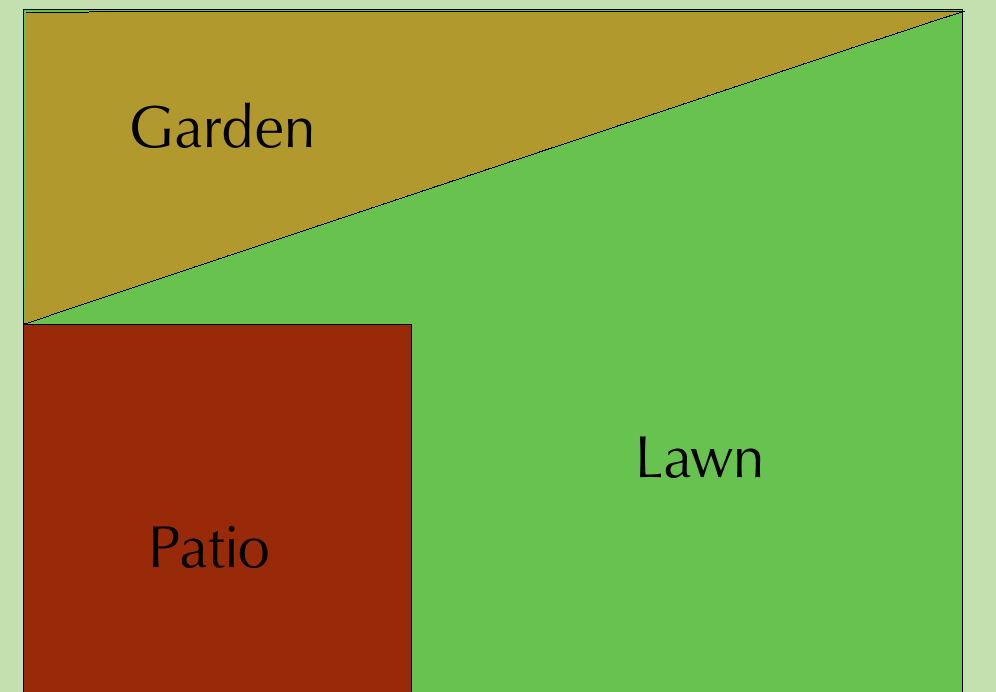
Solution:
- Measure each side: 4 cm + 12 cm + 12.7 cm = 28.7 cm
- Using scale 1:100: 28.7 cm × 100 = 2870 cm = 28.7 m
Example
Worked Example 3: Estimating circle circumference
Question: Mr Dlamini wants to put paving around a circular fish pond. Using string to estimate the circumference, the measurement is approximately 12 cm. If the scale is 1:100, what is the actual circumference?
Solution:
- Estimated circumference ≈ 12 cm
- Using scale 1:100: 12 cm × 100 = 1200 cm = 12 m
Note: We use "estimate" when we approximate our answer knowing it may not be exact. The symbol means "approximately" when rounding answers.
Example
Worked Example 4: Using formulae for precise calculations
Question: Calculate the circumference of a lampshade where the inner circle has a radius of 50 mm and the outer circle has a diameter of 40 cm.
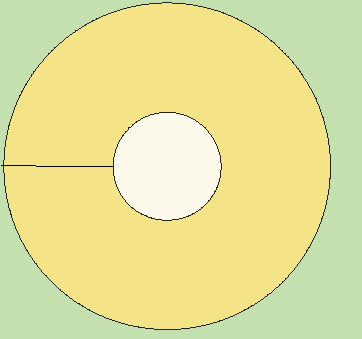
Solution:
a) Inner circle radius = 50 mm = 5 cm
b) Outer circle diameter = 40 cm
Example
Worked Example 5: Complex shapes
Question: Calculate the perimeter of this composite shape.
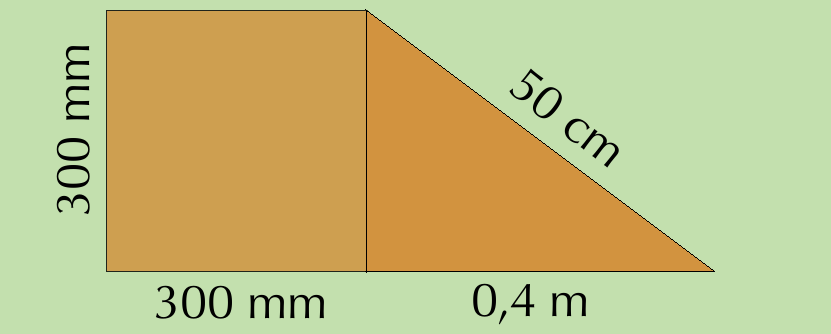
Solution: This shape combines a square and triangle. We measure the outer edges only:
- Three sides of square:
- Two sides of triangle:
- Total perimeter =
Exam tips and common mistakes
Understanding these key points will help you avoid common errors and improve your performance:
Important
Common Mistakes to Avoid:
- Always check units - convert all measurements to the same unit before calculating
- Use the correct formula - rectangle needs length AND width, square only needs one side length
- For circles, remember - you'll always be given this value in assessments
- Estimation vs calculation - string method gives estimates, formulae give exact answers
- Scale drawings - multiply your measured result by the scale factor to get actual size
- Complex shapes - break them down into simple shapes and add the outer edges only
Summary
Key Points to Remember:
- Perimeter is the total distance around the outside of any shape
- Direct measurement using rulers works for simple shapes, but string is needed for circles
- Formulae provide more accurate results than estimation methods
- Rectangle: , Square: , Triangle: , Circle:
- Always convert units to match before calculating and check your final answer makes sense