Algebraic Expressions (Grade 10 NSC Matric Mathematics): Revision Notes
📚Revision Notes
Factorisation
Factorisation is the reverse process of expanding algebraic expressions. While expanding involves multiplying out brackets to get a sum of terms, factorisation starts with a sum of terms and rewrites it as a product of factors.
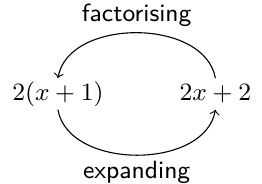
When you expand , you get . Factorisation works in the opposite direction - starting with and writing it as . These two expressions are equivalent and have the same value for all values of .
Note
Understanding factorisation builds on your previous work with common factors and special patterns like the difference of squares. This skill is essential for solving equations, simplifying expressions, and working with more advanced algebraic concepts.
Common factors
Common factor factorisation relies on identifying factors that are shared by all terms in an expression. This is often the first step in any factorisation problem.
The process involves finding the highest common factor of all terms and writing it outside brackets. For instance, the expression can be factorised by identifying that both terms contain the factor :
When expressions have more complex patterns, you can use a "switch around" strategy. This involves recognising that subtraction can be rewritten to reveal common factors. For example, if you have , you can rewrite this as .
Example
Worked Example: Factorising using the switch around strategy
Question: Factorise
Solution:
The key is to notice that . This allows us to rewrite the expression:
Always check your factorisation by expanding the result to verify it matches the original expression.
Difference of two squares
The difference of two squares is a special pattern that appears frequently in algebra. The key formula is:
To identify a difference of two squares, look for expressions that have:
- Exactly two terms
- Terms with opposite signs (one positive, one negative)
- Each term is a perfect square
Examples include , , and .
Example
Worked Example: Factorising the difference of two squares
Question: Factorise
Solution:
Step 1: Take out the common factor
Step 2: Factorise the difference of two squares
The final answer combines both the common factor method and the difference of squares pattern.
Factorising by grouping in pairs
When an expression has four terms with no common factor across all terms, you can often use grouping in pairs. This method involves grouping terms that do share common factors, then looking for a new common factor that emerges.
Note
The strategy works when you can group the terms so that each group has a common factor, and the remaining expressions after factoring are identical.
Example
Worked Example: Factorising by grouping in pairs
Question: Find the factors of
Solution:
Step 1: Check for factors common to all terms - there aren't any.
Step 2: Group terms with common factors together
The first two terms share the factor 7, and the last two terms share the factor :
Step 3: Take out the new common factor
The factors are and .
Factorising quadratic trinomials
Quadratic trinomials have the form and require a systematic approach to factorise. The goal is to find two binomial factors that multiply to give the original quadratic.
Note
General procedure for factorising trinomials:
- Take out any common factor first to get the form where , , and have no common factors
- Write two brackets with in each:
- Find the factors of the constant term
- Create options for possible factor combinations using these factors
- Expand each option to find which gives the correct middle term
Important
Important tip: If is positive, both factors must have the same sign (both positive or both negative). If is negative, the factors must have opposite signs.
Example
Worked Example: Factorising a quadratic trinomial
Question: Factorise
Solution:
Step 1: Check the quadratic is in the form ✓
Step 2: Write brackets and identify possible factors
The possible factors for are: 1 and 3 The possible factors for are: -1 and 1
Step 3: Create options for factor combinations:
| Option 1 | Option 2 |
|---|---|
Step 4: Check by expanding
✓
Therefore:
Sum and difference of two cubes
There are two special formulas for factorising cubic expressions:
Sum of two cubes:
Difference of two cubes:
These formulas are used when you can identify perfect cube terms in the expression.
Example
Worked Example: Factorising a difference of two cubes
Question: Factorise
Solution:
Step 1: Identify the cube roots
We're working with the difference of two cubes:
Here, and , so and
Step 2: Apply the formula
Step 3: Verify by expanding
✓
Example
Worked Example: Factorising a sum of two cubes
Question: Factorise
Solution:
Step 1: Identify the cube roots
We have
Here, and , so the terms are and
Step 2: Apply the sum of cubes formula
Step 3: Verify by expanding
✓
Exam tips for factorisation
Summary
Key Strategies for Success:
- Always look for common factors first - this often simplifies the remaining work significantly
- Check your work by expanding your factored form back to the original expression
- For quadratics, remember that the signs of factors depend on the sign of the constant term
- Learn the special patterns - difference of squares and sum/difference of cubes save time in exams
- When grouping in pairs, try different groupings if the first attempt doesn't work
- Use the switch around strategy when you see expressions like and - they're opposites
Summary
Key Points to Remember:
- Factorisation is the reverse process of expansion - use this relationship to check your answers
- Common factors should always be taken out first before applying other factorisation methods
- The difference of squares formula is one of the most useful patterns in algebra
- Grouping in pairs works well for expressions with four terms that don't have a single common factor
- For quadratic trinomials, systematic trial and error with factor combinations will lead to the correct answer